
How Program Managers Can Transition to Release Train Engineer with SAFe
Updated on Jul 31, 2026 | 181 views
Share:
Table of Contents
View all
- Step-by-Step Roadmap to Transition from Program Manager to Release Train Engineer with SAFe
- Program Manager to RTE: Transferable & New Skills
- Program Manager vs. Release Train Engineer: What's the Difference?
- How Long Does the Transition Usually Take?
- Tools Every Aspiring Release Train Engineer Should Learn
- Common Challenges Program Managers Face During the Transition
- Is Becoming a Release Train Engineer the Right Career Move?
- Conclusion
Quick Overview
- Transitioning from Program Manager to Release Train Engineer involves learning Lean-Agile principles, mastering the SAFe framework, gaining Agile delivery experience, facilitating PI Planning, earning RTE certification, and applying those skills in enterprise Agile environments.
- Program Managers can become Release Train Engineers by shifting from traditional project management to servant leadership and adopting Lean-Agile principles within the SAFe framework.
- The transition focuses on mastering Agile frameworks, facilitating PI Planning, improving value flow, and enabling cross-functional teams instead of managing projects through fixed timelines.
- Program Managers already have transferable skills like leadership, stakeholder management, and risk management, but becoming an RTE requires learning SAFe, servant leadership, Agile facilitation, and value-driven delivery.
- The blog explains the complete transition journey, including the RTE roadmap, role differences, timelines, essential tools, common challenges, and practical skills needed to succeed in SAFe environments.
Ready to deepen your SAFe knowledge? Explore the AI-Empowered SAFe® 6 Release Train Engineer (RTE) Certification to build the practical skills needed for leading Agile Release Trains.
Master the Right Skills & Boost Your Career
Avail your free 1:1 mentorship session
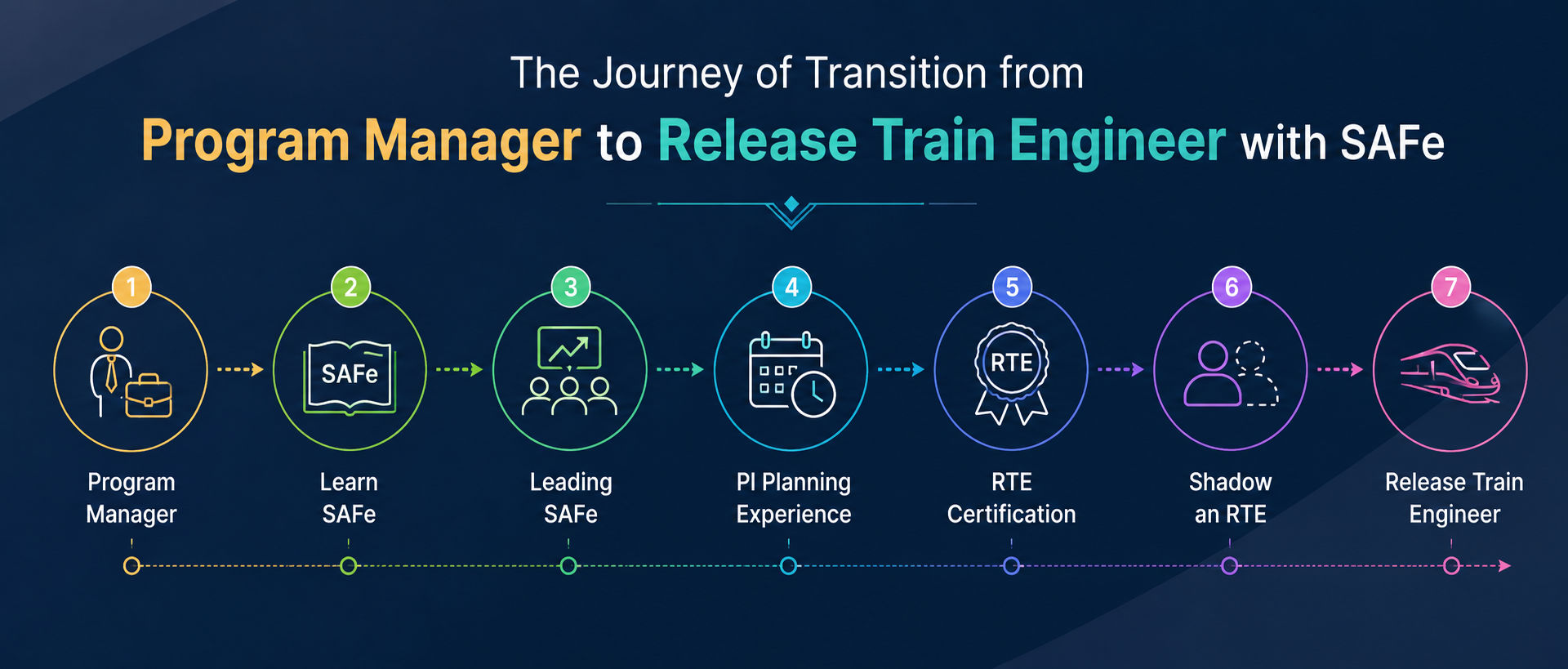
Step-by-Step Roadmap to Transition from Program Manager to Release Train Engineer with SAFe
Step 1: Understand Lean-Agile Principles
Start by learning how Lean-Agile thinking works. It's about delivering value fast, respecting people, and improving continuously. This mindset shift is the real starting point before anything else.
Step 2: Learn the SAFe Framework
Study how SAFe connects teams, programs, and business goals. Understanding the big picture helps you see where an RTE fits and why the role matters so much.
Step 3: Gain Hands-On Agile Delivery Experience
Get real experience working with Agile teams. Join sprints, attend standups, or support a Scrum team. Practical exposure teaches things no course ever fully can.
Step 4: Participate in PI Planning
Try to be part of a Program Increment Planning session, even as an observer. Watching how teams align goals across a quarter builds real understanding fast.
Step 5: Learn Facilitation Techniques
RTEs guide conversations, they don't control them. Practice listening well, asking good questions, and helping groups reach decisions without pushing your own agenda.
Step 6: Earn SAFe RTE Certification
Getting certified proves you know the framework and are serious about the role. It also gives employers confidence that you understand SAFe fundamentals properly.
Step 7: Shadow an Experienced RTE
Spend time watching a working RTE handle real challenges. Seeing how they manage Scrum of Scrums or Inspect and Adapt sessions teaches lessons no textbook covers.
Step 8: Apply for RTE Roles
Once you've built knowledge, experience, and confidence, start applying. Highlight your Program Manager background as a strength, not something to hide or downplay.
Not sure which SAFe certification fits your career goals? Compare RTE and SPC certifications to choose the right path for enterprise Agile leadership.
Program Manager to RTE: Transferable & New Skills
This section breaks down which of your existing Program Manager skills already fit the RTE role, and which new ones you'll still need to pick up. It's meant to show that you're not starting from scratch, just building on what you already know.
Which Program Manager Skills Transfer Directly to the RTE Role?
- Leadership Skills
You already know how to guide people and keep things moving forward. That natural leadership ability carries over into the RTE role, just applied in a different way. - Stakeholder Management
Years of keeping stakeholders informed and aligned means you already understand how to manage expectations. RTEs need this constantly, just across a bigger group of people. - Dependency Management
Spotting bottlenecks and connecting the dots between teams is second nature to you by now. This skill is exactly what keeps an Agile Release Train running smoothly. - Risk Management
You've spent your career anticipating problems before they happen. That instinct is hugely valuable for an RTE, who needs to catch risks across multiple teams early. - Cross-Team Coordination
Getting different teams to work toward the same goal is something you've likely done for years. This is basically a daily task for any RTE. - Planning and Delivery Oversight
Your experience organizing timelines and tracking delivery gives you a real head start. RTEs need this same discipline, just applied through an Agile lens.
What New Skills Do Program Managers Need to Become an RTE?
- Lean-Agile Leadership
This is about leading through influence, not authority. You'll need to guide teams by supporting them, not by giving direct orders. - SAFe Framework
You'll need a solid grasp of how SAFe organizes work across teams and the wider business. It's the backbone of everything an RTE does. - PI Planning
This is a big one. You'll learn how to plan and run sessions where multiple teams align on goals for the next few months. - Scrum of Scrums
This is a regular meeting where teams share updates and flag issues. Learning to run these well keeps everything connected and moving. - ART Sync
Similar to Scrum of Scrums, but focused on keeping the whole Agile Release Train in step. You'll need to learn how to run these effectively. - Inspect & Adapt
This is a structured way for teams to reflect on what worked and what didn't. You'll help guide these sessions so teams keep improving. - Servant Leadership
Instead of directing people, you support them so they can do their best work. It's a real mindset shift from traditional management. - Agile Coaching
You'll need to help teams understand and apply Agile principles, not just manage their tasks. This means teaching, not just tracking progress. - Facilitation Techniques
Good facilitation keeps meetings productive without you controlling every decision. This skill takes practice, but it makes a huge difference. - Continuous Improvement
RTEs constantly look for small ways to help teams work better. This means staying curious and always asking how things could improve.
Build a stronger foundation in Agile principles, frameworks, and leadership with KnowledgeHut's Agile Management courses. Explore certifications designed to support your transition into enterprise Agile roles.
Program Manager vs. Release Train Engineer: What's the Difference?
It's a fair question, on paper, the two roles can look similar. But the day-to-day reality is quite different.
Area |
Program Manager |
Release Train Engineer (RTE) |
|---|---|---|
Primary Goal |
Deliver projects on time, within scope and budget |
Enable continuous value delivery across Agile Release Trains |
Success Metrics |
Project completion, timelines, budget, and milestones |
Team flow, PI objectives, business outcomes, and predictability |
Leadership Style |
Directive, decision-driven, task-focused |
Servant leadership, coaching, facilitation, and team empowerment |
Planning |
Top-down planning with predefined schedules |
Collaborative PI Planning with cross-functional teams |
Team Interaction |
Oversees execution, tracks progress, assigns responsibilities |
Facilitates collaboration, removes blockers, supports Agile teams |
Governance |
Formal governance with structured reporting and approvals |
Lean governance focused on transparency and continuous improvement |
Risk Management |
Identifies, owns, and manages project risks centrally |
Helps teams identify, resolve, and mitigate risks collaboratively |
Stakeholder Management |
Provides status updates and manages stakeholder expectations |
Aligns stakeholders, teams, and business priorities continuously |
Agile Involvement |
Uses Agile practices when required by the project |
Plays a central role in SAFe and Agile execution |
The short version: a Program Manager typically drives and owns outcomes directly, while an RTE creates the conditions for Agile teams to deliver value on their own. RTEs aren't project managers in disguise, and they don't manage people in a traditional sense, they enable teams to perform at their best.
Curious about the daily responsibilities of an RTE? Learn what a Release Train Engineer does day-to-day and how the role supports Agile Release Trains.
How Long Does the Transition Usually Take?
Timelines vary depending on your starting point:
| Experience | Estimated Timeline |
|---|---|
| Experienced Agile Program Manager | 2 to 4 months |
| Traditional Program Manager | 6 to 12 months |
| PMP with Scrum background | 4 to 8 months |
| Delivery Manager | 3 to 6 months |
Several factors influence how quickly you'll move through this process:
- Existing Agile exposure
- Current SAFe knowledge
- PI Planning experience
- Coaching skills
- Organizational support for the transition
If your company is already running SAFe, you'll likely move faster simply by being embedded in the ecosystem.
Tools Every Aspiring Release Train Engineer Should Learn
Release Train Engineers use a combination of Agile planning, collaboration, and delivery tools to coordinate teams, facilitate PI Planning, track progress, and improve communication across the Agile Release Train.
Tool |
Why RTE Uses It |
|---|---|
Jira |
Track stories, sprints, and team progress |
Jira Align |
Manage Agile Release Trains at scale |
Azure DevOps |
Plan backlogs and monitor delivery |
Miro |
Run virtual PI Planning workshops |
Confluence |
Document plans, objectives, and knowledge |
Rally |
Track Agile portfolios and releases |
Aha! |
Align product roadmaps and strategy |
Microsoft Teams |
Collaborate through meetings and chats |
Slack |
Enable real-time team communication |
Learning these tools will help you collaborate effectively and succeed as a Release Train Engineer in SAFe environments.
Explore the top Release Train Engineer tools used for PI Planning, collaboration, Agile delivery, and enterprise-scale coordination in 2026.
Common Challenges Program Managers Face During the Transition
Moving into an RTE role isn't just about learning new frameworks, it requires a shift in mindset. Common hurdles include:
- Moving from command-and-control to servant leadership
- Letting teams self-organize
- Facilitating instead of directing
- Learning flow-based metrics
- Leading multiple Agile teams at once
Common Mistake: Many Program Managers try to manage Agile Release Trains like traditional projects. Successful RTEs focus on enabling teams rather than directing their daily work, a subtle but critical distinction.
Is Becoming a Release Train Engineer the Right Career Move?
Before committing to this path, it's worth reflecting on whether the role genuinely fits your working style. You may be a good fit if you:
- Enjoy coaching rather than directing
- Like cross-functional collaboration
- Want enterprise-level impact
- Thrive in Agile environments
- Prefer facilitating teams over managing individual tasks
- Enjoy continuous improvement
Want to understand how the RTE role is evolving? Explore how Release Train Engineers are shaping enterprise Agile practices and driving business agility in 2026.
Conclusion
Transitioning from a Program Manager to a Release Train Engineer is more than a change in job title; it is a shift in mindset, leadership style, and way of working. By learning SAFe principles, gaining hands-on Agile experience, developing facilitation skills, and mastering the right tools, you can confidently prepare for the RTE role. Your existing project management experience provides a strong foundation, while new Agile and servant leadership skills help you enable teams, improve collaboration, and deliver continuous business value at scale.
Have A Query? Get in Touch With Our Customer Support | KnowledgeHut
Frequently Asked Questions (FAQs)
1. Do I need coding or technical skills to become a Release Train Engineer?
No. Release Train Engineers are not expected to write code or build software. Their primary responsibility is to facilitate Agile practices, coordinate multiple teams, remove impediments, and improve value delivery. A strong understanding of Agile principles, communication, and leadership is generally more important than technical programming skills.
2. Can I become a Release Train Engineer without working in a SAFe organization?
Yes. You can start learning SAFe concepts, earn relevant certifications, and practice Agile facilitation even if your current organization does not use SAFe. However, gaining hands-on experience in a SAFe environment later will help you better understand Agile Release Trains and enterprise-level Agile practices.
3. Which SAFe certification is best before pursuing the RTE certification?
Many professionals begin with the Leading SAFe (SA) certification because it provides a strong understanding of Lean-Agile principles, Agile Release Trains, and the SAFe framework. Building this foundation makes it easier to understand the responsibilities of a Release Train Engineer before pursuing advanced certifications.
4. Is Release Train Engineer a full-time role?
Yes. In most organizations, the Release Train Engineer is a dedicated full-time role. Managing Agile Release Trains, facilitating SAFe events, coordinating multiple teams, resolving dependencies, and driving continuous improvement typically require consistent focus and cannot be handled effectively as a part-time responsibility.
5. What industries hire Release Train Engineers?
Release Train Engineers are employed across industries that use SAFe and enterprise Agile practices. Common sectors include information technology, banking, financial services, healthcare, telecommunications, manufacturing, retail, and government organizations managing large-scale Agile transformation initiatives.
6. Can Scrum Masters become Release Train Engineers?
Yes. Scrum Masters are often strong candidates for the RTE role because they already understand Agile principles, servant leadership, facilitation, and team coaching. Expanding their knowledge of SAFe, Program Increment Planning, and enterprise Agile coordination prepares them for Release Train Engineer responsibilities.
7. What interview questions are commonly asked for Release Train Engineer roles?
RTE interviews often focus on SAFe concepts, PI Planning, Scrum of Scrums, dependency management, conflict resolution, servant leadership, Agile metrics, stakeholder collaboration, and handling large-scale Agile transformations. Employers also assess facilitation skills through practical, scenario-based questions.
8. Is Release Train Engineer a managerial role?
Not in the traditional sense. Although Release Train Engineers provide leadership across Agile Release Trains, they generally do not manage employee performance or supervise teams directly. Their role focuses on facilitation, coaching, alignment, and enabling teams to deliver business value effectively.
9. Can Release Train Engineers work remotely?
Yes. Many organizations support remote or hybrid Release Train Engineer roles using digital collaboration tools such as Jira, Microsoft Teams, Miro, and Confluence. Since Agile ceremonies can be conducted virtually, RTEs can successfully coordinate distributed teams across different locations.
10. What are the career opportunities after becoming a Release Train Engineer?
Experienced Release Train Engineers can advance into leadership roles such as SAFe Program Consultant (SPC), Agile Coach, Enterprise Agile Coach, Lean Portfolio Manager, Transformation Lead, or Head of Agile Delivery. These positions involve leading enterprise Agile adoption and large-scale organizational transformation initiatives.
11. How can Program Managers transition to a Release Train Engineer role?
Program Managers can transition to a Release Train Engineer role by learning Lean-Agile principles, understanding the SAFe framework, gaining hands-on Agile experience, participating in PI Planning, developing facilitation and servant leadership skills, and earning an RTE certification. Building practical experience with Agile Release Trains further strengthens your readiness for enterprise SAFe roles.
1638 articles published
KnowledgeHut is an outcome-focused global ed-tech company. We help organizations and professionals unlock excellence through skills development. We offer training solutions under the people and proces...
Get Free Consultation
By submitting, I accept the T&C and
Privacy Policy
Ready to learn about Agile Certifications Roadmap?