
RTE vs SPC: Which SAFe Certification Opens More Doors for Program Leaders?
Updated on Jul 28, 2026 | 183 views
Share:
Table of Contents
View all
- Quick Overview
- Understanding the Difference Between RTE and SPC at a Glance
- Who Should Choose RTE Certification?
- Who Should Choose SPC Certification?
- RTE vs SPC Responsibilities Compared
- Career Opportunities After RTE vs SPC
- When Should You Choose RTE Over SPC?
- When Should You Choose SPC Over RTE?
- Can You Earn Both Certifications?
- Conclusion
Master the Right Skills & Boost Your Career
Avail your free 1:1 mentorship session
Quick Overview
- RTE is best for professionals who want to lead Agile Release Trains and program delivery, while SPC is ideal for those aiming to drive enterprise-wide Agile transformation and leadership.
- RTE focuses on execution, whereas SPC focuses on coaching, SAFe implementation, and organizational change.
- Many professionals earn RTE first and later pursue SPC to expand into strategic leadership and consulting roles.
- In this guide, you'll learn the differences between RTE and SPC, their career opportunities, and which certification best fits your goals.
To strengthen your program level Agile leadership skills, consider the AI-Empowered SAFe® 6 Release Train Engineer (RTE) Course, designed for current and aspiring Release Train Engineers.
Understanding the Difference Between RTE and SPC at a Glance
When professionals compare RTE vs SPC, they often assume one certification is simply a higher version of the other. They prepare professionals for different leadership responsibilities within SAFe.
A Release Train Engineer focuses on leading Agile Release Trains, ensuring multiple Agile teams remain aligned, resolving cross team dependencies, and helping programs deliver value on schedule. Their work revolves around execution, collaboration, and continuous improvement.
A SAFe Practice Consultant operates at a broader level. Instead of managing a single Agile Release Train, SPCs help organizations adopt SAFe, coach executives, train employees, and guide large scale transformation initiatives. Their responsibility extends beyond delivery into organizational change.
The biggest distinction between RTE vs SPC is the scope of influence. An RTE improves how programs operate, while an SPC improves how the entire organization adopts Agile practices.
Feature |
RTE |
SPC |
| Primary Focus | Agile Release Train execution | Enterprise SAFe implementation |
| Scope | Program level | Enterprise level |
| Works With | Agile Release Trains and teams | Leadership, portfolios, ARTs |
| Leadership Level | Operational | Strategic |
| Coaching Responsibility | Moderate | High |
| Training Others | Limited | Extensive |
| SAFe Implementation | Supports | Leads |
Think of it this way.
An RTE keeps a complex train running smoothly every day. An SPC designs the railway system, trains the engineers, and ensures every train across the organization follows the same direction.
That simple comparison captures the essence of RTE vs SPC.
Also Read: Release Train Engineer Jobs to learn about current roles, responsibilities, and hiring trends.
Who Should Choose RTE Certification?
Not every Agile professional needs to become an enterprise transformation leader. Many organizations need experts who can coordinate large programs, improve delivery consistency, and ensure multiple teams work together effectively. This is exactly where RTE certification delivers value.
If your career goals revolve around program execution and cross functional collaboration, RTE may be the better choice in the RTE vs SPC comparison.
Ideal Candidate Profile
RTE certification is well suited for Scrum Masters who already support multiple teams, Program Managers responsible for coordinating large initiatives, Delivery Managers overseeing releases, Release Managers handling enterprise deployments, and Agile Project Managers transitioning into SAFe environments. These professionals usually have experience working across teams and want to strengthen their leadership at the program level.
Typical Responsibilities
An RTE serves as the facilitator and leader of an Agile Release Train. Their responsibilities include organizing PI Planning events, removing delivery obstacles, managing risks and dependencies, tracking program progress, and encouraging continuous improvement. Rather than directing teams, they enable teams to work together effectively while maintaining alignment with business objectives.
RTE is ideal if you want to
- Lead Agile Release Trains
- Coordinate multiple Agile teams
- Improve delivery predictability
- Facilitate successful PI Planning events
- Build expertise in program execution
Example
Imagine a financial services company running five Agile teams that develop different components of a digital banking platform. Although every team performs well individually, delayed dependencies and poor coordination slow overall delivery.
An RTE helps synchronize planning, resolve communication gaps, tracks shared risks, and ensures every team works toward the same Program Increment objectives. Instead of solving technical problems, the RTE enables smoother collaboration across the entire program.
This practical focus makes RTE an excellent choice for professionals interested in execution rather than enterprise transformation.
Before applying for an RTE position, read Release Train Engineer Job Description Templates for 2026 to understand the qualifications and responsibilities employers look for.
Who Should Choose SPC Certification?
While RTE focuses on program delivery, SPC certification prepares professionals to influence how an entire organization embraces Agile. It is designed for experienced leaders who want to guide change, coach executives, and build sustainable Agile practices across multiple departments.
When evaluating RTE vs SPC, professionals interested in consulting, organizational leadership, or enterprise transformation usually find SPC to be the stronger fit.
Ideal Candidate Profile
SPC certification is ideal for Agile Coaches, Enterprise Coaches, Transformation Consultants, Lean Portfolio leaders, senior Delivery Managers, and experienced professionals responsible for driving organizational change. These individuals often work directly with leadership teams and influence business strategy alongside Agile adoption.
Key Responsibilities
SPCs lead SAFe implementation initiatives from planning through execution. They coach executives, train teams, mentor Release Train Engineers, create transformation roadmaps, and help organizations sustain long term Agile improvements. Their success is measured not only by delivery outcomes but also by cultural and organizational change.
SPC is ideal if you want to
- Lead enterprise Agile transformation
- Coach senior executives
- Implement SAFe across organizations
- Train Agile teams and leaders
- Build a career in Agile consulting
Example
Consider a global manufacturing company adopting SAFe across engineering, operations, and product management. Instead of managing one Agile Release Train, an SPC works with executives to define the transformation strategy, trains leaders, launches multiple Agile Release Trains, mentors RTEs, and measures of adoption across the organization.
This broader influence highlights why RTE vs SPC is ultimately a comparison between program leadership and enterprise leadership.
RTE vs SPC Responsibilities Compared
Understanding daily responsibilities is often the easiest way to decide between RTE vs SPC.
Both certifications contribute to successful SAFe adoption, but they operate at different levels of responsibility. An RTE spends most of the day supporting Agile Release Trains, facilitating collaboration, and ensuring delivery remains on track. An SPC, on the other hand, works closely with senior leadership, develops transformation strategies, trains employees, and creates long-term improvement plans.
A useful way to understand RTE vs SPC is to think about scale.
An RTE ensures that one Agile Release Train consistently delivers value. An SPC ensures the entire organization develops the capability to deliver value through SAFe.
Neither responsibility is more important than the other. Instead, each serves a different purpose within enterprise Agile. Choosing the right certification depends on whether you want to become an expert in program execution or lead transformation at the organizational level.
Career Opportunities After RTE vs SPC
One of the biggest factors professionals consider when comparing RTE vs SPC is long term career growth. Both certifications can lead to rewarding leadership roles, but they open different career paths depending on the direction you want to take.
RTE certification prepares professionals to manage large Agile programs, improve delivery performance, and coordinate multiple teams. As organizations continue scaling Agile practices, experienced RTEs are increasingly moving into senior program leadership positions.
SPC certification, on the other hand, is designed for professionals who want to influence organizational strategy. It opens opportunities in enterprise consulting, transformation of leadership, executive coaching, and Agile advisory roles. Instead of focusing on one program, SPCs often shape how an entire business adopts and sustains Agile practices
Typical career progression
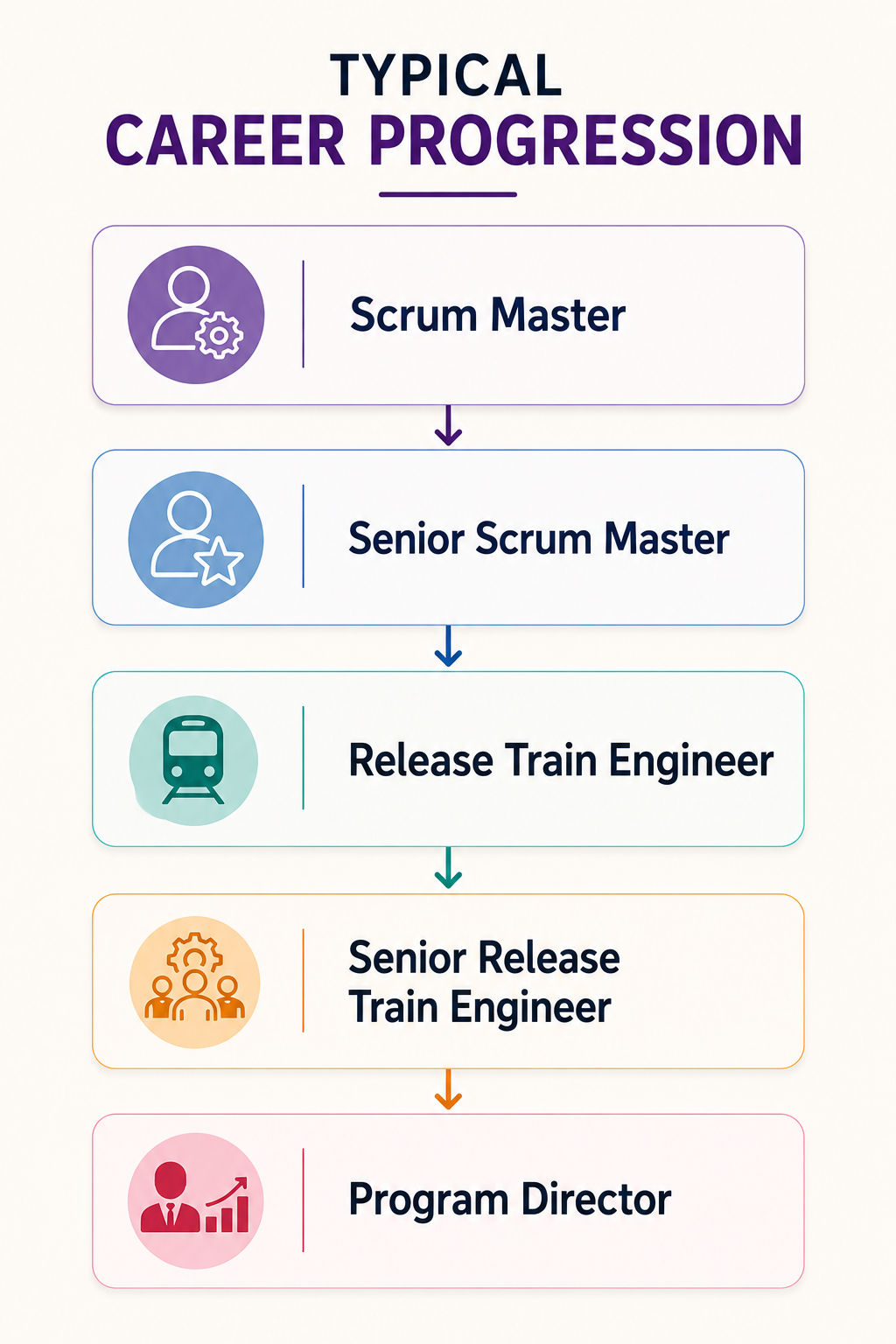
As experience grows, RTEs often take ownership of larger Agile Release Trains, mentor newer RTEs, and contribute to portfolio level planning. Many eventually transition into Program Director or Delivery Director roles where they oversee multiple strategic initiatives.
Example
Imagine two experienced Agile professionals with similar backgrounds.
One enjoys solving coordination challenges, facilitating PI Planning, and improving delivery across multiple teams. Pursuing RTE allows this professional to become a trusted program leader responsible for delivering complex initiatives.
The others enjoy coaching leaders, designing Agile operating models, and driving cultural change. SPC provides the knowledge and credibility needed to lead enterprise transformations across different organizations.
This example shows why RTE vs SPC is less about choosing the better certification and more about choosing the career that matches your strengths.
Before pursuing an RTE role, check out Release Train Engineer Salary in 2026 to learn how experience and skills influence compensation.
When Should You Choose RTE Over SPC?
The decision between RTE vs SPC becomes much easier when you think about the work you enjoy doing every day.
If your passion lies in helping teams collaborate better, improving delivery predictability, and ensuring large programs stay aligned, RTE is likely the better choice.
Choose RTE when you want to:
- Lead Agile Release Trains
- Coordinate multiple cross functional teams
- Facilitate PI Planning and Inspect and Adapt events
- Improve delivery quality and predictability
- Manage program risks and dependencies
- Build expertise within a single enterprise
- Grow into Program Manager or Delivery Director roles
Example
A technology company has already adopted SAFe successfully. Leadership is not looking for another transformation consultant. Instead, they need someone who can ensure three Agile Release Trains consistently deliver business value.
An RTE becomes the ideal fit because the focus is on execution rather than organizational change.
If your day revolves around delivery excellence, the RTE vs SPC comparison usually favors RTE.
Looking to build a successful RTE career? Release Train Engineer (RTE) Career Path for 2026 explains the typical career journey, promotion opportunities, and next steps after certification.
When Should You Choose SPC Over RTE?
Some professionals want to influence much more than program execution. They want to shape strategy, guide executives, and help organizations transform the way they work.
In these situations, SPC becomes the stronger choice.
Choose SPC when you want to:
- Lead enterprise Agile transformation
- Coach executives and senior leadership
- Implement SAFe across business units
- Train Agile teams and organizational leaders
- Build a consulting career
- Scale Agile across multiple portfolios
- Influence long term organizational change
Unlike an RTE, whose focus remains within an Agile Release Train, an SPC works across departments, leadership teams, and portfolios to create lasting transformation.
Example
A multinational healthcare organization plans to introduce SAFe across engineering, product management, operations, and business leadership.
The company needs someone who can assess its current maturity, create a transformation roadmap, train hundreds of employees, coach executives, and mentor Release Train Engineers.
This responsibility aligns perfectly with an SPC rather than an RTE.
For professionals interested in strategic leadership, RTE vs SPC often points toward SPC.
Can You Earn Both Certifications?
Absolutely.
Many experienced SAFe professionals eventually earn both certifications because the combination creates a well-rounded leadership profile.
Rather than viewing RTE vs SPC as competing certifications, think of them as complementary skills that prepare you for different stages of your career.
Is RTE Required Before SPC?
No.
There is no mandatory requirement to earn RTE certification before pursuing SPC.
Experienced Agile Coaches, Enterprise Coaches, consultants, and senior transformation leaders often pursue SPC directly because their existing responsibilities already align with enterprise level leadership.
However, professionals whose experience has primarily been at the team level may find RTE to be an excellent steppingstone.
Benefits of Holding Both Certifications
Professionals who hold both certifications often bring a balanced perspective to enterprise Agile initiatives.
Some of the biggest advantages include:
- Strong understanding of both execution and transformation
- Greater credibility with delivery teams and executive leadership
- Better ability to mentor Release Train Engineers
- Improved consulting opportunities
- Stronger leadership profile for enterprise roles
- Wider career opportunities across industries
Example
Consider an Enterprise Agile Coach responsible for launching several Agile Release Trains across a global organization.
Their SPC certification enables them to design the transformation strategy, coach executives, and train leaders.
Their RTE experience helps them understand the practical challenges Release Train Engineers face during PI Planning, dependency management, and program execution.
This combination allows them to make practical decisions instead of relying only on theory.
That is one of the biggest advantages when evaluating RTE vs SPC. Many senior leaders eventually realize they are strongest when they understand both perspectives.
Choosing the right certification can accelerate your Agile career. Explore Best Agile Management Certification Training Courses to understand which programs best match your professional goals.
Conclusion
Choosing between RTE vs SPC is not about identifying which certification is more prestigious. It is about understanding where you want your career to go and the type of impact you want to create within an organization.
The RTE vs SPC decision ultimately depends on your current experience, responsibilities, and long-term aspirations. If your focus is operational excellence and program execution, RTE is the better fit. If your goal is enterprise leadership and organizational transformation, SPC is the stronger choice.
Rather than asking which certification is better, ask yourself where you want to create the greatest impact. Your answer will naturally guide you toward the right choice in the RTE vs SPC journey.
Contact our upGrad KnowledgeHut experts for personalized guidance on choosing the right course, career path, and certification to achieve your goals.
Frequently Asked Questions
Is SPC higher than RTE?
SPC is generally considered a broader leadership certification because it focuses on enterprise-wide SAFe implementation, executive coaching, and organizational transformation. RTE specializes in leading Agile Release Trains and program execution. Rather than being a higher version of RTE, SPC serves a different purpose with a wider organizational scope.
Which certification is more difficult?
Both certifications are challenging in different ways. RTE requires a strong understanding of Agile Release Train execution, dependency management, and facilitation, while SPC demands knowledge of enterprise transformation, executive coaching, and change management. The difficulty depends largely on your professional experience and current responsibilities.
Which certification pays better?
SPC certified professionals often have access to higher paying opportunities because they work in enterprise transformation, consulting, and strategic leadership roles. However, experienced RTEs managing large Agile programs are also in strong demand and can earn competitive salaries. Compensation usually depends on industry, location, experience, and organizational responsibilities.
Can Scrum Masters directly pursue SPC?
Yes, Scrum Masters can pursue SPC if they have significant experience in Agile coaching or organizational leadership. However, professionals who are still focused on team level delivery often benefit from gaining experience as an RTE before moving into enterprise transformation roles.
Is RTE still valuable after SPC?
Absolutely. Even after earning SPC, RTE knowledge remains valuable because it provides practical insight into how Agile Release Trains operate. Many enterprise leaders use their RTE experience to better coach teams, mentor Release Train Engineers, and make informed transformation decisions.
Which certification is better for consulting?
For consulting careers, SPC is usually the preferred choice. It prepares professionals to assess organizations, implement SAFe, coach executives, train teams, and guide large scale transformation initiatives across multiple clients. These responsibilities align closely with the work performed by Agile consultants.
Which certification is better for enterprise leadership?
If your goal is enterprise leadership, SPC is the stronger option. It focuses on organizational strategy, portfolio alignment, executive coaching, and long-term Agile transformation. RTE remains essential for program leadership but typically operates within the boundaries of an Agile Release Train.
Can RTE implement SAFe?
An RTE plays an important role in supporting SAFe adoption by facilitating Agile Release Trains and helping teams follow SAFe practices. However, the overall planning, rollout, governance, and enterprise implementation of SAFe are typically led by an SPC or a transformation team.
Does SPC include RTE responsibilities?
An SPC understands many of the responsibilities performed by an RTE and often mentors Release Train Engineers during transformation initiatives. However, SPCs usually focus on strategy, coaching, and implementation rather than managing the day-to-day execution of an Agile Release Train.
Which certification has better global demand?
Both certifications are in demand as organizations continue scaling Agile practices. RTE is sought after by companies looking to strengthen program execution and delivery, while SPC is highly valued by enterprises undergoing large scale Agile transformation. The better choice depends on the type of leadership role you want to pursue rather than overall market demand.
1638 articles published
KnowledgeHut is an outcome-focused global ed-tech company. We help organizations and professionals unlock excellence through skills development. We offer training solutions under the people and proces...
Get Free Consultation
By submitting, I accept the T&C and
Privacy Policy
Ready to learn about Agile Certifications Roadmap?