
- Blog Categories
- Project Management
- Agile Management
- IT Service Management
- Cloud Computing
- Business Management
- BI And Visualisation
- Quality Management
- Cyber Security
- DevOps
- Most Popular Blogs
- PMP Exam Schedule for 2025: Check PMP Exam Date
- Top 60+ PMP Exam Questions and Answers for 2025
- PMP Cheat Sheet and PMP Formulas To Use in 2025
- What is PMP Process? A Complete List of 49 Processes of PMP
- Top 15+ Project Management Case Studies with Examples 2025
- Top Picks by Authors
- Top 170 Project Management Research Topics
- What is Effective Communication: Definition
- How to Create a Project Plan in Excel in 2025?
- PMP Certification Exam Eligibility in 2025 [A Complete Checklist]
- PMP Certification Fees - All Aspects of PMP Certification Fee
- Most Popular Blogs
- CSM vs PSM: Which Certification to Choose in 2025?
- How Much Does Scrum Master Certification Cost in 2025?
- CSPO vs PSPO Certification: What to Choose in 2025?
- 8 Best Scrum Master Certifications to Pursue in 2025
- Safe Agilist Exam: A Complete Study Guide 2025
- Top Picks by Authors
- SAFe vs Agile: Difference Between Scaled Agile and Agile
- Top 21 Scrum Best Practices for Efficient Agile Workflow
- 30 User Story Examples and Templates to Use in 2025
- State of Agile: Things You Need to Know
- Top 24 Career Benefits of a Certifed Scrum Master
- Most Popular Blogs
- ITIL Certification Cost in 2025 [Exam Fee & Other Expenses]
- Top 17 Required Skills for System Administrator in 2025
- How Effective Is Itil Certification for a Job Switch?
- IT Service Management (ITSM) Role and Responsibilities
- Top 25 Service Based Companies in India in 2025
- Top Picks by Authors
- What is Escalation Matrix & How Does It Work? [Types, Process]
- ITIL Service Operation: Phases, Functions, Best Practices
- 10 Best Facility Management Software in 2025
- What is Service Request Management in ITIL? Example, Steps, Tips
- An Introduction To ITIL® Exam
- Most Popular Blogs
- A Complete AWS Cheat Sheet: Important Topics Covered
- Top AWS Solution Architect Projects in 2025
- 15 Best Azure Certifications 2025: Which one to Choose?
- Top 22 Cloud Computing Project Ideas in 2025 [Source Code]
- How to Become an Azure Data Engineer? 2025 Roadmap
- Top Picks by Authors
- Top 40 IoT Project Ideas and Topics in 2025 [Source Code]
- The Future of AWS: Top Trends & Predictions in 2025
- AWS Solutions Architect vs AWS Developer [Key Differences]
- Top 20 Azure Data Engineering Projects in 2025 [Source Code]
- 25 Best Cloud Computing Tools in 2025
- Most Popular Blogs
- Company Analysis Report: Examples, Templates, Components
- 400 Trending Business Management Research Topics
- Business Analysis Body of Knowledge (BABOK): Guide
- ECBA Certification: Is it Worth it?
- Top Picks by Authors
- Top 20 Business Analytics Project in 2025 [With Source Code]
- ECBA Certification Cost Across Countries
- Top 9 Free Business Requirements Document (BRD) Templates
- Business Analyst Job Description in 2025 [Key Responsibility]
- Business Analysis Framework: Elements, Process, Techniques
- Most Popular Blogs
- Best Career options after BA [2025]
- Top Career Options after BCom to Know in 2025
- Top 10 Power Bi Books of 2025 [Beginners to Experienced]
- Power BI Skills in Demand: How to Stand Out in the Job Market
- Top 15 Power BI Project Ideas
- Top Picks by Authors
- 10 Limitations of Power BI: You Must Know in 2025
- Top 45 Career Options After BBA in 2025 [With Salary]
- Top Power BI Dashboard Templates of 2025
- What is Power BI Used For - Practical Applications Of Power BI
- SSRS Vs Power BI - What are the Key Differences?
- Most Popular Blogs
- Data Collection Plan For Six Sigma: How to Create One?
- Quality Engineer Resume for 2025 [Examples + Tips]
- 20 Best Quality Management Certifications That Pay Well in 2025
- Six Sigma in Operations Management [A Brief Introduction]
- Top Picks by Authors
- Six Sigma Green Belt vs PMP: What's the Difference
- Quality Management: Definition, Importance, Components
- Adding Green Belt Certifications to Your Resume
- Six Sigma Green Belt in Healthcare: Concepts, Benefits and Examples
- Most Popular Blogs
- Latest CISSP Exam Dumps of 2025 [Free CISSP Dumps]
- CISSP vs Security+ Certifications: Which is Best in 2025?
- Best CISSP Study Guides for 2025 + CISSP Study Plan
- How to Become an Ethical Hacker in 2025?
- Top Picks by Authors
- CISSP vs Master's Degree: Which One to Choose in 2025?
- CISSP Endorsement Process: Requirements & Example
- OSCP vs CISSP | Top Cybersecurity Certifications
- How to Pass the CISSP Exam on Your 1st Attempt in 2025?
- Most Popular Blogs
- Top 7 Kubernetes Certifications in 2025
- Kubernetes Pods: Types, Examples, Best Practices
- DevOps Methodologies: Practices & Principles
- Docker Image Commands
- Top Picks by Authors
- Best DevOps Certifications in 2025
- 20 Best Automation Tools for DevOps
- Top 20 DevOps Projects of 2025
- OS for Docker: Features, Factors and Tips
- More
- Agile & PMP Practice Tests
- Agile Testing
- Agile Scrum Practice Exam
- CAPM Practice Test
- PRINCE2 Foundation Exam
- PMP Practice Exam
- Cloud Related Practice Test
- Azure Infrastructure Solutions
- AWS Solutions Architect
- IT Related Pratice Test
- ITIL Practice Test
- Devops Practice Test
- TOGAF® Practice Test
- Other Practice Test
- Oracle Primavera P6 V8
- MS Project Practice Test
- Project Management & Agile
- Project Management Interview Questions
- Release Train Engineer Interview Questions
- Agile Coach Interview Questions
- Scrum Interview Questions
- IT Project Manager Interview Questions
- Cloud & Data
- Azure Databricks Interview Questions
- AWS architect Interview Questions
- Cloud Computing Interview Questions
- AWS Interview Questions
- Kubernetes Interview Questions
- Web Development
- CSS3 Free Course with Certificates
- Basics of Spring Core and MVC
- Javascript Free Course with Certificate
- React Free Course with Certificate
- Node JS Free Certification Course
- Data Science
- Python Machine Learning Course
- Python for Data Science Free Course
- NLP Free Course with Certificate
- Data Analysis Using SQL
Top SAFe Interview Questions and Answers to Help You Ace Enterprise Agile Interviews
Updated on Aug 05, 2026 | 287 views
Share:
Table of Contents
View all
- Beginner SAFe Interview Questions and Answers
- Intermediate SAFe interview questions and answers
- Scenario-Based SAFe Interview Questions and Answers
- Role-Specific SAFe Interview Questions and Answers
- Advanced SAFe Interview Questions and Answers
- How to Answer SAFe Interview Questions with Confidence
- Conclusion
Quick Overview
- SAFe interview questions assess your knowledge of enterprise Agile concepts, frameworks, and real-world problem-solving skills.
- Common topics include ARTs, PI Planning, Lean Portfolio Management, WSJF, Value Streams, and DevOps.
- Interviewers also look for your ability to apply SAFe concepts to practical business scenarios, not just define them.
- This guide covers 40+ beginner, advanced, scenario-based, and role-specific SAFe interview questions and answers, plus tips to answer with confidence.
Boost your enterprise Agile skills with the upGrad KnowledgeHut Leading SAFe® Certification Training and gain practical experience to confidently prepare for SAFe interviews and real-world Agile transformation initiatives.
Master the Right Skills & Boost Your Career
Avail your free 1:1 mentorship session
Beginner SAFe Interview Questions and Answers
These SAFe interview questions are commonly asked in interviews for beginners, people moving from Scrum to SAFe, or anyone preparing for their first enterprise Agile role.
1. What is SAFe?
Answer: SAFe (Scaled Agile Framework) is a framework that helps large organizations use Agile, Lean, and DevOps practices across multiple teams. It provides a clear way to coordinate work, align business goals with development, and deliver value faster on a large scale.
Also Read: What is SAFe Certification?
2. Why was SAFe created?
Answer: SAFe was created to solve the challenges of using Agile in large organizations. While Agile works well for individual teams, bigger companies need a structured way to manage multiple teams, align business goals, handle dependencies, and improve collaboration. SAFe provides that structure.
3. What problems does SAFe solve?
Answer: SAFe helps organizations overcome several common challenges, such as:
- Poor alignment between business goals and development teams
- Dependencies between multiple teams
- Slow product delivery
- Limited visibility into priorities and progress
- Difficulty applying Agile across the entire organization
4. What are the core values of SAFe?
Answer: SAFe is built on four core values:
- Alignment: Everyone works toward the same business goals.
- Built-In Quality: Quality is maintained throughout development, not just at the end.
- Transparency: Teams openly share information, progress, and challenges.
- Program Execution: Teams focus on delivering value consistently and on time.
These values help teams make better decisions and work together more effectively.
5. Explain the Lean-Agile principles.
Answer: SAFe is based on ten Lean-Agile principles that guide decision-making and product development. Some of the key principles include:
- Take an economic view when making decisions.
- Think about the entire system, not just individual teams.
- Accept change and keep different options open.
- Deliver work in small increments and collect feedback quickly.
- Organize teams around delivering customer value.
These principles help organizations improve quality, speed, and business outcomes.
6. What is an Agile Release Train (ART)?
Answer: An Agile Release Train (ART) is a group of Agile teams that work together to plan, build, test, and deliver solutions. Everyone on the train shares the same goals and follows the same schedule. An ART usually includes 50 to 125 people working together to deliver business value.
7. What is PI Planning?
Answer: PI (Program Increment) Planning is an important SAFe event where all teams in an Agile Release Train come together to plan their work for the next Program Increment. During this event, teams:
- Set shared goals
- Identify dependencies
- Discuss risks
- Create a plan for the upcoming work
This helps everyone stay aligned from the beginning.
8. What is a Program Increment (PI)?
Answer: A Program Increment (PI) is a planning and development cycle that usually lasts 8 to 12 weeks. During this period, teams complete several iterations (or sprints) and deliver small, valuable improvements to customers.
9. What are PI objectives?
Answer: PI Objectives are the business and technical goals that teams agree on during PI Planning. These objectives help teams stay focused on the most important work and measure whether they have successfully delivered the planned value.
10. What is inspect and adapt?
Answer: Inspect and Adapt is an event held at the end of every Program Increment. During this session, teams:
- Review what was achieved
- Discuss what went well and what didn't
- Find the root causes of problems
- Create improvement plans for the next PI
This helps teams continuously improve their performance.
11. What are Value Streams?
Answer: Value Streams are the series of steps an organization follows to deliver value to customers. Instead of working in separate departments, SAFe encourages organizations to organize teams around these value streams so they can deliver products faster and more efficiently.
12. What is Built-In Quality?
Answer: Built-In Quality means that quality is part of every stage of development instead of being checked only at the end. Teams use practices such as:
- Automated testing
- Continuous Integration (CI)
- Code reviews
- Following coding and quality standards
This approach helps reduce defects and ensures high-quality products.
Build a strong foundation in Agile and SAFe with upGrad KnowledgeHut Agile Management courses, designed to help professionals grow in today's fast-changing business environment.
Intermediate SAFe interview questions and answers
Once you've covered the basics, interviewers move on to safe interview questions that test how well you understand enterprise Agile practices. These safe agile interview questions often focus on scaling Agile, prioritization, portfolio management, and collaboration across multiple teams.
1. How is SAFe different from Scrum?
Answer: Scrum is designed for a single Agile team, while SAFe helps multiple Agile teams work together across an organization. Scrum focuses on team-level planning and delivery, whereas SAFe adds layers like Agile Release Trains, PI Planning, and Lean Portfolio Management to align teams with business goals.
Also Read: Scrum vs SAFe
2. Scrum vs SAFe vs LeSS
Answer:
Framework |
Best For |
Key Difference |
| Scrum | Single Agile team | Focuses on one team's work and delivery. |
| SAFe | Large enterprises | Coordinates multiple teams with structured planning and governance. |
| LeSS (Large-Scale Scrum) | Organizations with a few Scrum teams | Extends Scrum with minimal additional roles and processes, keeping the framework lightweight. |
3. Explain Lean Portfolio Management.
Answer: Lean Portfolio Management (LPM) helps organizations decide where to invest time, budget, and resources. Instead of approving every project upfront, LPM continuously reviews priorities, funds value streams, and ensures work supports business strategy.
4. What is WSJF prioritization?
Answer: WSJF (Weighted Shortest Job First) is a prioritization method used in SAFe to decide which work should be done first. It compares the value of a feature with the effort required using this formula:
WSJF = Cost of Delay ÷ Job Size
Higher WSJF scores mean the work should generally be prioritized first because it delivers more value sooner.
5. What are Enablers?
Answer: Enablers are work items that support future business features. They include activities like improving architecture, reducing technical debt, upgrading infrastructure, or completing research. Although customers may not see them directly, they help teams deliver features faster and with better quality.
6. Explain Architectural Runway.
Answer: Architectural Runway is the existing technical foundation that supports upcoming features. It includes the code, infrastructure, and architecture needed so teams can develop new functionality without major redesigns or delays.
7. What is DevOps in SAFe?
Answer: DevOps in SAFe brings development, testing, security, and operations teams together to speed up software delivery. It encourages automation, continuous testing, frequent deployments, and shared responsibility, helping organizations release reliable software more quickly.
8. Explain the Continuous Delivery Pipeline.
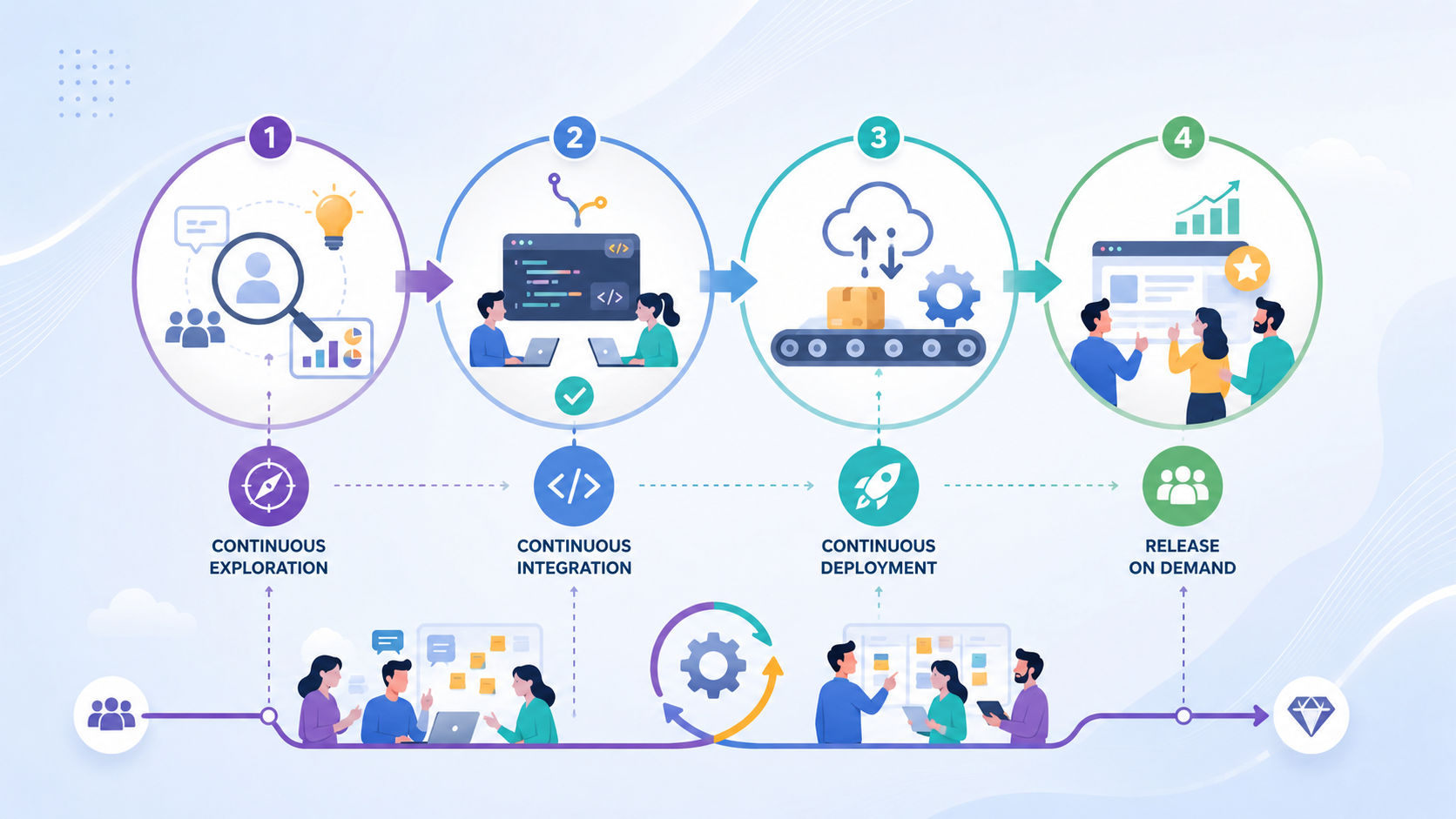
Answer: The Continuous Delivery Pipeline is the process of moving an idea from planning to production. It has four main stages:
- Continuous Exploration: Understand customer needs and define solutions.
- Continuous Integration: Build and test the solution regularly.
- Continuous Deployment: Prepare and deploy changes to production.
- Release on Demand: Release features whenever the business is ready.
9. What are Solution Trains?
Answer: A Solution Train is used when one Agile Release Train isn't enough to deliver a large, complex solution. It coordinates multiple ARTs working together on shared goals, dependencies, and delivery schedules, making it suitable for large enterprise systems.
10. What metrics are used in SAFe?
Answer: Common SAFe metrics include:
- PI Objectives achievement
- Predictability Measure
- Team Velocity
- Lead Time
- Cycle Time
- Flow Efficiency
- Defect Rate
- Customer Satisfaction
- Deployment Frequency
These metrics help organizations measure delivery performance and identify areas for improvement instead of tracking output alone.
Also Read: Safe Agilist Exam: A Complete Study Guide 2026
Scenario-Based SAFe Interview Questions and Answers
Scenario-based SAFe interview questions are designed to test how you handle real workplace situations. These questions are especially common for experienced Agile professionals.
1. A PI Planning session is running behind schedule. What would you do?
Answer: If a PI Planning session starts falling behind, I would first identify what's causing the delay. Then, I would focus on resolving the most important dependencies and keep discussions time-boxed so the meeting stays productive. Any topics that don't need everyone's attention can be moved to separate follow-up discussions. My goal would be to keep the session on track while making sure all teams remain aligned on their objectives.
2. Leadership changes priorities in the middle of a PI. How do you respond?
Answer: I would first understand why the priorities have changed and evaluate the impact on the current work. Next, I would discuss the changes with stakeholders, assess the team's capacity, and communicate the updated priorities clearly. Finally, I would work with the teams to adjust the plan while minimizing disruption.
3. Multiple Agile teams have conflicting priorities. What would you do?
Answer: I would bring the teams together to discuss their priorities and understand the business impact of each request. Then, I would align the work with the organization's strategic goals and use prioritization techniques like WSJF (Weighted Shortest Job First) if needed. The objective is to ensure everyone is working on the highest-value tasks.
4. Your Agile Release Train (ART) keeps missing PI Objectives. How would you handle it?
Answer: I would start by finding the root cause of the problem. This could include reviewing estimation accuracy, identifying dependency issues, or checking whether teams are overcommitting. During the Inspect and Adapt workshop, I would work with the teams to identify improvements and create an action plan for future PIs.
5. Stakeholders keep introducing urgent work. How would you manage it?
Answer: I would establish a clear process for handling urgent requests instead of accepting every new task immediately. Each request should be reviewed based on its business value and priority. This helps protect the team's planned work while still allowing genuinely urgent items to be addressed when necessary.
6. Teams are struggling with cross-team dependencies. What would you do?
Answer: I would make the dependencies visible so everyone understands how teams are connected. During PI Planning, I would encourage early discussions between teams and schedule regular synchronization meetings to track progress. Better communication and planning usually reduce dependency-related delays.
7. Product Management and the Development team disagree on priorities. How would you resolve the situation?
Answer: I would encourage an open discussion focused on facts rather than opinions. Together, we would review customer needs, business goals, technical feasibility, and available capacity. The aim is to make decisions that deliver the greatest value to customers and the business.
8. How would you handle resistance to SAFe adoption?
Answer: Resistance is normal during any change. I would listen to people's concerns, explain the benefits of SAFe, and provide the training and support they need. I would also celebrate early successes to build confidence and involve teams in the transformation process so they feel part of the change instead of having it imposed on them.
9. Describe a successful Agile transformation you were part of.
Answer: Use the STAR method to answer this question:
- Situation: Explain the challenge or problem.
- Task: Describe your role and responsibilities.
- Action: Explain the steps you took to improve the situation.
- ResultN Share measurable outcomes, such as faster delivery, better collaboration, improved quality, or higher customer satisfaction.
Using real examples makes your answer stronger and more convincing.
10. Tell us about your biggest Agile challenge.
Answer: Choose a real challenge you've faced, such as managing changing priorities, improving collaboration, or handling resistance to change. Explain how you approached the problem, what actions you took, and what you learned from the experience. Interviewers are often more interested in your problem-solving process and willingness to learn than in the challenge itself.
Role-Specific SAFe Interview Questions and Answers
Many interviewers ask role-specific SAFe interview questions to understand how well you can perform the responsibilities of the position you're applying for.
While the core concepts of SAFe remain the same, the questions and expected answers vary depending on the role.
Scrum Master Interview Questions
Sample Question: How do you remove impediments across multiple teams?
Answer: I work closely with different teams to identify blockers early and encourage collaboration to resolve them. If an issue affects multiple teams or cannot be solved at the team level, I escalate it to the right stakeholders. My goal is to remove obstacles quickly so teams can stay focused on delivering value.
Product Owner Interview Questions
Sample Question: How do you prioritize Team Backlog items?
Answer: I prioritize backlog items based on business value, customer needs, team dependencies, and PI Objectives. I also work closely with stakeholders and the development team to make sure the backlog reflects the most important work.
Product Manager Interview Questions
Sample Question: How do you balance customer needs with business strategy?
Answer: I use customer feedback, market research, business goals, and product strategy to make prioritization decisions. My focus is on delivering features that solve customer problems while supporting the organization's long-term objectives.
Release Train Engineer (RTE) Interview Questions
Sample Question: How do you improve ART predictability?
Answer: I improve predictability by encouraging better PI Planning, managing dependencies proactively, tracking risks throughout the PI, and maintaining regular communication with teams and stakeholders. Reviewing past performance and applying lessons learned also helps improve future delivery.
Agile Coach Interview Questions
Sample Question: How do you improve Agile maturity across the organization?
Answer: I coach teams and leaders on Agile principles and best practices, support continuous learning, and encourage regular improvement through retrospectives and feedback. I also help build an Agile culture where teams can continuously grow and improve.
SAFe Program Consultant (SPC) Interview Questions
Sample Question: What is your approach to an enterprise Agile transformation?
Answer: I begin by working with leadership to create a shared vision for the transformation. Then, I identify value streams, provide SAFe training, develop an implementation roadmap, and track measurable outcomes. Throughout the transformation, I focus on continuous improvement to ensure long-term success.
Also Read: What is Leading SAFe Certification?
Advanced SAFe Interview Questions and Answers
Advanced SAFe interview questions are commonly asked for senior-level roles such as Release Train Engineer (RTE), Agile Coach, SAFe Program Consultant (SPC), and transformation leaders.
These questions focus on enterprise Agile transformation, governance, strategy, and organizational change rather than day-to-day team activities.
1. Explain the SAFe Implementation Roadmap.
Answer: The SAFe Implementation Roadmap is a step-by-step guide that helps organizations successfully adopt SAFe. It includes activities such as building support for the transformation, training leaders and teams, identifying value streams, launching Agile Release Trains (ARTs), and continuously improving the implementation over time.
2. What are the seven core competencies of SAFe?
Answer: SAFe is built around seven core competencies that help organizations achieve Business Agility:
- Lean-Agile Leadership
- Team and Technical Agility
- Agile Product Delivery
- Enterprise Solution Delivery
- Lean Portfolio Management
- Organizational Agility
- Continuous Learning Culture
Together, these competencies help organizations improve collaboration, deliver value faster, and respond more effectively to changing business needs.
3. How does SAFe improve Business Agility?
Answer: SAFe helps organizations become more adaptable by improving collaboration, speeding up decision-making, and delivering customer value more consistently. It enables businesses to respond quickly to changing market conditions while keeping teams aligned with strategic goals.
4. How does Portfolio Kanban work?
Answer: Portfolio Kanban is a visual system for managing strategic initiatives from the initial idea through implementation. It helps leaders prioritize work, monitor progress, and make informed decisions based on business value and available capacity.
5. How does SAFe align strategy with execution?
Answer: SAFe connects business strategy with day-to-day work through Lean Portfolio Management, Value Streams, and PI Planning. These practices ensure that strategic goals are broken down into clear priorities that Agile teams can plan, develop, and deliver.
6. Explain governance in SAFe.
Answer: Governance in SAFe ensures that teams stay aligned with business objectives while meeting compliance, budgeting, and risk management requirements. It provides the right level of oversight without creating unnecessary processes or slowing down Agile delivery.
7. How would you measure the success of a SAFe implementation?
Answer: The success of a SAFe implementation can be measured using several key metrics, including:
- Predictable delivery of work
- Customer satisfaction
- Business outcomes
- Team productivity
- Product quality
- Employee engagement
Tracking these metrics helps organizations understand whether the transformation is delivering real business value.
8. What challenges do organizations face during SAFe implementation?
Answer: Some of the most common challenges include:
- Resistance to organizational change
- Lack of leadership alignment
- Limited SAFe training and coaching
- Legacy systems and outdated processes
- Managing dependencies across multiple teams
Successfully addressing these challenges is essential for a smooth Agile transformation.
9. How does SAFe integrate DevOps?
Answer: SAFe includes DevOps practices throughout the Continuous Delivery Pipeline. It encourages collaboration between development, operations, testing, and security teams to automate processes, improve software quality, and deliver releases more quickly and reliably.
10. What are the common challenges in enterprise Agile transformation?
Answer: Large organizations often face challenges such as:
- Teams working in isolated silos
- Traditional governance slowing decision-making
- Inconsistent Agile adoption across departments
- Resistance to change
- Change fatigue caused by multiple transformation initiatives
Overcoming these challenges requires strong leadership, continuous learning, and a long-term commitment to improvement.
How to Answer SAFe Interview Questions with Confidence
Understanding SAFe concepts is important, but doing well in SAFe interview questions requires more than just knowing definitions. Interviewers want to see how you apply SAFe in real projects, solve problems, and communicate your ideas clearly.
1. Use the STAR Method for Scenario-Based Questions
A simple way to answer behavioral and scenario-based questions is by using the STAR method:
- Situation: Briefly explain the context or challenge.
- Task: Describe your role or responsibility.
- Action: Explain what you did to solve the problem.
- Result: Share the outcome and what was achieved.
This structure keeps your answers organized, easy to follow, and more convincing.
2. Connect SAFe Concepts to Real Project Experience
Whenever possible, support your answers with real examples from your work.
Instead of only explaining what a SAFe practice is, describe how you used it in a project, the challenges you faced, and the results you achieved. Interviewers are usually more interested in practical experience than textbook knowledge.
3. Focus on Business Results
Don't stop at explaining the framework. Also talk about the business impact of your work.
For example, mention how your team:
- Delivered features faster
- Reduced defects
- Improved collaboration between teams
- Increased customer satisfaction
- Better aligned work with business goals
Showing measurable results makes your answers stronger.
4. Avoid Memorizing Definitions
Instead of repeating SAFe definitions word for word, explain concepts in your own words.
Speaking naturally shows that you understand the framework and know how to apply it in real situations.
5. Be Ready to Explain SAFe Concepts Without Visuals
In many interviews, you may be asked to explain SAFe concepts without using diagrams or slides.
Practice explaining topics like:
- Agile Release Trains (ARTs)
- Value Streams
- PI Planning
- The Continuous Delivery Pipeline
If you can explain these clearly in simple language, you'll leave a positive impression.
6. Review Important SAFe Terms
Before your interview, make sure you're comfortable with common SAFe terminology, including:
- ART (Agile Release Train)
- PI (Program Increment)
- WSJF (Weighted Shortest Job First)
- Enablers
- Lean Portfolio Management (LPM)
- Solution Trains
- Inspect and Adapt
- Built-In Quality
Knowing these terms will help you answer technical and scenario-based questions with confidence.
Conclusion
Preparing for SAFe interviews requires more than knowing Agile terminology. Employers want candidates who understand how SAFe connects teams, programs, portfolios, and business strategies to deliver measurable outcomes at scale.
By mastering these beginner, intermediate, scenario-based, role-specific, and advanced SAFe interview questions, you'll be better equipped to explain key concepts, discuss real-world experiences, and demonstrate enterprise Agile thinking.
Focus on giving practical examples, highlighting business impact, and communicating your answers clearly to stand out as a strong candidate in any SAFe interview.
Have A Query? Get in Touch With Our Customer Support | upGrad KnowledgeHut
Frequently Asked Questions (FAQs)
Is a SAFe certification enough to crack a SAFe interview?
A SAFe certification gives you a good understanding of the framework, but interviewers also look for practical knowledge. Be prepared to explain how SAFe concepts work in real projects and how you would handle common Agile challenges. Real-world examples can make your answers much stronger.
How should I prepare for a SAFe interview if I have no enterprise Agile experience?
Start by learning the core SAFe concepts and understanding how they fit together. Watch PI Planning sessions, study common enterprise workflows, and practice explaining concepts in your own words. Even if you haven't worked in SAFe, showing a clear understanding and willingness to learn leaves a positive impression.
How many SAFe interview questions should I practice before an interview?
Quality matters more than quantity. Instead of memorizing dozens of answers, focus on understanding around 30–40 commonly asked questions across beginner, intermediate, and scenario-based topics. Practice explaining them naturally rather than word for word.
How long does it take to prepare for a SAFe interview?
The preparation time depends on your experience. If you're already familiar with Agile, one to two weeks of focused study is often enough. Beginners may need more time to understand SAFe concepts, practice interview questions, and review enterprise Agile scenarios.
Which roles commonly require SAFe interview preparation?
SAFe knowledge is valuable for roles like Scrum Master, Product Owner, Product Manager, Release Train Engineer, Agile Coach, Business Analyst, and Project Manager. Many large enterprises also expect developers, testers, and architects to understand how SAFe works.
What should I study one day before a SAFe interview?
Instead of learning new topics, revise important SAFe terms, key roles, common ceremonies, and enterprise scenarios. Review your own project examples and practice answering questions out loud to improve clarity and confidence.
What documents or examples should I prepare before a SAFe interview?
You don't usually need to carry project documents, but you should prepare a few real examples that demonstrate your problem-solving, collaboration, and Agile experience. Having measurable outcomes ready makes your answers more convincing.
What are the most common mistakes candidates make in SAFe interviews?
Many candidates focus only on definitions and forget to explain why a practice is important. Others confuse Scrum with SAFe or give overly long answers. Keeping your responses simple, relevant, and supported by examples usually works best.
How can I improve my confidence while answering SAFe interview questions?
Practice speaking instead of silently reading notes. Record your answers, take mock interviews, and explain SAFe concepts in your own words. The more naturally you communicate, the more confident you'll appear during the interview.
Where can I find more SAFe interview questions to practice?
You can practice using official SAFe learning resources, certification study guides, mock interview platforms, Agile communities, and enterprise interview preparation blogs. Solving a mix of conceptual and scenario-based questions will help you prepare more effectively.
1639 articles published
KnowledgeHut is an outcome-focused global ed-tech company. We help organizations and professionals unlock excellence through skills development. We offer training solutions under the people and proces...
Get Free Consultation
By submitting, I accept the T&C and
Privacy Policy
Ready to learn about Agile Certifications Roadmap?