
What is CSM Certification? A Complete Beginner's Guide for 2026
Updated on Jul 24, 2026 | 354 views
Share:
Table of Contents
View all
- Quick Overview
- What is CSM Certification?
- What Is the Purpose of CSM Certification?
- What Does a Certified ScrumMaster Do?
- Skills Required
- Who Should Pursue CSM Certification?
- Eligibility Requirements for CSM Certification
- CSM Certification Exam Pattern (2026)
- Certification Journey for CSM Certification
- How to Get CSM Certified
- CSM Certification Cost in 2026
- Is CSM Certification Worth It in 2026?
- Conclusion
Master the Right Skills & Boost Your Career
Avail your free 1:1 mentorship session
Quick Overview
- CSM Certification is a globally recognized entry level Scrum certification offered by Scrum Alliance that validates your understanding of Agile principles and the Scrum framework.
- It is designed for professionals who want to start or advance a career in Agile and requires a 16-hour instructor-led training followed by a 50-question online exam with a minimum passing score of 74 percent.
- The certification is valid for two years, with certification costs starting from ₹17,135 and can open opportunities for roles such as Scrum Master, Agile Coach, and Delivery Manager.
- In this guide, you'll learn what CSM certification is, who should pursue it, eligibility requirements, exam details, certification costs, career opportunities, salary prospects, and how to earn your CSM certification in 2026.
Whether you're new to Agile or planning a Scrum career, CSM® Certification Training can help you prepare for CSM certification. This guide covers everything you need to know in 2026.
What is CSM Certification?
The Certified ScrumMaster (CSM) certification is an internationally recognized credential offered by Scrum Alliance, one of the world's leading organizations for Scrum education and certification. It is designed to help professionals understand the Scrum framework and develop the practical knowledge needed to support Agile teams.
For beginners wondering, what is CSM Certification? CSM serves as an excellent introduction to Agile project management. Rather than focusing only on theory, the certification explains how Scrum works in real workplace environments and how teams can deliver value through collaboration, transparency, and continuous improvement.
What Is the Purpose of CSM Certification?
Understanding What is CSM Certification? begins with knowing that the main purpose of CSM certification. The main purpose of CSM certification is to help professionals understand how Scrum teams operate and how a Scrum Master supports successful project delivery.
The course focuses on developing practical knowledge that can be applied immediately in Agile work environments. Participants learn how to guide teams, facilitate Scrum events, encourage collaboration, and remove challenges that prevent teams from achieving their goals.
Understanding the Scrum Framework
To better understand What is CSM Certification? Scrum is an Agile framework used to manage complex projects through short development cycles known as sprints. Instead of delivering an entire project at the end, Scrum encourages teams to deliver smaller improvements regularly, allowing organizations to respond quickly to customer feedback and change business needs.
The framework is built around three primary roles:
- Scrum Master
- Product Owner
- Development Team
Also read: Top Scrum Master Certification: Definitive Guide 2026
What Does a Certified ScrumMaster Do?
When exploring What is CSM Certification? A Certified ScrumMaster plays a key role in helping Agile teams work efficiently and deliver value consistently. Rather than managing people or assigning tasks, a Scrum Master acts as a facilitator, coach, and servant leader who helps the team follow Scrum practices while creating an environment where collaboration and continuous improvement can thrive.
While the responsibilities may vary across organizations, the core objective remains the same: enabling Agile teams to perform at their best.
Key Responsibilities
1. Facilitating Scrum Ceremonies
One of the primary responsibilities of a Scrum Master is facilitating Scrum events. These meetings help the team plan work, review progress, and identify opportunities for improvement.
A Scrum Master ensures that the following ceremonies are conducted effectively:
- Sprint Planning
- Daily Scrum
- Sprint Review
- Sprint Retrospective
- Backlog Refinement
2. Removing Impediments
Every project encounters challenges that can slow down progress. These may include communication gaps, resource constraints, technical issues, or dependency on other teams.
The Scrum Master identifies these impediments and works with the appropriate stakeholders to resolve them as quickly as possible. Removing obstacles allows the development team to concentrate on delivering value without unnecessary disruptions.
3. Coaching Agile Teams
A Scrum Master helps team members understand and apply Scrum principles in their daily work. This includes explaining Agile values, encouraging self-management, and promoting collaboration across the team.
4. Supporting Product Owners
Product Owners are responsible for maximizing product value by managing the product backlog. Scrum Masters work closely with them to ensure that the backlog is well organized and ready for upcoming sprints.
5. Improving Collaboration
Successful Agile teams depend on effective communication and teamwork. Scrum Masters create an environment where everyone feels comfortable sharing ideas, raising concerns, and working together toward common goals.
6. Promoting Continuous Improvement
Continuous improvement is one of the core principles of Scrum.
After every sprint, Scrum Masters encourages the team to reflect on what went well, identify areas for improvement, and agree on practical actions for the next sprint.
Skills Required
If you're researching What is CSM Certification? A successful Certified ScrumMaster combines technical knowledge of Scrum with strong interpersonal skills. Since the role focuses heavily on people, employers value professionals who can build trust, facilitate discussions, and guide teams through change.
1. Communication
Clear communication is essential for keeping everyone aligned. Scrum Masters regularly interact with developers, Product Owners, managers, and stakeholders, ensuring that expectations, priorities, and progress are understood by everyone involved.
2. Leadership
Scrum Masters practice servant leadership by supporting rather than directing the team. They empower team members to make decisions, take ownership of their work, and continuously improve their performance.
3. Facilitation
Meetings are an important part of Scrum, and a Scrum Master should know how to facilitate them effectively. Good facilitation ensures discussions remain focused, encourages participation from every team member, and helps meetings end with clear outcomes.
4. Conflict Resolution
Differences of opinion are common in cross functional teams. Scrum Masters help resolve conflicts constructively by encouraging respectful discussions and guiding the team toward solutions that support project goals.
5. Agile Mindset
Beyond following Scrum practices, employers look for professionals who embrace an Agile mindset. This includes adapting to change, welcoming feedback, learning continuously, and focusing on delivering value to customers.
6. Coaching
Coaching is one of the defining characteristics of an effective Scrum Master. Rather than solving every problem directly, they help team members develop the confidence and skills needed to solve challenges independently.
Who Should Pursue CSM Certification?
If you're asking What is CSM Certification? One of the biggest advantages of the Certified ScrumMaster certification is that it is suitable for professionals from a wide range of backgrounds. Unlike many technical certifications, CSM does not require programming knowledge or previous Scrum experience. Whether you are starting your career, transitioning into Agile, or looking to strengthen your project management skills, CSM can provide a solid foundation.
Below are the professionals who can benefit the most from earning a CSM certification.
1. Aspiring Scrum Masters
If your goal is to become a Scrum Master, CSM is one of the best places to start. It introduces the Scrum framework, explains the responsibilities of a Scrum Master, and prepares you to support Agile teams in real work environments.
Many employers also prefer candidates who have completed a recognized Scrum certification when hiring for entry level Scrum Master roles.
2. Project Managers
Project Managers who want to move from traditional project management to Agile delivery can benefit significantly from CSM certification.
The course helps them understand how Agile teams plan to work, manage changing priorities, and deliver projects through short development cycles. This knowledge makes it easier to lead Agile initiatives and collaborate with Scrum teams.
Not sure if the Scrum Master role is right for you? Explore Who Should do Scrum Master Certification? to find out who can benefit most.
3. Business Analysts
Business Analysts regularly work with business stakeholders and development teams. Learning Scrum enables them to communicate more effectively, participate in backlog refinement, and contribute to Agile planning activities.
For Business Analysts planning to transition into Scrum Master or Product Owner roles, CSM provides an excellent starting point.
4. Developers
Software developers often work within Scrum teams but may not fully understand the responsibilities of every Scrum role.
A CSM certification helps developers gain a broader understanding of Agile practices, improve collaboration with Product Owners and Scrum Masters, and prepare for future leadership opportunities.
5. QA Engineers
Quality Assurance professionals play an important role in Agile teams by ensuring that products meet quality standards throughout development.
Understanding Scrum helps QA Engineers participate more effectively in sprint planning, testing activities, and continuous improvement discussions while expanding their career opportunities within Agile environments.
6. Product Owners
Although Product Owners have a separate certification path, learning Scrum through the CSM program provides valuable insights into how Agile teams operate.
It helps Product Owners collaborate more effectively with Scrum Masters and development teams while improving backlog management and sprint planning.
7. Team Leads
Team Leads responsible for guiding technical or business teams can use CSM certification to strengthen their leadership skills and improve team collaboration.
The knowledge gained through the course helps them create productive Agile environments where teams can deliver work more efficiently.
8. Non IT Professionals
Scrum is no longer limited to software development. Many industries now use Agile practices to improve project delivery, customer service, marketing, operations, and product development.
Professionals working in banking, healthcare, manufacturing, consulting, education, retail, and other sectors can benefit from learning Scrum, especially if their organizations are adopting Agile ways of working.
9. Fresh Graduates
Fresh graduates looking to begin their careers in project management, or Agile can use CSM certification to strengthen their resumes.
Although practical experience remains important, certification demonstrates initiative and provides a solid understanding of Agile concepts before entering the job market.
If you're evaluating different Agile certifications, our guide to the Best Agile Management Certification Training Courses can help you make an informed decision.
Eligibility Requirements for CSM Certification
For those asking What is CSM Certification? One of the reasons the Certified ScrumMaster certification is so popular is its accessibility. Unlike many professional certifications that require years of experience or technical expertise, CSM is designed for beginners and experienced professionals alike. Whether you are transitioning into Agile or starting your career, the eligibility requirements are straightforward.
1. No Formal Prerequisites
There are no formal educational or professional prerequisites for taking the CSM certification. You do not need a specific degree, previous Scrum knowledge, or work experience to enroll in the course.
2. Mandatory Scrum Alliance Training
Before taking the certification exam, every candidate must complete an official training program approved by the Scrum Alliance.
The training is typically delivered over 16 hours through live online or classroom sessions. During the course, participants learn the fundamentals of Scrum, Agile principles, Scrum roles, events, artifacts, and practical ways to apply Scrum in real projects.
3. Certified Scrum Trainer
Certified Scrum Trainers are experienced Agile professionals who provide practical examples, interactive discussions, group activities, and real-world insights throughout the training. This instructor-led approach helps participants understand Scrum beyond theory and prepares them for both the certification exam and workplace challenges.
4. No Experience Requirement
Previous experience working in Scrum or Agile environments is not required.
Many first-time learners enroll in the CSM course without ever having worked on an Agile project. The training starts with the basics, making it suitable for beginners while still providing value to experienced professionals who want a structured understanding of Scrum.
Although experience is not necessary to earn the certification, gaining hands on exposure after certification will help you apply Scrum principles more confidently in your career.
If you're unsure which Scrum certification to pursue, read What is the Difference Between CSM and PSM Certification? to compare both credentials.
CSM Certification Exam Pattern (2026)
If you're learning What is CSM Certification? After completing the mandatory training, candidates become eligible to take the CSM certification exam. The exam is designed to assess your understanding of Scrum fundamentals rather than your ability to memorize complex concepts. Most candidates who actively participate in the training and review the course material find the exam manageable.
Knowing the exam format in advance can help you prepare with confidence and avoid unnecessary surprises on exam day.
Exam Feature |
Details |
| Exam Format | Online multiple-choice exam |
| Number of Questions | 50 |
| Time Limit | 60 minutes |
| Passing Score | 74 percent (37 correct answers) |
| Eligibility | Complete official CSM training |
| Exam Attempts | Two attempts are generally included with the course fee |
| Difficulty Level | Beginner friendly |
The CSM certification exam is designed to confirm that you understand the fundamentals of Scrum and can apply them in real workplace situations. Rather than being a barrier, it serves as the final step in validating the knowledge gained during the training, making it an approachable certification for beginners and experienced professionals alike.
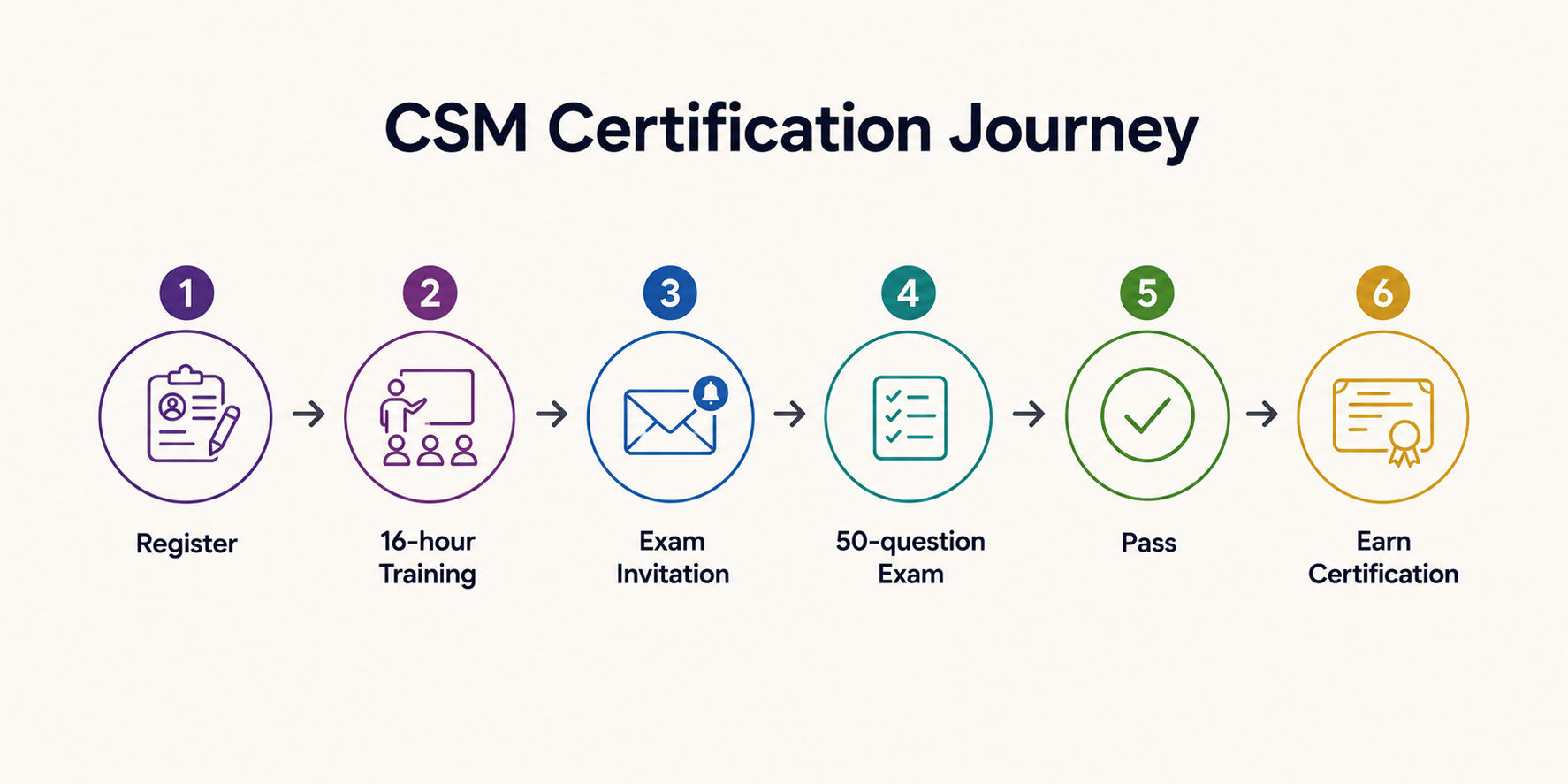
Certification Journey for CSM Certification
The CSM certification process is simple and structured, making it easy for beginners to understand what comes next. The infographic below provides a quick overview of the key steps involved, from registering for training to earning your Certified ScrumMaster (CSM) credential.
How to Get CSM Certified
After understanding What is CSM Certification? Becoming a Certified ScrumMaster is a straightforward process. Unlike many professional certifications that require months of preparation before you can sit for an exam, the CSM certification follows a structured path that begins with official training and ends with earning your credential from Scrum Alliance.
Following each step carefully will help you complete the certification process smoothly.
Step |
Typical Duration |
| Register for a CSM Training Program | 1 Day |
| Attend Mandatory Live Training | 2 Days (16 Hours) |
| Exam Preparation | 2 to 7 Days |
| Take the CSM Certification Exam | 60 Minutes |
| Receive Your CSM Certification | Same Day (After Passing the Exam) |
Overall Timeline: Most professionals earn their CSM certification in 3 to 10 days, depending on how soon they take the exam after completing the training.
New to Agile? Explore with Scrum Master - Definition, Benefits, Roles, Skills Required to understand the role before learning how AI is changing it in 2026.
CSM Certification Cost in 2026
The largest portion of the certification cost is the official training. Since Scrum Alliance requires candidates to attend a live instructor led course, the training fee is included in the overall package offered by approved training providers.
In India, the CSM certification course starts at ₹17,135, although the final cost may vary depending on the training provider, trainer, course format, and any additional learning resources included.
If you're planning to earn a Scrum certification, it's helpful to understand the latest costs before enrolling. Read our guide on How Much Does Scrum Master Certification Cost in 2026? for a detailed breakdown.
Is CSM Certification Worth It in 2026?
If you're still wondering What is CSM Certification? For many professionals, the answer is yes.
The Certified ScrumMaster certification continues to be one of the most recognized Agile credentials in the industry. As organizations across technology, banking, healthcare, consulting, retail, and manufacturing continue adopting Agile practices, the demand for professionals who understand Scrum remains strong.
While a certification alone does not guarantee a job, it can help you stand out in a competitive market and demonstrate that you have a solid understanding of Scrum fundamentals.
Key Benefits of CSM Certification
One of the biggest advantages of CSM is that it provides a structured introduction to Scrum without requiring prior experience.
Some of the key benefits include:
- Builds a strong foundation in Scrum and Agile principles
- Enhances credibility with recruiters and employers
- Improves understanding of Scrum roles and responsibilities
- Develops facilitation and team collaboration skills
- Expands professional networking opportunities through Scrum Alliance
- Opens pathways to advanced Agile certifications
Conclusion
In summary, what is CSM Certification? The Certified ScrumMaster certification remains one of the best starting points for professionals who want to build a career in Agile and Scrum. It provides a practical understanding of Scrum principles, strengthens your professional credibility, and prepares you to contribute effectively to Agile teams across a wide range of industries.
Although certification alone cannot replace real world experience, it demonstrates your commitment to learning and gives you the confidence to apply Scrum practices in the workplace.
Contact our upGrad KnowledgeHut experts for personalized guidance on choosing the right course, career path, and certification to achieve your goals.
Frequently Asked Questions
Can I take the CSM certification without Scrum experience?
Yes. You do not need prior Scrum or Agile experience to earn the CSM certification. The course is designed for beginners and covers the fundamentals of Scrum from the ground up. Completing the mandatory training is enough to become eligible for the certification exam.
Is training mandatory before taking the CSM exam?
Yes. Scrum Alliance requires every candidate to complete a 16-hour live training conducted by a Certified Scrum Trainer before they can access the certification exam. You cannot take the exam without attending the official training.
Can I take the CSM exam online?
Yes. The CSM certification exam is conducted online through the Scrum Alliance portal. After completing the training, you will receive an email with instructions to activate your account and take the exam from a suitable location with a stable internet connection.
What is the passing score for the CSM exam?
To earn the Certified ScrumMaster certification, you must score 74 percent, which means answering 37 out of 50 questions correctly.
How long is the CSM training program?
The official CSM training lasts 16 hours and is usually delivered over two days. The sessions are conducted live by a Certified Scrum Trainer and include interactive discussions, practical examples, and group activities.
What study materials are recommended for CSM beginners?
Beginners should review the Scrum Guide, training notes, practice questions, and learning resources provided during the official course. Revisiting Scrum roles, events, values, and artifacts can also help build confidence before the exam.
Can students or fresh graduates earn the CSM certification?
Yes. Students and recent graduates can enroll in the CSM course because there are no formal experience requirements. The certification helps build a strong foundation in Agile and can strengthen a resume when applying for entry level roles.
How soon will I receive my CSM certificate after passing the exam?
Once you pass the exam and complete the required steps on the Scrum Alliance portal, your digital CSM certificate is usually available through your Scrum Alliance account shortly afterward. You can then download it and add the credential to your resume and professional profiles.
Which industries hire CSM certified professionals?
CSM certified professionals are hired across many industries, including technology, banking, healthcare, consulting, retail, manufacturing, telecommunications, and financial services. As Agile adoption continues to grow, opportunities are expanding beyond software development.
Can CSM certification help me transition into Agile roles?
Yes. CSM certification provides a solid understanding of Scrum and Agile principles, making it easier to transition into roles such as Scrum Master, Agile Project Coordinator, Agile Coach, Delivery Manager, or other Agile focused positions. When combined with practical experience, it can significantly improve your career prospects.
1639 articles published
KnowledgeHut is an outcome-focused global ed-tech company. We help organizations and professionals unlock excellence through skills development. We offer training solutions under the people and proces...
Get Free Consultation
By submitting, I accept the T&C and
Privacy Policy
Ready to learn about Agile Certifications Roadmap?