
- Home
- Blog
- Data Science
- Enterprise AI Platform Selection Framework
Enterprise AI Platform Selection Framework
Updated on Aug 27, 2026 | 0.5k+ views
Share:
Table of Contents
View all
Quick Overview
- An enterprise AI platform selection framework provides a structured approach to evaluate AI platforms based on business needs, technical requirements, security, scalability, and cost.
- Before selecting a platform, enterprises should define objectives and use cases, identify users and data requirements, establish security and governance needs, and set up budget and performance expectations.
- Key evaluation criteria include model performance, data integration, security and compliance, scalability, enterprise integrations, customization, governance, vendor support, and total cost of ownership.
- This guide explains how to evaluate enterprise AI platforms, align platform capabilities with business priorities, validate solutions using real workloads, and assess long term vendor and technology fit.
Build enterprise AI expertise with Enterprise AI Platforms with AWS, Azure & Google Cloud and learn how leading cloud platforms support scalable AI solutions.
What is an enterprise AI platform selection framework?
An enterprise AI platform selection framework is a structured approach for evaluating AI platforms against business, technical, financial, security, and operational requirements.
It helps decision makers:
- Define what the platform needs to achieve
- Identify essential capabilities
- Compare vendors consistently
- Evaluate risks and trade offs
- Make a long-term technology decision
Why Enterprises Need a Structured AI Platform Selection Process
AI platforms can differ significantly in models, infrastructure, integrations, governance, pricing, and customization.
Without a structured process, organizations may:
- Overlook critical requirements
- Prioritize features that are not business relevant
- Underestimate implementation costs
- Create integration challenges
- Select a platform that becomes difficult to scale
Key Business and Technical Factors in AI Platform Selection
An effective enterprise AI platform selection framework should consider both business and technology requirements.
Key areas include:
- Business use cases
- AI model capabilities
- Data requirements
- Security and compliance
- Integration
- Scalability
- Customization
- Governance
- Cost
- Vendor support
Build a stronger approach to AI adoption with How Enterprises Can Build a Strong AI Strategy Framework and align AI initiatives with business goals, governance, and measurable outcomes.
What should enterprises consider before selecting an AI platform?
Before comparing vendors, organizations should establish what the platform actually needs to support. Clear requirements make it easier to separate essential capabilities from features that are simply attractive on paper.
1. Defining Business Objectives and AI Use Cases
Start with the business problem rather than technology.
Define:
- Business objectives
- Target AI use cases
- Expected outcomes
- Business users
- Critical workflows
- Success metrics
2. Identifying Users, Workloads, and Data Requirements
Different users may require different AI capabilities.
Consider:
- Data scientists
- Developers
- Product teams
- Business users
- Analysts
Also assess:
- Workload volume
- Data types
- Data location
- Model usage
- Processing requirements
3. Establishing Security, Compliance, and Governance Requirements
Security requirements should be defined before vendor selection.
Evaluate:
- Data protection
- Identity and access management
- Privacy
- Auditability
- Regulatory requirements
- AI governance
- Model controls
4. Setting Budget, Scalability, and Performance Expectations
Organizations should establish realistic expectations for:
- Platform costs
- AI usage costs
- Infrastructure
- Response time
- Availability
- Expected growth
- Workload scalability
Build practical data skills with Data Science Courses with Certification Online and prepare for data driven career opportunities.
Key criteria for evaluating enterprise AI platforms
The evaluation stage is the core of an enterprise AI platform selection framework. Each platform should be assessed against the same criteria so that decisions are based on comparable evidence.
1. AI Models and Model Performance
Evaluate whether the platform provides suitable models for current and future use cases.
Consider:
- Model quality
- Accuracy
- Latency
- Supported modalities
- Context capabilities
- Model choice
- Model customization
2. Data Integration and Interoperability
Enterprise AI applications often need information from multiple systems.
Evaluate support for:
- Databases
- Data warehouses
- APIs
- Files
- Data pipelines
- Vector databases
- Enterprise data platforms
3. Security, Privacy, and Compliance
Security should be evaluated across the entire platform rather than treated as a single feature.
Assess:
- Data encryption
- Access controls
- Identity management
- Data residency
- Audit logging
- Privacy controls
- Regulatory support
4. Scalability and Infrastructure
The platform should support both current and anticipated workloads.
Consider:
- Compute capacity
- Elastic scaling
- Storage
- Inference workloads
- Geographic availability
- Reliability
- High availability requirements
5. Integration With Existing Enterprise Systems
AI platforms need to work with the organization's existing technology environment.
Review integrations with:
- CRM systems
- ERP platforms
- Cloud environments
- Business applications
- Collaboration tools
- Identity systems
6. Customization and Extensibility
Organizations should determine how much flexibility they need.
Look for:
- APIs
- SDKs
- Custom workflows
- Model customization
- Application extensions
- Developer tools
7. Governance, Monitoring, and Explainability
Enterprise AI requires visibility into how systems are being used and how they perform.
Evaluate:
- Model monitoring
- Usage tracking
- Evaluation tools
- Audit trails
- Governance controls
- Explainability capabilities
8. Vendor Support and Enterprise Readiness
Vendor capability extends beyond the technology itself.
Assess:
- Technical support
- Documentation
- Professional services
- Service level commitments
- Enterprise references
- Product roadmap
- Vendor stability
9. Total Cost of Ownership
The enterprise AI platform selection framework should look beyond licensing or subscription prices.
Include:
- Platform fees
- Model usage
- Infrastructure
- Integration
- Data management
- Security
- Staffing
- Training
- Maintenance
- Support
Also Read: How to Evaluate AI Platforms: A Complete Guide for Enterprises
How to choose the right enterprise AI platform?
Once requirements and evaluation criteria are defined, organizations can move toward a final decision. The goal is to identify the platform that offers the best overall fit rather than the highest score in one category.
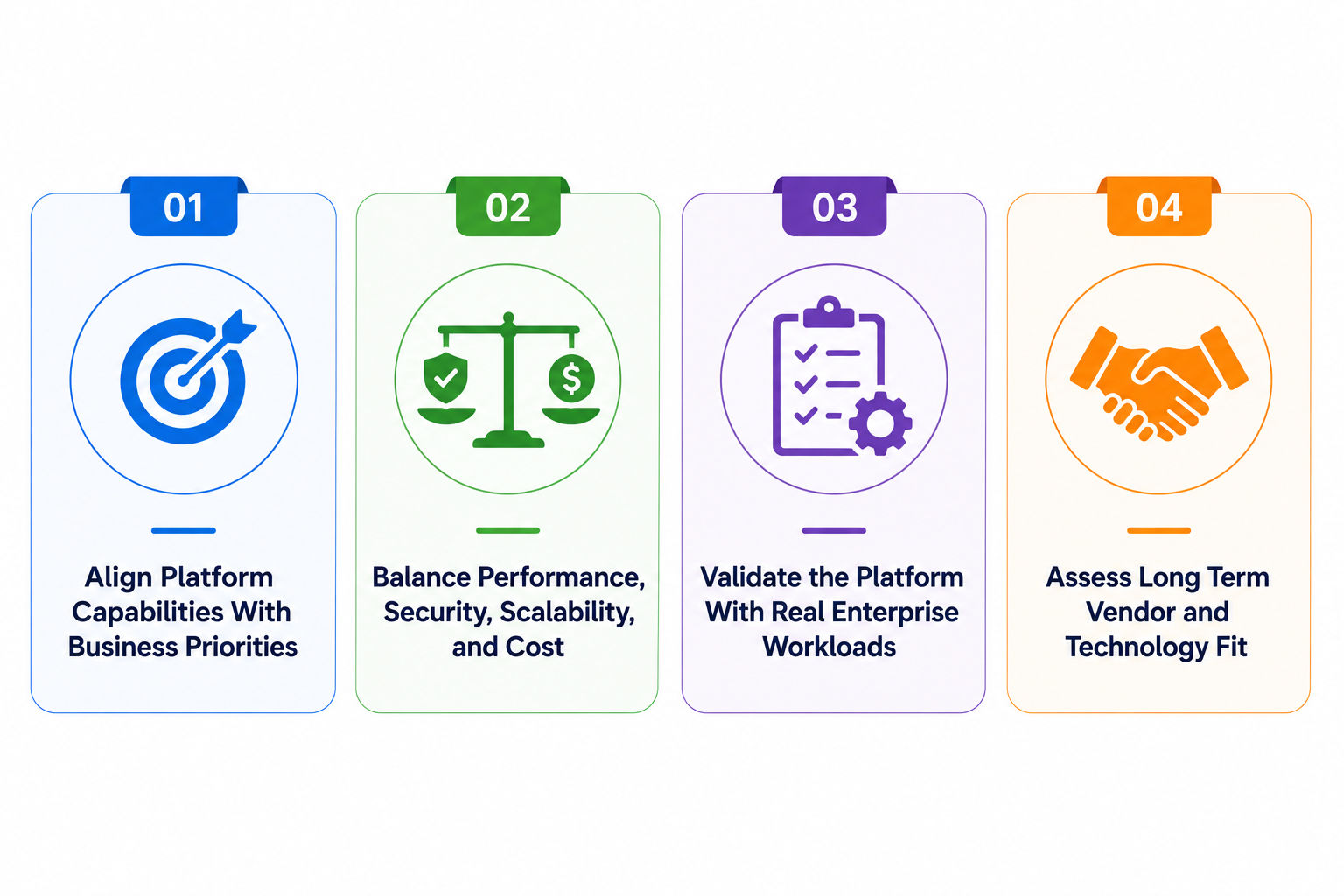
1. Align Platform Capabilities with Business Priorities
Start by mapping platform capabilities to the highest priority use cases.
Ask:
- Does the platform support the required workloads?
- Can it handle current data requirements?
- Does it integrate with important business systems?
- Can it support future AI initiatives?
2. Balance Performance, Security, Scalability, and Cost
Platform selection usually involves tradeoffs.
A platform may offer:
- Excellent model performance but higher costs
- Strong security but limited customization
- Broad integrations but greater complexity
- Fast deployment but less architectural control
3. Validate the Platform With Real Enterprise Workloads
A proof of concept can provide stronger evidence than vendor demonstrations alone.
Test the platform using:
- Representative data
- Actual workflows
- Expected workloads
- Security requirements
- Integration scenarios
4. Assess Long Term Vendor and Technology Fit
The platform should remain suitable as AI requirements evolve.
Evaluate:
- Vendor roadmap
- Model flexibility
- Technology updates
- Data portability
- Integration options
- Migration considerations
- Long term support
Explore AI Platform Governance Models and learn how enterprises can choose the right approach for secure, scalable, and responsible AI adoption.
Conclusion
An enterprise AI platform selection framework helps organizations compare AI platforms across capabilities, security, integration, scalability, governance, customization, support, and cost.
The right platform should match the organization's AI use cases, business priorities, and long-term technology needs. A structured evaluation and real workload testing can help make the final decision.
Contact our upGrad KnowledgeHut experts for personalized guidance on choosing the right course, career path, and certification to achieve your goals.
Frequently Asked Questions (FAQs)
1. How should enterprises create a weighted scorecard for AI platform selection?
Start by listing the most important selection criteria and assigning each one a weight based on business priorities. Score shortlisted platforms against those criteria to create a consistent comparison. Critical areas such as security or integration can receive higher weights.
2. How can enterprises compare AI platforms using their own real workloads?
Organizations should test shortlisted platforms using representative data, workloads, and business scenarios. Compare results across performance, accuracy, latency, integration, scalability, and cost. This provides more practical evidence than relying only on standard vendor demonstrations.
3. What questions should enterprises ask AI platform vendors before signing a contract?
Ask about pricing, data handling, security, service levels, support, model updates, integrations, and data portability. Contract terms should also clarify ownership, usage of rights, exit options, and responsibilities if the platform changes.
4. How can enterprises evaluate AI platform switching costs before planning?
Evaluate how difficult it would be to move data, applications, models, workflows, and integrations to another platform. Enterprises should also consider migration effort, technical dependencies, contract restrictions, and potential business disruption.
5. What should an enterprise AI platform proof of concept include?
A proof of concept should use realistic data and representative enterprise workloads. It should test required integrations, security, performance, scalability, user experience, reliability, and estimated operating costs before a larger commitment is made.
6. How can enterprises determine whether an AI platform is ready for production?
Production readiness requires more than a successful prototype. Organizations should verify security, reliability, monitoring, governance, scalability, performance, cost controls, support processes, and the ability to manage failures in real operating conditions.
7. How should enterprises evaluate model portability across AI platforms?
Check whether models, prompts, configurations, workflows, and supporting data can be transferred or recreated elsewhere. Standard APIs, portable formats, and clear vendor terms can reduce dependence on proprietary platform capabilities.
8. What role should procurement, legal, security, and business teams play in AI platform selection?
Each team evaluates a different risk or requirement. Business teams assess value, security reviews data protection, legal reviews of contracts and compliance, and procurement evaluate pricing and commercial terms. Their input should be included before the final selection.
9. How can enterprises prevent AI platform selection from being driven by vendor demonstrations?
Use a standardized evaluation framework and test every shortlisted platform against the same requirements. Vendor demonstrations should be treated as initial evidence, while decisions should rely on independent testing with realistic enterprise workloads and measurable criteria.
10. When should an enterprise reconsider its AI platform after implementation?
Reconsider the platform when costs rise unexpectedly; performance declines, requirements change, integrations become limiting, or security and governance needs are no longer being met. Major changes in vendor strategy or available technology can also justify a fresh evaluation.
1639 articles published
KnowledgeHut is an outcome-focused global ed-tech company. We help organizations and professionals unlock excellence through skills development. We offer training solutions under the people and proces...
Get Free Consultation
By submitting, I accept the T&C and
Privacy Policy