
- Blog Categories
- Project Management
- Agile Management
- IT Service Management
- Cloud Computing
- Business Management
- BI And Visualisation
- Quality Management
- Cyber Security
- DevOps
- Most Popular Blogs
- PMP Exam Schedule for 2025: Check PMP Exam Date
- Top 60+ PMP Exam Questions and Answers for 2025
- PMP Cheat Sheet and PMP Formulas To Use in 2025
- What is PMP Process? A Complete List of 49 Processes of PMP
- Top 15+ Project Management Case Studies with Examples 2025
- Top Picks by Authors
- Top 170 Project Management Research Topics
- What is Effective Communication: Definition
- How to Create a Project Plan in Excel in 2025?
- PMP Certification Exam Eligibility in 2025 [A Complete Checklist]
- PMP Certification Fees - All Aspects of PMP Certification Fee
- Most Popular Blogs
- CSM vs PSM: Which Certification to Choose in 2025?
- How Much Does Scrum Master Certification Cost in 2025?
- CSPO vs PSPO Certification: What to Choose in 2025?
- 8 Best Scrum Master Certifications to Pursue in 2025
- Safe Agilist Exam: A Complete Study Guide 2025
- Top Picks by Authors
- SAFe vs Agile: Difference Between Scaled Agile and Agile
- Top 21 Scrum Best Practices for Efficient Agile Workflow
- 30 User Story Examples and Templates to Use in 2025
- State of Agile: Things You Need to Know
- Top 24 Career Benefits of a Certifed Scrum Master
- Most Popular Blogs
- ITIL Certification Cost in 2025 [Exam Fee & Other Expenses]
- Top 17 Required Skills for System Administrator in 2025
- How Effective Is Itil Certification for a Job Switch?
- IT Service Management (ITSM) Role and Responsibilities
- Top 25 Service Based Companies in India in 2025
- Top Picks by Authors
- What is Escalation Matrix & How Does It Work? [Types, Process]
- ITIL Service Operation: Phases, Functions, Best Practices
- 10 Best Facility Management Software in 2025
- What is Service Request Management in ITIL? Example, Steps, Tips
- An Introduction To ITIL® Exam
- Most Popular Blogs
- A Complete AWS Cheat Sheet: Important Topics Covered
- Top AWS Solution Architect Projects in 2025
- 15 Best Azure Certifications 2025: Which one to Choose?
- Top 22 Cloud Computing Project Ideas in 2025 [Source Code]
- How to Become an Azure Data Engineer? 2025 Roadmap
- Top Picks by Authors
- Top 40 IoT Project Ideas and Topics in 2025 [Source Code]
- The Future of AWS: Top Trends & Predictions in 2025
- AWS Solutions Architect vs AWS Developer [Key Differences]
- Top 20 Azure Data Engineering Projects in 2025 [Source Code]
- 25 Best Cloud Computing Tools in 2025
- Most Popular Blogs
- Company Analysis Report: Examples, Templates, Components
- 400 Trending Business Management Research Topics
- Business Analysis Body of Knowledge (BABOK): Guide
- ECBA Certification: Is it Worth it?
- Top Picks by Authors
- Top 20 Business Analytics Project in 2025 [With Source Code]
- ECBA Certification Cost Across Countries
- Top 9 Free Business Requirements Document (BRD) Templates
- Business Analyst Job Description in 2025 [Key Responsibility]
- Business Analysis Framework: Elements, Process, Techniques
- Most Popular Blogs
- Best Career options after BA [2025]
- Top Career Options after BCom to Know in 2025
- Top 10 Power Bi Books of 2025 [Beginners to Experienced]
- Power BI Skills in Demand: How to Stand Out in the Job Market
- Top 15 Power BI Project Ideas
- Top Picks by Authors
- 10 Limitations of Power BI: You Must Know in 2025
- Top 45 Career Options After BBA in 2025 [With Salary]
- Top Power BI Dashboard Templates of 2025
- What is Power BI Used For - Practical Applications Of Power BI
- SSRS Vs Power BI - What are the Key Differences?
- Most Popular Blogs
- Data Collection Plan For Six Sigma: How to Create One?
- Quality Engineer Resume for 2025 [Examples + Tips]
- 20 Best Quality Management Certifications That Pay Well in 2025
- Six Sigma in Operations Management [A Brief Introduction]
- Top Picks by Authors
- Six Sigma Green Belt vs PMP: What's the Difference
- Quality Management: Definition, Importance, Components
- Adding Green Belt Certifications to Your Resume
- Six Sigma Green Belt in Healthcare: Concepts, Benefits and Examples
- Most Popular Blogs
- Latest CISSP Exam Dumps of 2025 [Free CISSP Dumps]
- CISSP vs Security+ Certifications: Which is Best in 2025?
- Best CISSP Study Guides for 2025 + CISSP Study Plan
- How to Become an Ethical Hacker in 2025?
- Top Picks by Authors
- CISSP vs Master's Degree: Which One to Choose in 2025?
- CISSP Endorsement Process: Requirements & Example
- OSCP vs CISSP | Top Cybersecurity Certifications
- How to Pass the CISSP Exam on Your 1st Attempt in 2025?
- Most Popular Blogs
- Top 7 Kubernetes Certifications in 2025
- Kubernetes Pods: Types, Examples, Best Practices
- DevOps Methodologies: Practices & Principles
- Docker Image Commands
- Top Picks by Authors
- Best DevOps Certifications in 2025
- 20 Best Automation Tools for DevOps
- Top 20 DevOps Projects of 2025
- OS for Docker: Features, Factors and Tips
- More
- Agile & PMP Practice Tests
- Agile Testing
- Agile Scrum Practice Exam
- CAPM Practice Test
- PRINCE2 Foundation Exam
- PMP Practice Exam
- Cloud Related Practice Test
- Azure Infrastructure Solutions
- AWS Solutions Architect
- IT Related Pratice Test
- ITIL Practice Test
- Devops Practice Test
- TOGAF® Practice Test
- Other Practice Test
- Oracle Primavera P6 V8
- MS Project Practice Test
- Project Management & Agile
- Project Management Interview Questions
- Release Train Engineer Interview Questions
- Agile Coach Interview Questions
- Scrum Interview Questions
- IT Project Manager Interview Questions
- Cloud & Data
- Azure Databricks Interview Questions
- AWS architect Interview Questions
- Cloud Computing Interview Questions
- AWS Interview Questions
- Kubernetes Interview Questions
- Web Development
- CSS3 Free Course with Certificates
- Basics of Spring Core and MVC
- Javascript Free Course with Certificate
- React Free Course with Certificate
- Node JS Free Certification Course
- Data Science
- Python Machine Learning Course
- Python for Data Science Free Course
- NLP Free Course with Certificate
- Data Analysis Using SQL
- Home
- Blog
- Data Science
- Prompt Engineering for Data Analysis and Insights
Prompt Engineering for Data Analysis and Insights
Updated on Aug 06, 2026 | 0.6k+ views
Share:
Table of Contents
View all
- What Is Prompt Engineering for Data Analysis?
- Why Use Prompt Engineering for Data Analysis?
- How Does Prompt Engineering Work for Data Analysis?
- Essential Components of an Effective Data Analysis Prompt
- Best Prompt Engineering Techniques for Data Analysis
- Common Use Cases of Prompt Engineering in Data Analysis
- Best Practices for Writing Data Analysis Prompts
- Prompt Engineering for Different Types of Data
- Conclusion
Quick Overview
- Prompt engineering for data analysis helps AI generate accurate insights by using clear, structured prompts with defined goals, context, and output requirements.
- Effective prompts to improve data exploration, trend analysis, reporting, and decision making across structured and unstructured datasets.
- Including the analysis of objective, dataset details, output format, and constraints helps AI deliver more reliable and actionable results.
- This guide explains how prompt engineering works for data analysis, essential prompting techniques, real world use cases, and best practices for generating accurate AI driven insights.
Learn the fundamentals of AI with Generative AI and Prompt Engineering.
What Is Prompt Engineering for Data Analysis?
Prompt engineering for data analysis is the process of designing clear and structured instructions that guide AI models to analyze datasets, identify patterns, summarize findings, and generate meaningful insights. Rather than asking broad questions, prompt engineering focuses on giving AI enough direction to understand the objective, context, expected output, and constraints.
Well-designed prompts reduce ambiguity and improve the accuracy of AI generated responses. They also help ensure that analytical outputs remain relevant to business goals instead of producing generic summaries.
Why are prompts important for AI driven data analysis?
AI models rely entirely on the information provided in a prompt manner. The better the prompt, the more useful the analysis becomes.
Effective prompts help AI:
- Understand the business objective before beginning the analysis.
- Focus on the most relevant variables within a dataset.
- Identify meaningful trends instead of reporting unnecessary information.
- Produce structured and organized responses.
- Reduce misunderstandings caused by vague instructions.
- Generate insights aligned with business requirements.
- Improve consistency across multiple analytical tasks.
Poorly written prompts often lead to:
- Incomplete analysis.
- Generic responses.
- Missing trends.
- Irrelevant recommendations.
- Misinterpretation of available data.
Since AI cannot automatically determine user's intent, prompt engineering for data analysis provides the direction needed to generate reliable analytical outputs.
How do large language models analyze structured and unstructured data?
Large language models process information differently depending on the type of data they receive. Understanding this capability helps professionals write more effective prompts.
For structured data, AI can:
- Interpret tables and spreadsheets.
- Compare numerical values.
- Detect patterns across multiple variables.
- Calculate trends and percentages.
- Summarize performance metrics.
- Identify anomalies within datasets.
For unstructured data, AI can:
- Analyze customer reviews.
- Summarize documents.
- Categorize textual information.
- Identify recurring themes.
- Detect customer sentiment.
- Extract important insights from lengthy reports.
Modern AI models can also combine structured and unstructured information when prompts clearly define relationships between different data sources.
This makes prompt engineering data analysis valuable across industries where multiple types of business information must be interpreted together.
Why Use Prompt Engineering for Data Analysis?
Organizations increasingly depend on AI to analyze large datasets, generate reports, and support strategic decisions. However, AI only performs as well as the instructions it receives. Prompt engineering for data analysis helps businesses obtain accurate, relevant, and actionable insights instead of broad or inconsistent responses.
By improving prompt quality, organizations can reduce manual effort, increase analytical accuracy, and accelerate decision making across departments.
How does prompt engineering improve data insights?
Well-designed prompts guide AI toward producing focused and meaningful insights rather than surface level observations.
Prompt engineering improves analysis by helping AI:
- Identify hidden patterns within datasets.
- Highlight important performance indicators.
- Compare results across different time periods.
- Detect unusual trends and anomalies.
- Generate structured summaries.
- Prioritize the most significant findings.
- Recommend possible business actions.
Better prompts also improve consistency. Different analysts using the same prompt framework are more likely to receive comparable outputs, making reporting more reliable.
Another important advantage is reducing information overload. Instead of generating lengthy responses, AI focuses only on insights that directly support business objectives.
What business problems can AI solve through better prompts?
Organizations use AI to solve a wide range of analytical challenges. Better prompts allow AI to understand these problems more accurately and produce more useful recommendations.
Common business applications include:
- Sales performance analysis.
- Customer retention analysis.
- Revenue forecasting.
- Marketing campaign evaluation.
- Financial reporting.
- Inventory optimization.
- Operational efficiency tracking.
- Product performance analysis.
- Employee productivity reporting.
- Risk assessment.
When prompts clearly define objectives, desired metrics, and evaluation criteria, AI can deliver insights that directly contribute to business strategy.
This is one of the primary reasons organizations continue investing in prompt engineering for data analysis across multiple departments.
How does prompt engineering save time and improve decision making?
Traditional data analysis often requires several manual steps before insights become available. AI significantly reduces this effort when guided by effective prompts.
Prompt engineering saves time by enabling AI to:
- Summarize large datasets quickly.
- Generate executive reports.
- Compare multiple datasets simultaneously.
- Identify key trends without manual filtering.
- Create structured analytical summaries.
- Highlight high-priority business issues.
- Organize findings for presentations.
Improved prompts also strengthen decision making because they encourage AI to focus on relevant business questions rather than presenting excessive information.
Decision makers benefit from:
- Faster access to insights.
- Improved reporting consistency.
- Better understanding of performance trends.
- Reduced manual analysis.
- More informed strategic planning.
- Higher productivity across analytical teams.
Understand the basics of AI prompting with What Is Prompt Engineering in Generative AI?
How Does Prompt Engineering Work for Data Analysis?
Effective AI analysis begins long before a prompt is entered. The quality of the response depends on how well the prompt communicates the objective, available data, expected outcome, and evaluation criteria. Prompt engineering for data analysis follows a structured process that helps AI generate reliable and actionable insights rather than generic summaries.
Instead of asking broad questions, professionals should guide AI through a logical analytical workflow. This improves accuracy, consistency, and overall quality of results.
Understanding the data before writing prompts
Before creating a prompt, it is important to understand the dataset being analyzed. AI performs better when prompts clearly describe the available information and its purpose.
Review the following before writing a prompt:
- Identify the business objective.
- Understand the type of dataset available.
- Review the important variables.
- Check for missing or incomplete data.
- Understand relationships between different fields.
- Determine the expected analytical outcome.
Important questions to consider include:
- What decision should this analysis support?
- Which metrics are most important?
- Is the data numerical, textual, or both?
- What period does the dataset cover?
- Are there any limitations within the data?
A clear understanding of the data reduces ambiguity and allows prompt engineering for data analysis to produce more focused and meaningful outputs.
Structuring prompts for accurate analysis
A well-structured prompt gives AI enough information to perform the analysis correctly while minimizing assumptions.
An effective prompt generally includes:
- The objective of the analysis.
- Relevant business context.
- Description of the dataset.
- Key variables to analyze.
- Required calculations or comparisons.
- Preferred output format.
- Constraints or assumptions.
- Expected level of detail.
A structured approach helps AI:
- Focus on relevant information.
- Ignore unnecessary details.
- Generate organized responses.
- Reduce inconsistent outputs.
- Improve analytical accuracy.
Rather than combining multiple unrelated requests into one instruction, separate complex analyses into logical tasks. This allows AI to produce clearer and more reliable results.
Refining prompts based on AI responses
The first AI response is not always the final answer. Prompt engineering is an iterative process where prompts are refined until the desired outcome is achieved.
Prompt refinement may involve:
- Clarifying vague instructions.
- Adding missing business context.
- Specifying additional variables.
- Narrowing the analytical scope.
- Requesting deeper explanations.
- Asking for comparisons or summaries.
- Simplifying overly complex requests.
Useful refinement strategies include:
- Narrowing the focus on one business objective.
- Asking AI to prioritize key findings.
- Please request additional reasoning.
- Removing unnecessary instructions.
- Specifying the desired level of detail.
Small improvements in prompt wording often produce significant improvements in analytical quality.
Validating AI generated insights
AI generated insights should always be verified before being used for business decisions. While AI can identify patterns and summarize information quickly, it may occasionally overlook context or misinterpret incomplete data.
Validation should include:
- Comparing results with the original dataset.
- Check numerical calculations.
- Confirming statistical accuracy.
- Reviewing business assumptions.
- Identifying missing variables.
- Verify conclusions with domain experts when necessary.
Additional validation practices include:
- Cross checking reports using business intelligence tools.
- Comparing outputs with previous analyses.
- Reviewing unexpected trends.
- Ensuring recommendations align with business objectives.
Get started with AI prompting in Prompt Engineering for Beginners.
Essential Components of an Effective Data Analysis Prompt
Every successful prompt contains a few essential building blocks. These components help AI understand not only what to analyze but also how the results should be presented. Including these elements significantly improves the quality, consistency, and usefulness of AI generated insights.
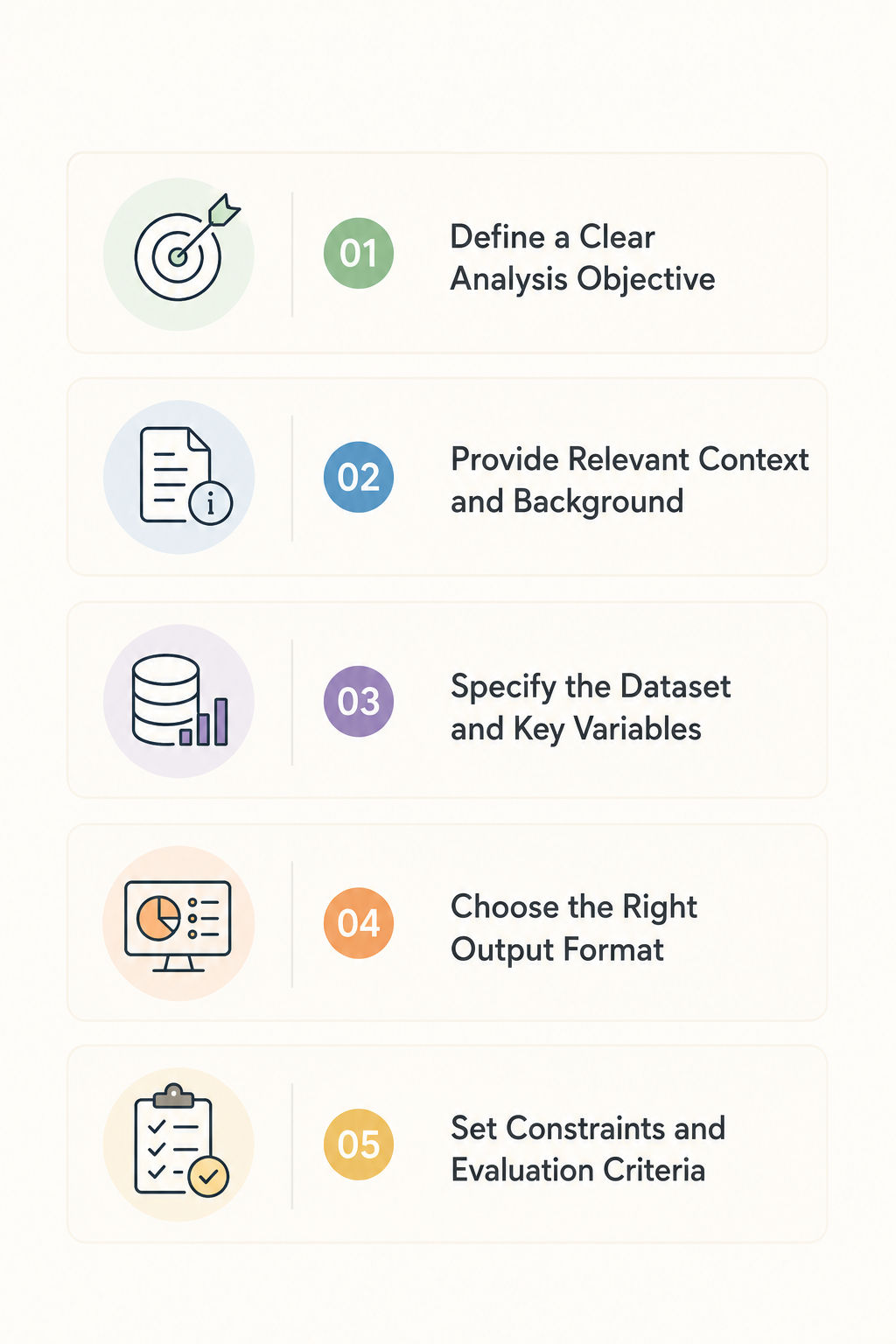
1. Defining the analysis objective
The first step is to state exactly what the analysis should be accomplished.
A clear objective helps AI: accomplish
- Focus on the right problem.
- Avoid unnecessary information.
- Deliver targeted insights.
- Improve response relevance.
Objectives may involve:
- Identifying trends.
- Comparing performance.
- Measuring growth.
- Detecting anomalies.
- Forecasting outcomes.
- Summarizing results.
Clearly defined objectives form the foundation of effective prompt engineering for data analysis.
2. Providing context and background
Context helps AI understand why the analysis is being performed.
Useful background information may include:
- Industry.
- Business function.
- Organizational goals.
- Reporting period.
- Business challenges.
- Existing performance benchmarks.
Adding context enables AI to:
- Produce more relevant insights.
- Prioritize important metrics.
- Generate recommendations aligned with business needs.
- Interpret data more accurately.
Without context, AI may provide technically correct but less useful responses.
3. Specifying the dataset or variables
AI performs better when prompts identify the specific data being analyzed.
Clearly mention:
- Dataset name.
- Columns or variables.
- Key performance indicators.
- Time periods.
- Categories.
- Geographic regions if applicable.
This allows AI to:
- Focus on relevant variables.
- Avoid assumptions.
- Produce more accurate comparisons.
- Generate consistent analytical outputs.
The more precise the dataset description, the better the results.
4. Choosing the desired output format
Specifying the expected output makes responses easier to understand and use.
Common output formats include:
- Bullet point summaries.
- Executive reports.
- Tables.
- Comparative analysis.
- Trend analysis.
- Recommendations.
- Key findings.
- Action plans.
Clearly defining the format helps AI organize information according to business requirements.
5. Adding constraints and evaluation criteria
Constraints guide AI by defining boundaries for the analysis.
Useful constraints include:
- Analyze only specific variables.
- Ignore incomplete records.
- Focus on quarterly performance.
- Limit recommendations to measurable actions.
- Rank findings by business impact.
Evaluation criteria may include:
- Accuracy.
- Relevance.
- Statistical significance.
- Business value.
- Clarity.
- Actionability.
Take your AI prompting skills further with Advanced Prompt Engineering Techniques for Better Results.
Best Prompt Engineering Techniques for Data Analysis
Different prompting techniques help AI solve different analytical problems. Choosing the right approach depends on the complexity of the task, the amount of available context, and the desired level of reasoning. Combining these techniques with prompt engineering for data analysis enables professionals to obtain more accurate, detailed, and reliable results.
1. Zero shot prompting
Zero shot prompting asks AI to complete a task without providing prior examples.
This technique is suitable when:
- The task is straightforward.
- The objective is clearly defined.
- The dataset is well described.
- The expected output is simple.
Benefits include:
- Faster prompt creation.
- Reduced preparation time.
- Flexible analytical tasks.
- Efficient exploratory analysis.
However, the prompt must still include sufficient context to avoid vague or incomplete responses.
2. Few shot prompting
Few shot prompting provides AI with a small number of reference examples before requesting analysis.
This technique helps AI:
- Understand expected response patterns.
- Maintain consistency.
- Produce structured outputs.
- Handle more complex analytical tasks.
Few shots prompting is particularly useful when organizations require standardized reports or recurring analytical formats.
3. Chain of Thought prompting
Chain of Thought prompting encourages AI to reason through a problem before presenting its final answer.
Instead of generating immediate conclusions, AI evaluates information in logical stages.
This technique supports:
- Complex analytical reasoning.
- Multi step calculations.
- Trend interpretation.
- Root cause analysis.
- Comparative evaluations.
Breaking the reasoning process into smaller steps often improves the quality and transparency of AI generated insights.
4. Role based prompting
Role based prompting instructs AI to respond from the perspective of a specific professional role.
Common analytical roles include:
- Business analyst.
- Data analyst.
- Financial analyst.
- Marketing analyst.
- Operations manager.
- Business intelligence consultant.
Assigning a role helps AI tailor its language, priorities, and recommendations to the intended audience, resulting in more relevant outputs.
5. Step by step analytical prompting
Step by step prompting divides complex analytical tasks into smaller and more manageable stages.
Rather than requesting everything in one instruction, the analysis progresses logically.
Typical stages include:
- Understanding the dataset.
- Identifying key variables.
- Detecting trends.
- Comparing performance.
- Summarizing findings.
- Providing recommendations.
Benefits include:
- Improved analytical accuracy.
- Better organization of results.
- Easier validation.
- Reduced risk of missing important insights.
- More transparent reasoning process.
For complex business problems, this approach is one of the most reliable techniques used in prompt engineering for data analysis, as it enables AI to build insights progressively instead of attempting to solve multiple analytical tasks at once.
Common Use Cases of Prompt Engineering in Data Analysis
The value of prompt engineering for data analysis extends across industries and business functions. Organizations use AI to process large volumes of information, identify patterns, and generate insights that support faster and more informed decisions.
When prompts clearly define objectives and expected outcomes, AI becomes a practical tool for solving a wide range of analytical challenges.
1. Business intelligence and reporting
Business intelligence teams use AI to transform raw data into reports that support strategic planning and operational improvements.
Common reporting tasks include:
- Summarizing business performance.
- Track key performance indicators.
- Comparing quarterly or annual results.
- Identifying growth opportunities.
- Highlighting business risks.
- Creating executive summaries.
- Preparing dashboard insights.
Using prompt engineering for data analysis helps ensure reports remain focused, consistent, and aligned with organizational goals.
2. Financial data analysis
Finance teams manage large datasets that require careful interpretation. AI can simplify this process when prompts clearly specify the required calculations and reporting criteria.
Common financial analysis tasks include:
- Revenue analysis.
- Expense tracking.
- Profitability assessment.
- Budget variance analysis.
- Cash flow reporting.
- Investment performance evaluation.
- Financial forecasting support.
Well-designed prompts also improve the clarity of financial summaries, making complex information easier for stakeholders to understand.
3. Marketing analytics
Marketing departments collect data from multiple digital channels, campaigns, and customer interactions. AI helps consolidate this information into meaningful insights.
Marketing teams commonly analyze:
- Campaign performance.
- Website traffic trends.
- Conversion rates.
- Customer acquisition metrics.
- Advertising effectiveness.
- Content engagement.
- Email marketing performance.
With effective prompt engineering for data analysis, AI can identify successful campaigns, highlight underperforming activities, and recommend areas for improvement.
4. Customer behavior analysis
Understanding customer behavior allows organizations to improve their products, services, and customer experiences.
AI can assist by analyzing:
- Customer purchase patterns.
- Browse behavior.
- Customer preferences.
- Feedback trends.
- Retention metrics.
- Churn indicators.
- Customer satisfaction levels.
Prompt engineering enables AI to organize customer insights into actionable findings that support retention strategies and personalized experiences.
5. Operational performance analysis
Operations teams rely on data to improve productivity, reduce costs, and streamline business processes.
AI can evaluate operational data by examining:
- Resource utilization.
- Production efficiency.
- Delivery performance.
- Inventory management.
- Process bottlenecks.
- Workforce productivity.
- Quality metrics.
Discover how AI can improve marketing workflows in Prompt Engineering for SEO and Digital Marketing Teams.
Best Practices for Writing Data Analysis Prompts
Creating effective prompts requires more than asking clear questions. The best prompts provide direction, context, and measurable expectations that help AI produce reliable analytical results.
Following proven practices improve both the quality and consistency of AI generated insights.
1. Be specific with objectives
Clearly defining the purpose of the analysis helps AI focus on the most relevant information.
Instead of broad requests, specify:
- The business question.
- Required metrics.
- Desired comparisons.
- Expected conclusions.
- Decision making goals.
Specific objectives reduce ambiguity and improve response quality.
2. Provide sufficient context
Context helps AI interpret data more accurately.
Useful contextual information includes:
- Business domain.
- Industry.
- Reporting period.
- Dataset purpose.
- Business priorities.
- Performance expectations.
Adding context also helps AI generate recommendations that are relevant to organizational objectives rather than generic observations.
3. Break complex tasks into smaller prompts
Large analytical requests often produce inconsistent or incomplete outputs.
Dividing work into smaller tasks allows AI to:
- Focus on one objective at a time.
- Produce more detailed analysis.
- Reduce errors.
- Improve logical flow.
- Simplify validation.
Breaking the analysis into manageable stages is a core practice in prompt engineering for data analysis.
4. Ask AI to explain its reasoning
Understanding how AI reaches its conclusions improves transparency and supports better decision making.
Requesting reasoning enables users to:
- Review the analytical process.
- Verify assumptions.
- Identify missing variables.
- Evaluate logical consistency.
- Improve confidence in the results.
Reasoning also makes it easier to refine prompts when responses require additional detail.
5. Verify AI generated outputs with source data
AI should support data analysis rather than replace human judgment.
Always validate important findings by:
- Comparing outputs with the original dataset.
- Checking numerical accuracy.
- Reviewing calculations.
- Confirming statistical results.
- Verifying business assumptions.
- Consulting subject matter experts when required.
Explore Data Science Courses with Certification Online to build in demand data skills.
Prompt Engineering for Different Types of Data
Different datasets require different prompting strategies. Adjusting prompts according to the nature of the data helps AI generate more accurate and meaningful insights.
Understanding these differences is an important part of prompt engineering for data analysis.
Structured data
Structured data is organized into predefined rows and columns, making it easier for AI to analyze relationships and numerical patterns.
Common sources include:
- Spreadsheets.
- Databases.
- Sales records.
- Financial reports.
- CRM systems.
- ERP platforms.
When working with structured data, prompts should clearly specify:
- Variables to analyze.
- Time period.
- Performance metrics.
- Required calculations.
- Desired output format.
Clear instructions help AI produce focused and measurable insights.
Unstructured text data
Unstructured data does not follow a fixed format and often consists of large volumes of text.
Examples include:
- Customer reviews.
- Emails.
- Support tickets.
- Research reports.
- Social media posts.
- Internal documents.
Prompts should guide AI to:
- Identify recurring themes.
- Detect sentiment.
- Summarize key findings.
- Categorize information.
- Highlight emerging trends.
Providing sufficient context improves the quality of text-based analysis.
Time series data
Time series data tracks changes over regular intervals and is widely used for forecasting and trend analysis.
Typical datasets include:
- Monthly sales.
- Website traffic.
- Stock prices.
- Production output.
- Customer growth.
- Seasonal demand.
Prompts should specify:
- Time period.
- Comparison of intervals.
- Growth calculations.
- Seasonal trends.
- Forecasting objectives.
- Significant anomalies.
This enables AI to recognize meaningful patterns over time.
Survey and customer feedback data
Organizations collect customer opinions to improve products, services, and overall customer experience.
AI can analyze feedback by:
- Grouping similar responses.
- Identifying satisfaction drivers.
- Detect recurring complaints.
- Measuring sentiment.
- Highlighting improvement opportunities.
- Summarizing open-ended responses.
Effective prompts ensure AI focuses on actionable insights rather than simply summarizing responses.
Conclusion
Prompt engineering for data analysis helps AI deliver more accurate, relevant, and actionable insights by providing clear instructions and context. It is ideal for data analysts, business professionals, marketers, finance teams, and anyone using AI for reporting and decision making. However, AI-generated insights should always be validated against source data. The key to success is writing specific, well-structured prompts that align with the analysis objective.
Contact our upGrad KnowledgeHut experts for personalized guidance on choosing the right course, career path, and certification to achieve your goals.
Frequently Asked Questions (FAQs)
What is prompt engineering for data analysis?
Prompt engineering for data analysis is the process of writing clear and structured instructions that help AI analyze data, identify patterns, and generate meaningful insights. Well-designed prompts improve the accuracy, relevance, and consistency of AI generated results.
How does prompt engineering improve data analysis?
Prompt engineering improves data analysis by helping AI understand the objective, dataset, and expected output. This leads to more focused insights, fewer errors, and faster decision making while reducing the need for repeated prompt revisions.
What are the best prompts for data analysis?
The best prompts clearly define the analysis objective, provide relevant context, specify the dataset, and mention the desired output format. Including constraints and success criteria helps AI generate more accurate and actionable insights.
How can ChatGPT analyze datasets?
ChatGPT can analyze structured and unstructured datasets by identifying trends, summarizing information, comparing performance, and answering analytical questions. It works best when the prompt includes sufficient context and details about the data.
What prompt engineering techniques are used in analytics?
Common prompt engineering techniques include Zero shot prompting, few shot prompting, Chain of Thought prompting, Role based prompting, Step by Step prompting, and Fan out querying. Each technique improves AI performance depending on the complexity of the analysis.
Can AI generate insights from Excel and CSV files?
Yes. AI can analyze Excel and CSV files to summarize data, identify trends, compare metrics, and generate reports. Clear prompts that describe the dataset and analysis objective help produce more reliable results.
How to write prompts for business intelligence?
Business intelligence prompts should include the business objective, key performance indicators, reporting period, and preferred output format. This helps AI generate insights that support strategic planning and operational decision making.
How to create prompts for different types of datasets?
The prompt should be tailored to the dataset type, whether it is structured, unstructured, time series, or customer feedback data. Including relevant variables, context, and analytical goals ensures more accurate AI generated insights.
What are examples of prompts for data visualization?
Data visualization prompts can ask AI to recommend suitable charts, summarize trends, compare categories, or explain visual patterns. Specifying the dataset and the message to communicate helps AI suggest the most appropriate visualization.
Which AI tools support prompt-based analytics?
Many AI tools support prompt-based analytics, including ChatGPT, Microsoft Copilot, Google Gemini, Claude, and Perplexity. These tools can assist with data interpretation, reporting, forecasting, and business intelligence when provided with well-structured prompts.
1639 articles published
KnowledgeHut is an outcome-focused global ed-tech company. We help organizations and professionals unlock excellence through skills development. We offer training solutions under the people and proces...
Get Free Consultation
By submitting, I accept the T&C and
Privacy Policy