
- Blog Categories
- Project Management
- Agile Management
- IT Service Management
- Cloud Computing
- Business Management
- BI And Visualisation
- Quality Management
- Cyber Security
- DevOps
- Most Popular Blogs
- PMP Exam Schedule for 2025: Check PMP Exam Date
- Top 60+ PMP Exam Questions and Answers for 2025
- PMP Cheat Sheet and PMP Formulas To Use in 2025
- What is PMP Process? A Complete List of 49 Processes of PMP
- Top 15+ Project Management Case Studies with Examples 2025
- Top Picks by Authors
- Top 170 Project Management Research Topics
- What is Effective Communication: Definition
- How to Create a Project Plan in Excel in 2025?
- PMP Certification Exam Eligibility in 2025 [A Complete Checklist]
- PMP Certification Fees - All Aspects of PMP Certification Fee
- Most Popular Blogs
- CSM vs PSM: Which Certification to Choose in 2025?
- How Much Does Scrum Master Certification Cost in 2025?
- CSPO vs PSPO Certification: What to Choose in 2025?
- 8 Best Scrum Master Certifications to Pursue in 2025
- Safe Agilist Exam: A Complete Study Guide 2025
- Top Picks by Authors
- SAFe vs Agile: Difference Between Scaled Agile and Agile
- Top 21 Scrum Best Practices for Efficient Agile Workflow
- 30 User Story Examples and Templates to Use in 2025
- State of Agile: Things You Need to Know
- Top 24 Career Benefits of a Certifed Scrum Master
- Most Popular Blogs
- ITIL Certification Cost in 2025 [Exam Fee & Other Expenses]
- Top 17 Required Skills for System Administrator in 2025
- How Effective Is Itil Certification for a Job Switch?
- IT Service Management (ITSM) Role and Responsibilities
- Top 25 Service Based Companies in India in 2025
- Top Picks by Authors
- What is Escalation Matrix & How Does It Work? [Types, Process]
- ITIL Service Operation: Phases, Functions, Best Practices
- 10 Best Facility Management Software in 2025
- What is Service Request Management in ITIL? Example, Steps, Tips
- An Introduction To ITIL® Exam
- Most Popular Blogs
- A Complete AWS Cheat Sheet: Important Topics Covered
- Top AWS Solution Architect Projects in 2025
- 15 Best Azure Certifications 2025: Which one to Choose?
- Top 22 Cloud Computing Project Ideas in 2025 [Source Code]
- How to Become an Azure Data Engineer? 2025 Roadmap
- Top Picks by Authors
- Top 40 IoT Project Ideas and Topics in 2025 [Source Code]
- The Future of AWS: Top Trends & Predictions in 2025
- AWS Solutions Architect vs AWS Developer [Key Differences]
- Top 20 Azure Data Engineering Projects in 2025 [Source Code]
- 25 Best Cloud Computing Tools in 2025
- Most Popular Blogs
- Company Analysis Report: Examples, Templates, Components
- 400 Trending Business Management Research Topics
- Business Analysis Body of Knowledge (BABOK): Guide
- ECBA Certification: Is it Worth it?
- Top Picks by Authors
- Top 20 Business Analytics Project in 2025 [With Source Code]
- ECBA Certification Cost Across Countries
- Top 9 Free Business Requirements Document (BRD) Templates
- Business Analyst Job Description in 2025 [Key Responsibility]
- Business Analysis Framework: Elements, Process, Techniques
- Most Popular Blogs
- Best Career options after BA [2025]
- Top Career Options after BCom to Know in 2025
- Top 10 Power Bi Books of 2025 [Beginners to Experienced]
- Power BI Skills in Demand: How to Stand Out in the Job Market
- Top 15 Power BI Project Ideas
- Top Picks by Authors
- 10 Limitations of Power BI: You Must Know in 2025
- Top 45 Career Options After BBA in 2025 [With Salary]
- Top Power BI Dashboard Templates of 2025
- What is Power BI Used For - Practical Applications Of Power BI
- SSRS Vs Power BI - What are the Key Differences?
- Most Popular Blogs
- Data Collection Plan For Six Sigma: How to Create One?
- Quality Engineer Resume for 2025 [Examples + Tips]
- 20 Best Quality Management Certifications That Pay Well in 2025
- Six Sigma in Operations Management [A Brief Introduction]
- Top Picks by Authors
- Six Sigma Green Belt vs PMP: What's the Difference
- Quality Management: Definition, Importance, Components
- Adding Green Belt Certifications to Your Resume
- Six Sigma Green Belt in Healthcare: Concepts, Benefits and Examples
- Most Popular Blogs
- Latest CISSP Exam Dumps of 2025 [Free CISSP Dumps]
- CISSP vs Security+ Certifications: Which is Best in 2025?
- Best CISSP Study Guides for 2025 + CISSP Study Plan
- How to Become an Ethical Hacker in 2025?
- Top Picks by Authors
- CISSP vs Master's Degree: Which One to Choose in 2025?
- CISSP Endorsement Process: Requirements & Example
- OSCP vs CISSP | Top Cybersecurity Certifications
- How to Pass the CISSP Exam on Your 1st Attempt in 2025?
- Most Popular Blogs
- Top 7 Kubernetes Certifications in 2025
- Kubernetes Pods: Types, Examples, Best Practices
- DevOps Methodologies: Practices & Principles
- Docker Image Commands
- Top Picks by Authors
- Best DevOps Certifications in 2025
- 20 Best Automation Tools for DevOps
- Top 20 DevOps Projects of 2025
- OS for Docker: Features, Factors and Tips
- More
- Agile & PMP Practice Tests
- Agile Testing
- Agile Scrum Practice Exam
- CAPM Practice Test
- PRINCE2 Foundation Exam
- PMP Practice Exam
- Cloud Related Practice Test
- Azure Infrastructure Solutions
- AWS Solutions Architect
- IT Related Pratice Test
- ITIL Practice Test
- Devops Practice Test
- TOGAF® Practice Test
- Other Practice Test
- Oracle Primavera P6 V8
- MS Project Practice Test
- Project Management & Agile
- Project Management Interview Questions
- Release Train Engineer Interview Questions
- Agile Coach Interview Questions
- Scrum Interview Questions
- IT Project Manager Interview Questions
- Cloud & Data
- Azure Databricks Interview Questions
- AWS architect Interview Questions
- Cloud Computing Interview Questions
- AWS Interview Questions
- Kubernetes Interview Questions
- Web Development
- CSS3 Free Course with Certificates
- Basics of Spring Core and MVC
- Javascript Free Course with Certificate
- React Free Course with Certificate
- Node JS Free Certification Course
- Data Science
- Python Machine Learning Course
- Python for Data Science Free Course
- NLP Free Course with Certificate
- Data Analysis Using SQL
- Home
- Blog
- Data Science
- 9 Best Vibe Coding Tools in 2026 to Build Apps Faster
9 Best Vibe Coding Tools in 2026 to Build Apps Faster
Updated on Oct 14, 2026 | 396 views
Share:
Table of Contents
View all
Quick Overview
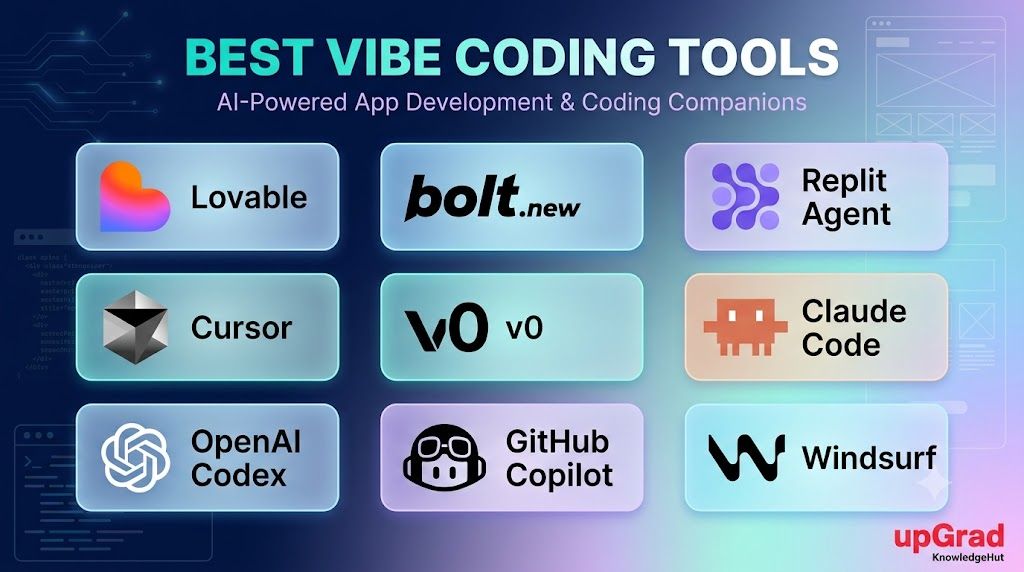
- The 9 best vibe coding tools in 2026 are Lovable, Bolt.new, Replit Agent, Cursor, v0, Claude Code, OpenAI Codex, GitHub Copilot, and Windsurf.
- Lovable, Bolt.new, and Replit Agent are suitable for beginners who want to build apps with prompts.
- Cursor, Claude Code, Windsurf, GitHub Copilot, and OpenAI Codex help professional developers with coding, debugging, and existing codebases.
- Compare tools based on your project needs, pricing, code access, integrations, security, and deployment requirements.
- This guide covers the best vibe coding tools for beginners, professional developers, and web app development, along with the key factors to consider before choosing one.
Want to go beyond using AI coding tools and learn how to build autonomous AI systems? Explore the Applied Agentic AI Certification Course by upGrad KnowledgeHut to gain hands-on experience with AI agents, multi-agent systems, and real-world AI applications.
What are the 9 best vibe coding tools in 2026?
The top vibe coding tools for 2026 include Lovable, Bolt.new, Replit Agent, Cursor, v0, Claude Code, OpenAI Codex, GitHub Copilot, and Windsurf. Some of them are used in developing applications using prompts, while some help coders in writing, debugging, and code management.
Tool |
Best for |
Main category |
| Lovable | Building full-stack web apps from prompts | AI app builder |
| Bolt.new | Rapid web app prototyping | Browser-based app builder |
| Replit Agent | Building, testing, and deploying apps in one environment | AI development platform |
| Cursor | Editing and developing existing codebases | AI code editor |
| v0 | Generating polished web interfaces | UI and app builder |
| Claude Code | Complex coding tasks and repository changes | Terminal-based coding agent |
| OpenAI Codex | Delegating coding tasks to AI agents | Coding agent |
| GitHub Copilot | Everyday coding assistance | AI coding assistant |
| Windsurf | AI-assisted coding in a development environment | AI IDE |
Also Read: What is Vibe Coding?
1. Lovable: Best for building full-stack web apps
Lovable is one of the most beginner friendly vibe coding tools currently available in the market. After describing the idea in a prompt, it generates a complete application with frontend, backend, database, and authentication integration.
Key features of Lovable:
- Full-stack application generation
- GitHub integration
- Backend support
- Visual editing options
Best for: Founders, entrepreneurs, and non-technical users who want to launch web applications quickly.
2. Bolt.new: Best for rapid prototyping
Bolt.new helps in creating and modifying web applications through natural language prompts within an hour directly in the browser. It is mainly used where speed is the focus point. It works well when testing a new product idea, creating a demo, or building a first version of a website.
Key features of Bolt.new:
- Browser-based development
- Fast application generation
- Instant previews
- Quick deployment options
Best for: Startups, designers and creators who need to validate their idea rapidly.
3. Replit Agent: Best for building and deploying in one place
It is possible to conduct coding, testing, collaboration, and deployment of software in one place with the help of Replit. The Replit agent creates projects based on prompts and allows users to develop and deploy applications in one application.
Key features of Replit:
- Built-in hosting
- AI-powered coding assistant
- Team collaboration
- Multi-language support
Best for: Beginners and developers who want an integrated development environment.
4. Cursor: Best for developers working with existing code
Cursor is one of the most popular vibe coding tools among developers as it helps developers in understanding, writing and modifying code. Its main strength is context, through which it suggests changes across files, explains unfamiliar code, and assists in debugging.
Key features of Cursor:
- Codebase-aware AI assistance
- Refactoring support
- Bug fixing
- Multi-file editing
Best for: Developers who are working on large-scale projects.
5. v0: Best for AI-generated user interfaces
v0 is mainly used for developing the front end of the application. You can use the platform to create high-quality UI components through prompts. This AI agent is used for creating front ends and dashboards.
Key features of v0:
- React-based UI generation
- Design system support
- Fast frontend creation
- Component customization
Best for: Frontend developers and designers.
Also Read: How Marketers Can Use Vibe Coding to Build Tools and Automations
6. Claude Code: Best for complex coding tasks
The Claude Code is an AI coding assistant that can interact with the project by reviewing the files and modifying them in a terminal process. The platform works on repositories and is useful for complex processes like analyzing the existing code base, modification of several files, or debugging a software problem.
Key features of Claude Code:
- Repository-wide understanding
- Advanced code generation
- Terminal-based workflows
- Comprehensive debugging assistance
Best for: Experienced developers who are working on large-scale applications.
7. OpenAI Codex: Best for delegating coding tasks
OpenAI Codex allows programmers to delegate programming tasks to AI assistants. The assistant can write code, make updates, and automate routine development.
Key features of OpenAI Codex:
- Task delegation
- Code generation
- Automated workflows
- Natural language instructions
Best for: Programmers who need to automate routine coding.
8. GitHub Copilot: Best for everyday coding assistance
GitHub Copilot helps developers with code suggestions, explanations, chat-based assistance, and other AI-powered features in its supported development environments. It can help in generating repetitive code, understanding unknown functions and fixing programming problems.
Key features of GitHub Copilot:
- Code suggestions
- Auto-completion
- Documentation assistance
- Integration with popular IDEs
Best for: Programmers who code every day.
9. Windsurf: Best for AI-assisted IDE workflows
The Windsurf tool is an AI development environment where developers can work on code and tasks through the use of AI agents. Its workflow consists of project-aware coding and interaction with agents and lets users shift from understanding code to modifying and refining it.
Key features of Windsurf:
- AI-driven workflows
- Context-aware suggestions
- Repository understanding
- Multi-file project support
Best for: Professional programmers looking for AI-powered development environments.
Interested in using AI to build products that meet real user needs? Discover the AI-Powered Product Management Certification with Microsoft and learn to bring AI-powered product ideas to life.
Best vibe coding tools for beginners
For beginners, Lovable, Bolt.new, and Replit Agent will be the most convenient since they allow users to develop applications using single prompts rather than writing complex code.
1. Lovable
Good for beginners who want to build complete web apps without any code. Lovable can create full-stack applications, including building the user interface, databases, and authentication systems, from natural language prompts.
2. Bolt.new
Good for beginners who are interested in validating their ideas fast. Bolt.new is an IDE that specializes in developing ideas fast through rapid prototyping via browser-based development tools.
3. Replit Agent
Best for beginners who want to learn while building. Replit Agent is a platform that helps you to code, develop, test, and deploy applications while learning the whole development process.
Also Read: 8 Best Vibe Coding Tools of 2026
Best vibe coding tools for professional developers
For professionals, Cursor, Claude Code, Windsurf, GitHub Copilot, and OpenAI Codex would be better choices since they offer more control over codebases and debugging processes.
1. Cursor
Recommended for programmers who work on existing source codes. Cursor is perfect for debugging, refactoring and changing several files at once due to its understanding of the project context.
2. Claude Code
Best for handling complex programming tasks. Claude Code can analyze big code repositories, provide help with architecture decisions and change several files at once. This tool can help programmers with complex development tasks.
3. Windsurf
Best for AI-based development processes. Windsurf provides the developer with the IDE-like environment that uses AI to generate code, review changes and manage projects.
4. GitHub Copilot
Recommended for general coding assistance. GitHub Copilot suggests code in real time, provides autocomplete suggestions, and helps with code documentation.
5. OpenAI Codex
Best for delegation of coding tasks to AI. OpenAI Codex can generate code, implement features and automate routine development tasks based on natural language requests.
Also Read: Best AI Tools for Vibe Coding Beginners and Professionals
Best vibe coding tools for building web apps
In case the objective is to build web applications, Lovable, Bolt.new, Replit Agent, and v0 would be great tools to use.
1. Lovable
Good for building full stack web applications. Lovable is capable of generating frontend interfaces, backend logic, databases, and even an authentication system using prompts, thus being perfect for transforming ideas into ready-to-use web applications.
2. Bolt.new
Good for creating MVPs and prototypes very quickly. Bolt.new places the emphasis on speed and allows users to create web applications using a browser without having to configure any additional settings.
3. Replit Agent
Best at developing web applications in one place. Replit Agent is best used when the user wants to develop, test, host, and deploy their web applications in one place.
4. v0
Best at creating modern web interfaces. v0 is best at creating frontend web development prompts and React components from prompts.
Ready to make AI work more effectively for your app development projects? Discover the Generative AI and Prompt Engineering Course for Professionals and learn to create clearer, more effective prompts.
Things to consider when selecting a vibe coding app
The perfect tool is not necessarily the one which creates the application faster. Below are the factors to consider:
1. Pricing and limitations: See if the free package will work for your project. There may be certain limitations with regards to usage, premium functionalities, and deployment. Look at the paid packages and possible usage fees before beginning your big project.
2. Access to code and exporting: Find out if you can access and export the generated code. You might need the flexibility to change the platform for your project, or use a team to continue development.
3. Integrations and back-end development: See if there is support for databases, authentication, API, and other services needed for your app. Not all platforms work well with all aspects of the app development process.
4. Security and testing: How do you test the app, inspect the code, manage secrets, and user permissions? AI code should never be used without verification.
5. Maintenance and scalability: The app should not only have the first iteration but be maintained in the long run.
Also Read: Vibe Coding for Startups: Build MVPs Faster with AI
Conclusion
Choosing the right vibe coding tool depends on what you want to build and how much control you need over the code. Lovable and Bolt.new are practical choices for creating app prototypes, while Replit Agent helps combine development and deployment in one environment.
Developers working with existing code can consider Cursor, Claude Code, or GitHub Copilot. Before committing to a platform, check its pricing, integrations, code export options, and security features. Start with a small project to test whether the tool meets your needs before building a larger application.
Have A Query? Get in Touch With Our Customer Support | upGrad KnowledgeHut
Frequently Asked Questions (FAQs)
1. What is the difference between vibe coding tools and AI coding assistants?
Vibe coding tools let users build applications by describing what they want in natural language, while AI coding assistants help developers write, explain, debug, and improve code. Tools like Lovable and Bolt.new focus on app creation, whereas GitHub Copilot and Cursor support coding workflows. Some tools offer both capabilities.
2. Can I build an app without coding experience?
Yes, you can build a basic app without coding experience using tools such as Lovable, Bolt.new, or Replit Agent. Describe your idea, review the generated app, and request changes through prompts. However, complex features, integrations, debugging, and security checks may require programming knowledge or help from a developer.
3. Is Lovable good for beginners? Can Lovable build a full-stack app?
Yes, Lovable is suitable for beginners because it lets users create web applications using natural-language prompts. It can support full-stack development, including user interfaces, database integrations, and authentication workflows. However, you must configure and test backend functionality, permissions, and integrations before launching the application.
4. Which vibe coding tools are best for mobile apps?
For mobile app development, consider Replit Agent for web-based applications and prototypes, or tools such as FlutterFlow for building mobile apps with visual and AI-assisted workflows. The right choice depends on whether you need a native Android or iOS app, a cross-platform app, or a mobile-friendly website. Verify native build and publishing support before choosing.
5. Which vibe coding tools are best for enterprise development?
Cursor, GitHub Copilot, Claude Code, and OpenAI Codex are worth evaluating for enterprise development because they support coding workflows, repository changes, or delegated development tasks. Enterprise teams should compare access controls, data handling, integrations, auditability, and administrative features. Confirm that the selected plan meets the organization's security and compliance requirements.
6. How do you secure an AI-generated application?
Review the generated code for vulnerabilities, validate user inputs, and enforce authentication and authorization on the server. Protect API keys and database credentials, check dependencies, and configure database permissions correctly. Before deployment, run automated security tests, review access controls, and test the application for common vulnerabilities.
7. Which is better for vibe coding: Cursor or Lovable?
Lovable is better suited to creating web applications from prompts, particularly for beginners and founders who want to build an MVP quickly. Cursor is better for developers who need to edit existing code, understand repositories, and control implementation details. Choose Lovable for prompt-driven app creation and Cursor for code-focused development.
8. Do vibe coding tools replace software developers?
No, vibe coding tools assist developers but do not fully replace their work. They can generate code, create prototypes, and automate repetitive tasks, but people still need to review architecture, fix bugs, test functionality, and protect application data. Complex software projects also require ongoing maintenance and technical decision-making.
9. Which AI coding tool generates the best code?
Cursor is a strong choice for generating and refining code in existing projects, while Claude Code and OpenAI Codex are useful for complex coding tasks. The best option depends on your programming language, project requirements, and how well the generated code passes testing.
10. Which vibe coding tool is best for startups and MVPs?
Lovable is a strong choice for startups and MVPs because it helps users build web applications from natural-language prompts without writing all the code manually. Bolt.new is another good option for rapid prototyping, while Replit Agent suits teams that want to build and deploy apps in one environment.
1648 articles published
KnowledgeHut is an outcome-focused global ed-tech company. We help organizations and professionals unlock excellence through skills development. We offer training solutions under the people and proces...
Get Free Consultation
By submitting, I accept the T&C and
Privacy Policy