
How Business Analysts Can Transition to Product Owner with CSPO
Updated on Jul 28, 2026 | 199 views
Share:
Table of Contents
View all
- Can a Business Analyst Become a Product Owner?
- Business Analyst vs Product Owner
- Why Now Is the Right Time to Transition from Business Analyst to Product Owner
- Why Business Analysts Already Have an Advantage
- Skills Business Analysts Need to Develop
- How Your Responsibilities Will Change
- How CSPO Helps Business Analysts Transition to Product Owner
- Step-by-Step Roadmap to Transition from BA to Product Owner
- Conclusion
Quick Overview
- Business Analysts can transition to Product Owner roles with CSPO certification by building on existing skills in requirements analysis, stakeholder management, and problem-solving while developing Agile product ownership expertise.
- CSPO certification helps bridge the gap with structured Agile training, backlog management skills, and stakeholder alignment techniques needed to move from analysing business needs to owning product strategy.
- With the right Agile knowledge and practical experience, Business Analysts can confidently transition into Product Owner roles and drive successful product delivery.
- This guide covers the key differences between BA and PO roles, essential skills to develop, and a step-by-step roadmap to become a Product Owner.
Build practical Product Ownership skills with upGrad KnowledgeHut CSPO Certification Training, covering Agile, backlog management, prioritisation, and stakeholder collaboration.
Master the Right Skills & Boost Your Career
Avail your free 1:1 mentorship session
Can a Business Analyst Become a Product Owner?
Yes, Business Analysts are in a great position to step into the Product Owner role, making the Business Analysts Transition to Product Owner a practical and achievable career move. Business Analysts already know how to understand business needs, manage stakeholders, and prioritize necessary tasks.
Having experience with business processes, writing user stories, and collaborating across teams makes the move to Product Owner a natural and smooth next step.
Agile teams need professionals capable of managing backlogs, working closely with key stakeholders, and bringing out maximum product value. This is one of the biggest reasons why the Business Analysts Transition to Product Owner is becoming increasingly common across Agile organizations.
Business Analysts can strengthen their expertise with upGrad KnowledgeHut CBAP Certification Training and build a stronger foundation for transitioning into Product Ownership.
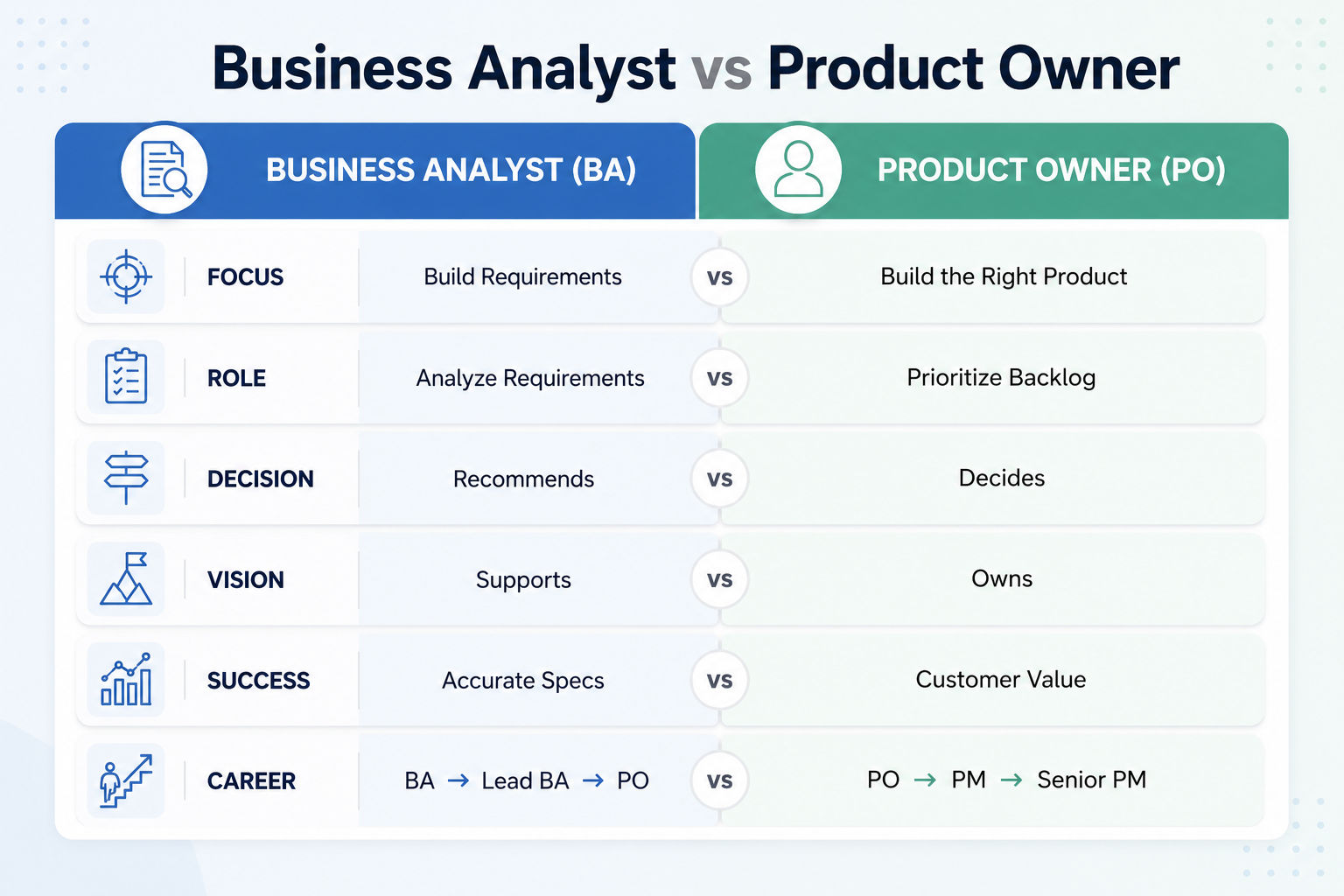
Business Analyst vs Product Owner
| Aspect | Business Analyst (BA) | Product Owner (PO) |
| Primary Focus | How to build requirements correctly | What to build next and why |
| Key Responsibility | Gathering and analyzing requirements | Managing and prioritizing the product backlog |
| Authority | Recommends solutions | Makes final product decisions |
| Product Vision | Supports the vision | Defines and owns the vision |
| Success Metric | Process efficiency and accurate specs | Product success, ROI, and customer value |
Career Progress |
Senior BA → Lead BA → Product Analyst → Product Owner | Product Owner → Product Manager → Senior Product Manager → Head of Product |
Also Read: Best Product Owner Certifications
Also Read: Career Benefits of CSPO Certification
Why Now Is the Right Time to Transition from Business Analyst to Product Owner
The role of a Product Owner is gaining relevance due to the increasing popularity of Agile and digital products.
Here are some of the main factors that make the current moment ideal to become a Product Owner:
- Increasing demand for Product Owners: Companies of different industries start using Agile and hiring Product Owners to manage customer-oriented development of products.
- Good background as a Business Analyst: The experience in stakeholder engagement, requirements analysis, and business problem solving correlates well with the duties of a Product Owner.
- Opportunity for better career development: Product Ownership allows developing a career of a Product Manager, Senior Product Manager, and Head of Product.
- Increased influence on the business: Product Owners create the vision of the product, set priorities, and create value rather than just work on the requirements.
- CSPO prepares for a career of a Product Owner: The CSPO certification provides the relevant skills and proves your readiness to be a Product Owner.
Why Business Analysts Already Have an Advantage
Business Analysts hold a massive head start when stepping into Product Ownership. Key transferable skills directly match daily Product Owner responsibilities.
These transferable skills make the Business Analysts Transition to Product Owner much easier than many professionals expect.
- Requirements gathering. Translates raw ideas into clear, actionable development specs.
- Stakeholder communication. Balances the needs of executives, users, and technical teams.
- User stories and acceptance criteria. Breaks complex epics into clear, defined user stories.
- Process mapping. Identifies workflow friction to prioritize high impact problems.
- Business value analysis. Evaluates feature ROI to keep backlogs focused on actual impact.
- Agile ceremonies. Navigates Scrum rituals like sprint planning and refinement with ease.
Also Read: Who should take CSPO Certification?
Skills Business Analysts Need to Develop
Transitioning from a Business Analyst to a Product Owner requires shifting from a requirements-focused mindset to a strategic, value-driven product approach.
Many Business Analyst skills are useful in this transition, but the following skills need extra focus and regular practice:
Decision-Making
Business Analysts usually present different options and recommendations. Product Owners need to make the final decision, especially when setting priorities.
How to practice: Lead backlog refinement meetings, suggest feature priorities during sprint planning, and clearly explain the reasons behind each decision. Making data-based recommendations regularly helps build confidence in product decision-making.
Product Thinking
Business Analysts often focus on collecting and delivering stakeholder requirements. Product Owners focus on solving customer problems and creating business value.
How to practice: For every new requirement, ask simple questions:
- Who will benefit from this?
- What problem does this solve?
- How will success be measured?
These questions help shift the focus from delivering features to delivering value.
Prioritization Frameworks
Product Owners often balance many requests while working with limited time and resources.
How to practice: Use prioritization methods such as MoSCoW, WSJF, or Value vs. Effort to organize requirements in current projects. Creating clear priority recommendations helps develop strong product-thinking skills, even without owning the product backlog.
Product Strategy
Product Owners need to understand how every feature supports long-term business goals.
How to practice: Take part in roadmap discussions, quarterly planning meetings, or product review sessions whenever possible. Connect requirements to business goals, KPIs, or OKRs to build a stronger strategic mindset.
Customer Discovery
Business Analysts often work mainly with internal stakeholders. Product Owners need a clear understanding of customer needs and challenges.
How to practice: Join customer calls, user interviews, product demos, and feedback sessions whenever possible. Hearing customer feedback directly helps validate ideas, understand pain points, and make better product decisions.
How Your Responsibilities Will Change
Moving from a position of a Business Analyst to a Product Owner involves a transition not into another profession but into a new role.
The shift occurs from the role of facilitating the process of product creation to one of making decisions about products and creating value for customers.
Requirements to Product Vision
A Business Analyst's main task is to understand business needs and write down requirements. A Product Owner's task includes defining the product vision and ensuring that all features contribute to meeting the business and customer needs.
Analysis to Prioritization
The role of a Business Analyst consists of analyzing requirements and offering a solution. However, the Product Owner prioritizes the product backlog according to the principle of customer value and business importance.
Stakeholders to Product Ownership
A Business Analyst works with stakeholders to get requirements. In contrast, a Product Owner balances customer needs and business executives' demands and makes final decisions regarding products.
Project Delivery to Business Success
A Business Analyst concentrates on providing accurate requirements for the successful delivery of the project. A Product Owner provides correct products, estimating success in terms of customer satisfaction and business and product outcomes.
Also Read: Product Owner vs Business Owner
How CSPO Helps Business Analysts Transition to Product Owner
CSPO helps Business Analysts move into Product Owner roles by building the skills needed to manage products in Agile teams. The certification covers Scrum fundamentals, product vision, roadmap planning, backlog management, release planning, stakeholder collaboration, customer-focused decision-making, and feature prioritization.
Instead of focusing only on gathering requirements, Business Analysts learn how to prioritize work, maximize product value, and make decisions that align with customer needs and business goals. These skills make the transition to Product Ownership much smoother.
CSPO also strengthens a resume by demonstrating formal training in Agile Product Ownership. It shows employers an understanding of backlog ownership, stakeholder management, product planning, and value-driven decision-making.
More importantly, the certification helps close common skill gaps by developing expertise in product vision, roadmap planning, backlog prioritization, customer value, and product strategy. Combined with existing Business Analysis experience, these skills provide a strong foundation for a successful transition into a Product Owner role.
What CSPO Doesn't Teach
CSPO builds an excellent foundation, but it is not a substitute for actually doing the job. No certification can fully teach real world product management experience, industry or domain expertise, leadership and influence built under pressure, or the kind of advanced product strategy instinct that only comes from years on the ground.
For example, a CSPO course can teach backlog prioritisation, but real product work requires learning which customer segment matters most, which product metrics to track, and how a specific business uses data to decide what gets built next. These are skills that grow with experience, not just classroom learning.
Does CSM Certification Help?
CSM Certification is genuinely useful for understanding Scrum practices, team collaboration, and Agile workflows. That said, for Business Analysts specifically aiming at Product Owner roles, CSPO is usually the better fit, since it focuses directly on product vision, backlog prioritization, stakeholder management, and delivering value to the customer.
Although CSPO is generally the preferred choice, both certifications can support the Business Analysts Transition to Product Owner depending on career goals.
Build the skills needed to transition into Product Ownership with upGrad KnowledgeHut Agile Management Courses, covering Scrum, CSPO, and other industry-recognized Agile certifications.
Step-by-Step Roadmap to Transition from BA to Product Owner
Moving from a Business Analyst to a Product Owner is really about shifting how you think and work. The Business Analysts Transition to Product Owner becomes much easier with a structured learning approach.
Here is a clear, step-by-step path to help you build the right skills and make the move.
Step 1: Master Agile Fundamentals
Learn Scrum by applying it to current projects rather than only studying theory. For example, join sprint planning and refinement sessions, understand how the backlog changes, and learn why certain stories move into a sprint while others wait.
Step 2: Earn a CSPO Certification
Use CSPO to build structured Product Owner knowledge and connect it with real work. After completing the course, apply concepts such as value-based prioritisation or product vision to an existing project instead of leaving them as certification notes.
Step 3: Shadow a Product Owner
Ask an experienced Product Owner to shadow backlog refinement, roadmap discussions, stakeholder meetings, or sprint planning. After each session, note how priorities were decided and compare those decisions with the approach used in Business Analysis.
Step 4: Take Ownership of a Small Backlog
Start with a small feature, workflow, or internal initiative rather than asking for ownership of an entire product. Offer to organise the backlog, refine stories, and prepare priorities for a small release.
Step 5: Practise Prioritisation
When several requirements compete for attention, create a simple Value vs. Effort comparison and share the recommendation with the Product Owner. For example, suggest delaying a low-impact feature when a smaller change could solve a bigger customer problem.
Step 6: Learn to Say “No” to Unplanned Work
Product Owners constantly balance new requests against existing priorities. Practise responding with, “Which current priority should move out if this needs to come in?” This builds the habit of protecting product goals instead of accepting every stakeholder request.
Step 7: Work with Customers
Ask to join customer calls, demos, support reviews, or user interviews. Start noting repeated pain points and turn them into potential product improvements rather than simply recording customer requirements.
Step 8: Build Product Thinking
For every new requirement, ask “What problem does this solve?” and “How will success be measured?” For example, instead of accepting a request for a new dashboard, identify whether the real problem is poor reporting, slow decision-making, or missing data.
Step 9: Apply Internally
Look for a chance to act as a proxy Product Owner for a small initiative. Take responsibility for prioritisation, stakeholder alignment, and backlog decisions while an experienced Product Owner provides guidance.
Step 10: Target Product Owner Roles
Update the resume with evidence of product ownership rather than only BA responsibilities. Highlight examples such as prioritising a backlog, influencing product decisions, working with customers, or delivering a measurable business outcome.
Conclusion
Transitioning from a Business Analyst to a Product Owner is a natural career move for professionals ready to take greater ownership of product decisions.
Existing BA skills in stakeholder management, requirements analysis, and problem-solving provide a strong starting point, while CSPO certification adds the Agile, backlog management, and prioritisation skills needed for the transition.
With hands-on experience, customer-focused thinking, and continuous learning, Business Analysts can build a strong path towards Product Owner and future product leadership roles.
Have A Query? Get in Touch With Our Customer Support | upGrad KnowledgeHut
Frequently Asked Questions (FAQs)
What types of projects help Business Analysts prepare for a Product Owner role?
Projects involving Agile development, digital products, mobile apps, SaaS platforms, or customer-facing solutions provide excellent exposure. Working on initiatives where you interact with stakeholders, prioritize features, or support product decisions can strengthen your transition.
How important is business knowledge for a Product Owner?
Business knowledge is one of a Product Owner's greatest strengths. Understanding customer needs, market trends, business goals, and revenue impact helps you prioritize the right features and make informed product decisions that create real value.
What tools do Business Analysts usually need to learn when they start working as Product Owners?
Backlog management tools like Jira, Azure DevOps, or Trello are the most common additions, since Product Owners spend a lot of time organizing and prioritizing work inside them. Most Business Analysts already have some exposure to these tools from Agile ceremonies, so it's rarely a steep learning curve. The bigger adjustment is using the tool to make ownership decisions, not just track tasks.
How is a Product Owner's performance typically measured compared to a Business Analyst's?
A Business Analyst is often judged on how accurate and complete the requirements documentation turns out to be. A Product Owner is judged on whether the product actually delivers value, things like user adoption, business impact, and whether the right features got built at the right time. It's a shift from measuring output to measuring outcome.
Does earning CSPO guarantee a Product Owner job right after certification?
No, and it's worth being upfront about that. CSPO builds the knowledge and vocabulary, but hiring managers still look for some form of hands-on exposure, even informal backlog work, alongside the certificate. It's best treated as a strong credibility booster rather than an automatic ticket to the role.
What other certifications pair well with CSPO for long term growth in a Product Owner career?
Certifications like Advanced CSPO, SAFe for Teams, or product management focused courses tend to build naturally on top of CSPO as a career progresses. Some Product Owners also pick up CSM later to better understand the ScrumMaster's side of the team. None of these are required early on, but they help once someone is a few years into the role.
What should Business Analysts learn after completing CSPO?
After earning a CSPO certification, focus on developing practical product management skills such as product discovery, roadmap planning, customer research, analytics, and prioritization frameworks. Hands-on experience is what ultimately prepares you for Product Owner roles.
Do Business Analysts need technical skills to become Product Owners?
Not necessarily. While a basic understanding of technology can help, Product Owners are primarily responsible for maximizing product value, understanding customer needs, and setting priorities rather than writing code or designing technical solutions.
Is Product Owner a good long-term career option for Business Analysts?
Yes. Product Ownership offers strong career growth and serves as a pathway to roles like Product Manager, Senior Product Manager, Group Product Manager, and Head of Product. As organizations continue adopting Agile, demand for skilled Product Owners remains high.
Why do employers prefer Business Analysts for Product Owner positions?
Business Analysts already understand how to gather requirements, communicate with stakeholders, and solve business problems. When combined with Agile knowledge and a CSPO certification, these transferable skills make them well-equipped to take ownership of product strategy and value delivery.
1639 articles published
KnowledgeHut is an outcome-focused global ed-tech company. We help organizations and professionals unlock excellence through skills development. We offer training solutions under the people and proces...
Get Free Consultation
By submitting, I accept the T&C and
Privacy Policy
Ready to learn about Agile Certifications Roadmap?