
- Blog Categories
- Project Management
- Agile Management
- IT Service Management
- Cloud Computing
- Business Management
- BI And Visualisation
- Quality Management
- Cyber Security
- DevOps
- Most Popular Blogs
- PMP Exam Schedule for 2025: Check PMP Exam Date
- Top 60+ PMP Exam Questions and Answers for 2025
- PMP Cheat Sheet and PMP Formulas To Use in 2025
- What is PMP Process? A Complete List of 49 Processes of PMP
- Top 15+ Project Management Case Studies with Examples 2025
- Top Picks by Authors
- Top 170 Project Management Research Topics
- What is Effective Communication: Definition
- How to Create a Project Plan in Excel in 2025?
- PMP Certification Exam Eligibility in 2025 [A Complete Checklist]
- PMP Certification Fees - All Aspects of PMP Certification Fee
- Most Popular Blogs
- CSM vs PSM: Which Certification to Choose in 2025?
- How Much Does Scrum Master Certification Cost in 2025?
- CSPO vs PSPO Certification: What to Choose in 2025?
- 8 Best Scrum Master Certifications to Pursue in 2025
- Safe Agilist Exam: A Complete Study Guide 2025
- Top Picks by Authors
- SAFe vs Agile: Difference Between Scaled Agile and Agile
- Top 21 Scrum Best Practices for Efficient Agile Workflow
- 30 User Story Examples and Templates to Use in 2025
- State of Agile: Things You Need to Know
- Top 24 Career Benefits of a Certifed Scrum Master
- Most Popular Blogs
- ITIL Certification Cost in 2025 [Exam Fee & Other Expenses]
- Top 17 Required Skills for System Administrator in 2025
- How Effective Is Itil Certification for a Job Switch?
- IT Service Management (ITSM) Role and Responsibilities
- Top 25 Service Based Companies in India in 2025
- Top Picks by Authors
- What is Escalation Matrix & How Does It Work? [Types, Process]
- ITIL Service Operation: Phases, Functions, Best Practices
- 10 Best Facility Management Software in 2025
- What is Service Request Management in ITIL? Example, Steps, Tips
- An Introduction To ITIL® Exam
- Most Popular Blogs
- A Complete AWS Cheat Sheet: Important Topics Covered
- Top AWS Solution Architect Projects in 2025
- 15 Best Azure Certifications 2025: Which one to Choose?
- Top 22 Cloud Computing Project Ideas in 2025 [Source Code]
- How to Become an Azure Data Engineer? 2025 Roadmap
- Top Picks by Authors
- Top 40 IoT Project Ideas and Topics in 2025 [Source Code]
- The Future of AWS: Top Trends & Predictions in 2025
- AWS Solutions Architect vs AWS Developer [Key Differences]
- Top 20 Azure Data Engineering Projects in 2025 [Source Code]
- 25 Best Cloud Computing Tools in 2025
- Most Popular Blogs
- Company Analysis Report: Examples, Templates, Components
- 400 Trending Business Management Research Topics
- Business Analysis Body of Knowledge (BABOK): Guide
- ECBA Certification: Is it Worth it?
- Top Picks by Authors
- Top 20 Business Analytics Project in 2025 [With Source Code]
- ECBA Certification Cost Across Countries
- Top 9 Free Business Requirements Document (BRD) Templates
- Business Analyst Job Description in 2025 [Key Responsibility]
- Business Analysis Framework: Elements, Process, Techniques
- Most Popular Blogs
- Best Career options after BA [2025]
- Top Career Options after BCom to Know in 2025
- Top 10 Power Bi Books of 2025 [Beginners to Experienced]
- Power BI Skills in Demand: How to Stand Out in the Job Market
- Top 15 Power BI Project Ideas
- Top Picks by Authors
- 10 Limitations of Power BI: You Must Know in 2025
- Top 45 Career Options After BBA in 2025 [With Salary]
- Top Power BI Dashboard Templates of 2025
- What is Power BI Used For - Practical Applications Of Power BI
- SSRS Vs Power BI - What are the Key Differences?
- Most Popular Blogs
- Data Collection Plan For Six Sigma: How to Create One?
- Quality Engineer Resume for 2025 [Examples + Tips]
- 20 Best Quality Management Certifications That Pay Well in 2025
- Six Sigma in Operations Management [A Brief Introduction]
- Top Picks by Authors
- Six Sigma Green Belt vs PMP: What's the Difference
- Quality Management: Definition, Importance, Components
- Adding Green Belt Certifications to Your Resume
- Six Sigma Green Belt in Healthcare: Concepts, Benefits and Examples
- Most Popular Blogs
- Latest CISSP Exam Dumps of 2025 [Free CISSP Dumps]
- CISSP vs Security+ Certifications: Which is Best in 2025?
- Best CISSP Study Guides for 2025 + CISSP Study Plan
- How to Become an Ethical Hacker in 2025?
- Top Picks by Authors
- CISSP vs Master's Degree: Which One to Choose in 2025?
- CISSP Endorsement Process: Requirements & Example
- OSCP vs CISSP | Top Cybersecurity Certifications
- How to Pass the CISSP Exam on Your 1st Attempt in 2025?
- Most Popular Blogs
- Top 7 Kubernetes Certifications in 2025
- Kubernetes Pods: Types, Examples, Best Practices
- DevOps Methodologies: Practices & Principles
- Docker Image Commands
- Top Picks by Authors
- Best DevOps Certifications in 2025
- 20 Best Automation Tools for DevOps
- Top 20 DevOps Projects of 2025
- OS for Docker: Features, Factors and Tips
- More
- Agile & PMP Practice Tests
- Agile Testing
- Agile Scrum Practice Exam
- CAPM Practice Test
- PRINCE2 Foundation Exam
- PMP Practice Exam
- Cloud Related Practice Test
- Azure Infrastructure Solutions
- AWS Solutions Architect
- IT Related Pratice Test
- ITIL Practice Test
- Devops Practice Test
- TOGAF® Practice Test
- Other Practice Test
- Oracle Primavera P6 V8
- MS Project Practice Test
- Project Management & Agile
- Project Management Interview Questions
- Release Train Engineer Interview Questions
- Agile Coach Interview Questions
- Scrum Interview Questions
- IT Project Manager Interview Questions
- Cloud & Data
- Azure Databricks Interview Questions
- AWS architect Interview Questions
- Cloud Computing Interview Questions
- AWS Interview Questions
- Kubernetes Interview Questions
- Web Development
- CSS3 Free Course with Certificates
- Basics of Spring Core and MVC
- Javascript Free Course with Certificate
- React Free Course with Certificate
- Node JS Free Certification Course
- Data Science
- Python Machine Learning Course
- Python for Data Science Free Course
- NLP Free Course with Certificate
- Data Analysis Using SQL
CSM for Agile Coaches: Is It the Right Starting Credential?
Updated on Jul 28, 2026 | 202 views
Share:
Table of Contents
View all
- Quick Overview
- Why Many Agile Coaches Start Their Journey with CSM
- What Does CSM Actually Teach That Helps Agile Coaches?
- CSM vs ICP ACC for Agile Coaches
- When Is CSM the Right Starting Credential?
- Career Path from CSM to Agile Coach
- Skills You Should Build Alongside CSM
- Is CSM Worth It If Your Goal Is Agile Coaching?
- Conclusion
Master the Right Skills & Boost Your Career
Avail your free 1:1 mentorship session
Quick Overview
- Yes, CSM for Agile Coaches is an excellent starting credential. It builds a strong Scrum foundation but should be complemented with practical experience and advanced coaching skills.
- CSM is a recognized entry level certification that teaches Scrum fundamentals, servant leadership, and team facilitation.
- It is a great starting point but not a complete Agile Coaching qualification, as coaching requires hands-on experience and advanced coaching skills.
- In this guide, you'll learn whether CSM is the right first certification, its benefits and limitations, and the career path from Scrum Master to Agile Coach.
Many aspiring Scrum Masters choose CSM® Certification Training to learn the fundamentals of Agile and Scrum before advancing their careers.
Why Many Agile Coaches Start Their Journey with CSM
Many experienced Agile Coaches did not begin their careers as coaches. They first worked as developers, testers, project managers, business analysts, or Scrum Masters. Before coaching multiple teams or helping organizations improve Agile adoption, they learned how Scrum works in everyday projects.
That is exactly why CSM for Agile Coaches has become such a common starting point.
For beginners, this structured learning removes much of the uncertainty around Agile practices. Instead of trying to understand multiple Agile frameworks at once, learners focus on mastering Scrum first.
Learning Scrum first also makes future coaching much easier. An Agile Coach spends significant time helping teams improve planning, collaboration, communication, and continuous improvement. These responsibilities are rooted in Scrum practices, making CSM a logical first step.
Example
Consider a software developer who wants to move into Agile leadership. Jumping directly into organizational coaching can feel overwhelming because coaching involves more than technical knowledge. Completing CSM helps the developer understand Scrum events, team dynamics, and servant leadership before taking on broader coaching responsibilities.
It is for this reason that many organizations encourage aspiring Agile professionals to begin with CSM for Agile Coaches before pursuing specialized coaching certifications.
Also Read: Successful Career Path with the Scrum Alliance Certifications
What Does CSM Actually Teach That Helps Agile Coaches?
Although CSM is designed primarily for Scrum Masters, many of the concepts it covers are directly relevant to Agile Coaching. It builds practical knowledge that coaches rely on every day while working with teams.
1. Scrum Framework Fundamentals
Every Agile Coach needs a strong understanding of Scrum because it remains one of the most widely used Agile frameworks across industries.
CSM introduces the three Scrum roles
- Scrum Master
- Product Owner
- Developers
The certification explains each Scrum event, including Sprint Planning, Daily Scrum, Sprint Review, and Sprint Retrospective. Rather than viewing these as routine meetings, participants learn their purpose and how each contributes to continuous delivery and improvement.
2. Facilitation Skills
One of the biggest responsibilities of an Agile Coach is creating an environment where productive conversations can happen. While CSM does not provide advanced coaching techniques, it introduces facilitation skills that are valuable in every Scrum team.
Good facilitation is not about controlling conversations. Instead, it focuses on helping teams communicate openly, identify issues, and make decisions together.
Example
Imagine a Sprint Retrospective where only two team members participate while everyone else stays silent. A trained Scrum Master knows how to ask questions that encourage wider participation rather than immediately suggesting solutions. This approach creates better engagement and helps the team uncover problems on its own.
3. Servant Leadership
Traditional managers often direct teams by assigning work and monitoring performance. Scrum promotes a different leadership style known as servant leadership.
This mindset is particularly valuable for CSM for Agile Coaches because coaching depends on empowering people rather than giving instructions.
An Agile Coach spends more time asking thoughtful questions than providing readymade answers. Developing this servant leadership approach early makes the transition into coaching much smoother.
4. Continuous Improvement
One of the defining characteristics of Agile teams is their commitment to continuous improvement.
CSM introduces the concept of inspecting work regularly and adapting based on feedback. Sprint Retrospectives play a central role in this process because they encourage teams to reflect on what worked well and what needs improvement.
For Agile Coaches, this mindset becomes even more important because their primary responsibility is helping teams improve over time instead of delivering short-term fixes.
Example
Suppose a team repeatedly misses Sprint Goals because work estimates are inaccurate. Instead of blaming individuals, an Agile Coach would guide the team in identifying patterns, improving estimation techniques, and experimenting with better planning approaches. This focus on learning rather than assigning blame reflects the continuous improvement philosophy introduced through CSM.
CSM vs ICP ACC for Agile Coaches
Professionals who plan to build a career in Agile Coaching often compare CSM and ICP ACC. Since both certifications are respected in the Agile community, it is natural to wonder which one should come first.
The answer depends largely on experience.
CSM for Agile Coaches is designed to build a strong understanding of Scrum, while ICP ACC focuses on developing coaching skills that help professionals work with teams, leaders, and organizations. Rather than competing, these certifications complement one another at different stages of an Agile career.
CSM is ideal for professionals who are new to Scrum or want to move into Scrum Master roles. It explains how Scrum teams operate, the responsibilities of each role, and the principles that drive successful Agile delivery. Someone without this foundation may find advanced coaching concepts difficult to apply in real project environments.
ICP ACC, on the other hand, assumes that learners already understand Agile practices. Its primary focus is coaching conversations, facilitation techniques, conflict management, emotional intelligence, and helping teams become self-managing. These skills are most effective when learners have already spent time working with Scrum teams.
When Is CSM the Right Starting Credential?
Not everyone begins an Agile career from the same place. Some professionals are fresh graduates, while others have years of experience in software development, project management, or business analysis. The value of CSM depends on where someone is in their career.
- If You Are a Beginner
For someone who has little or no exposure to Agile, CSM is one of the best starting points available.
It introduces Scrum terminology, explains Agile values, and provides a structured understanding of how modern Agile team works. Beginners can build confidence without feeling overwhelmed by advanced coaching concepts.
Someone entering the technology industry or planning a career transition will usually benefit from starting with CSM for Agile Coaches before exploring specialized coaching certifications.
- If You Are Already a Scrum Master
Professionals who already work as Scrum Masters may still find value in earning CSM if they have not completed formal Scrum training.
However, certification alone is not enough.
After leading teams for a year or two, the next step is usually to deepen coaching capabilities. Learning how to facilitate difficult conversations, coach leaders, and support organizational change becomes increasingly important.
At this stage, CSM acts as the foundation, while coaching certifications build the next layer of expertise.
- If You Want to Become an Agile Coach
Many professionals mistakenly believe they can become Agile Coaches immediately after completing a certification.
Coaching requires practical experience.
An Agile Coach often works with multiple Scrum teams, helps leaders improve collaboration, supports organizational change, and guides continuous improvement initiatives. These responsibilities require experience that cannot be gained through classroom learning alone.
This is why CSM for Agile Coaches should be viewed as the beginning of the journey rather than the destination.
A typical progression involves working as a Scrum Master, gaining experience with different teams, solving real challenges, and gradually taking on coaching responsibilities.
- If You Are Already Coaching Teams
Professionals who already coach multiple teams may have different learning needs.
If they possess strong Scrum knowledge but want to improve executive coaching, organizational transformation, or systems thinking, advanced coaching certifications may provide greater value than another introductory Scrum credential.
Even so, many experienced coaches appreciate the structured Scrum foundation that CSM provides, especially if they work with organizations where Scrum remains in the primary Agile framework.
As Agile adoption continues to grow, The Increasing Role and Importance of Scrum Masters explains why skilled Scrum Masters remain essential to high performing teams.
Career Path from CSM to Agile Coach
One of the biggest misconceptions about Agile Coaching is that certification alone leads directly to coaching positions. In practice, most professionals follow a gradual career progression that combines learning with practical experience.
The journey often begins with CSM for Agile Coaches because it provides the knowledge needed to support Scrum teams confidently.
After completing the certification, many professionals move into junior Scrum Master roles. During this stage, they learn how to facilitate Scrum events, remove team impediments, improve communication, and support Product Owners.
Those who continue expanding their expertise may later become Enterprise Agile Coaches, supporting large organizations with strategic Agile initiatives.
Example
Imagine a business analyst who earns CSM for Agile Coaches and joins an organization as a Junior Scrum Master. Over the next few years, the professional facilitates Sprint events, supports three different Scrum teams, helps improve delivery practices, and mentors new Scrum Masters. With this practical experience, transitioning into an Agile Coach role becomes a natural next step because coaching responsibilities are built on years of real team interactions rather than certification alone.
The journey typically looks like this:
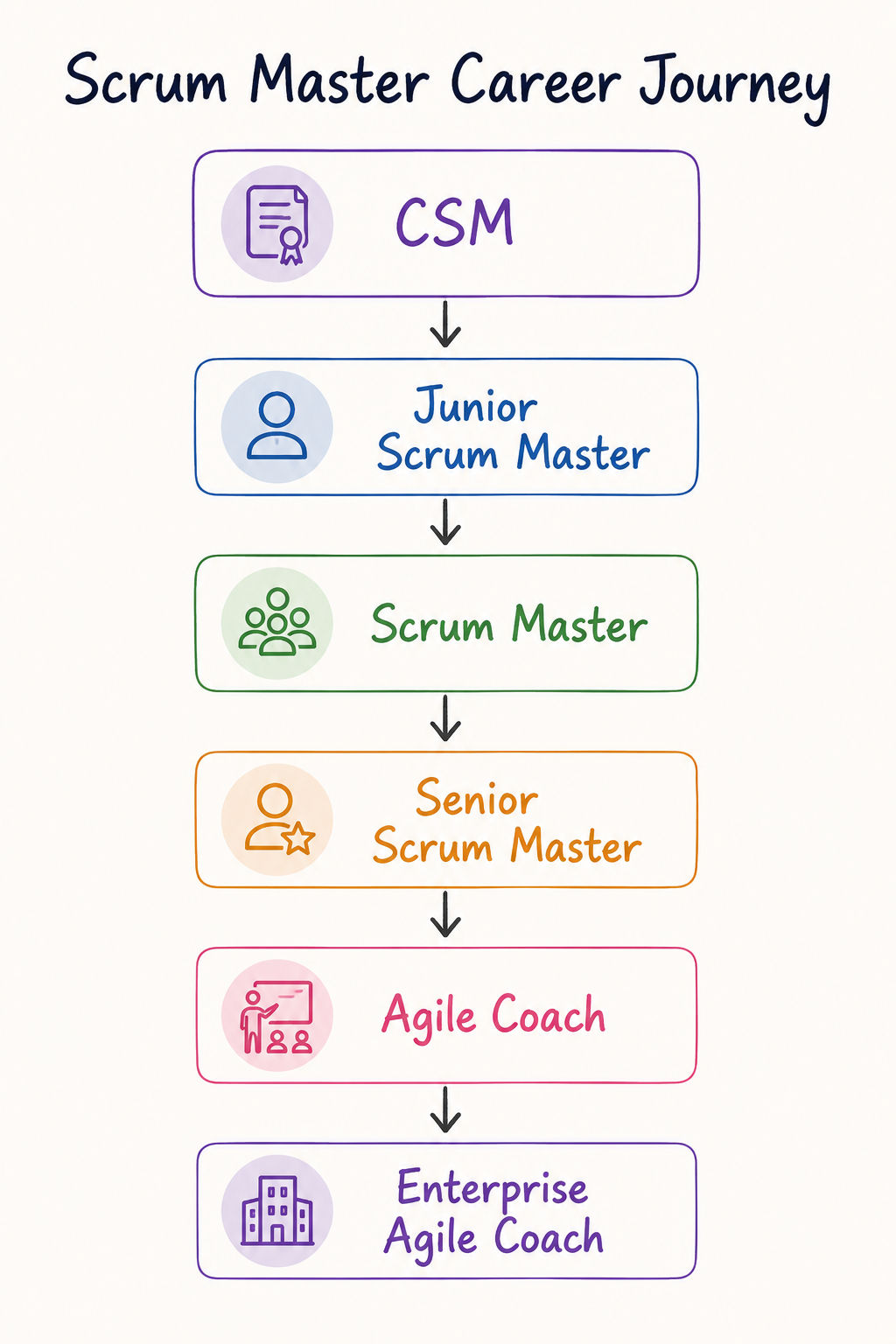
There is no fixed timeline for this progression. Some professionals move into coaching within three years, while others spend longer developing expertise across different industries. What matters most is the ability to apply Scrum principles consistently, help teams improve, and build the coaching mindset that organizations value.
Whether you're a beginner or an experienced professional, The Scrum Master Career Path Guide 2026 provides a clear roadmap for advancing your Scrum career.
Skills You Should Build Alongside CSM
Earning a CSM certification is an excellent first step, but successful Agile Coaches rely on a broader set of skills than Scrum knowledge alone. While CSM for Agile Coaches provides a strong foundation, professionals who continue learning and practicing complementary skills are better prepared to support teams, leaders, and organizations through change.
Developing these skills alongside CSM makes the transition from Scrum Master to Agile Coach much smoother.
1. Facilitation
Facilitation is one of the most valuable skills an Agile Coach can have. It is not about leading every discussion or making decisions for the team. Instead, it involves creating an environment where everyone can contribute, share ideas, and solve problems together.
CSM introduces facilitation through Scrum events such as Sprint Planning, Daily Scrum, Sprint Review, and Sprint Retrospective. However, experienced coaches learn additional techniques to handle larger workshops, cross functional meetings, and leadership discussions.
Example
Imagine two departments disagreeing on project priorities. Rather than deciding which side is right, an Agile Coach facilitates a conversation that helps both groups understand each other's concerns and agree on a practical solution.
2. Coaching Skills
Coaching goes beyond teaching Scrum practices. It focuses on helping individuals and teams discover solutions on their own instead of providing ready-made answers.
An Agile Coach asks thoughtful questions, encourages reflection, and helps teams improve their decision making over time.
While CSM for Agile Coaches introduces the mindset of servant leadership, professionals should continue developing active listening, powerful questioning, and constructive feedback skills through practice and advanced coaching education.
3. Leadership
Agile Coaches influence people without relying on formal authority. This requires strong leadership skills built on trust, credibility, and collaboration.
Rather than directing teams, Agile Coaches inspire continuous improvement by setting examples, encouraging experimentation, and supporting learning.
Leaders who embrace Agile understand that sustainable success comes from enabling teams rather than controlling them.
4. Conflict Resolution
Disagreements are common in every workplace. Different opinions, changing priorities, and communication gaps can create tension within Agile teams.
Instead of avoiding conflict, Agile Coaches learn how to guide productive conversations that help people understand one another and move forward together.
For example, if developers and Product Owners disagree about Sprint priorities, an Agile Coach can facilitate a discussion that focuses on customer value instead of individual preferences.
5. Emotional Intelligence
Technical knowledge alone does not make someone an effective coach. Understanding emotions, building trust, and communicating with empathy are equally important.
Emotional intelligence helps Agile Coaches recognize team morale, identify hidden concerns, and adapt their coaching approach to different personalities.
A coach who notices frustration during Sprint Planning can address the underlying issue before it affects team performance.
6. Change Management
Organizations rarely become Agile overnight. Teams often resist new ways of working because change introduces uncertainty.
Agile Coaches play an important role in helping people understand why change is necessary and how it benefits both the organization and individual teams.
Professionals pursuing CSM for Agile Coaches should gradually learn how organizational change works, how resistance develops, and how leaders can encourage adoption without forcing it.
7. Systems Thinking
As professionals progress into coaching roles, they begin working beyond individual Scrum teams.
Systems thinking helps coaches understand how departments, leadership decisions, business goals, and organizational culture influence one another.
Building these skills alongside CSM for Agile Coaches creates a balanced professional profile that employers value. Certification opens the door, but practical abilities determine long-term success.
As Agile roles continue to evolve with AI, exploring the Best Agile Management Certification Training Courses can help professionals build the skills needed to stay competitive.
Is CSM Worth It If Your Goal Is Agile Coaching?
For professionals planning a career in Agile Coaching, CSM remains one of the strongest starting credentials available. It introduces Scrum in a structured manner, develops servant leadership, and provides practical knowledge that is directly applicable in Scrum teams.
However, it is important to understand what CSM can and cannot do.
When CSM Is Highly Recommended
CSM is an excellent choice for beginners who have little or no experience with Scrum. It provides a clear understanding of Agile principles and helps professionals build confidence before taking on leadership responsibilities.
It is also valuable for developers, testers, project managers, business analysts, and team leads who want to transition into Agile roles.
Benefits of Starting with CSM
One of the biggest advantages of CSM is that it creates a common language for Agile professionals.
Teams, Product Owners, Scrum Masters, and stakeholders often rely on shared Scrum concepts during everyday work. Learning these concepts early helps professionals communicate more effectively and contribute to confidence.
Beyond learning Scrum, certification can open new career opportunities. Discover the Top 24 Career Benefits of Scrum Master Certification in 2026 before taking the next step.
Conclusion
Choosing the right certification can shape the direction of an Agile career, especially for professionals who aspire to become coaches. While there are several learning paths available, CSM for Agile Coaches remains one of the strongest places to begin because it builds a practical understanding of Scrum, team collaboration, facilitation, and servant leadership.
For most professionals, the journey follows natural progression. They start by learning Scrum, apply those concepts as Scrum Masters, develop confidence through real projects, and gradually expand into coaching roles. Along the way, advanced certifications, stronger facilitation skills, emotional intelligence, and organizational coaching capabilities help them grow into effective Agile Coaches.
Contact our upGrad KnowledgeHut experts for personalized guidance on choosing the right course, career path, and certification to achieve your goals.
Frequently Asked Questions
Is CSM enough to become an Agile Coach?
No. CSM for Agile Coaches provides a strong understanding of Scrum, facilitation, and servant leadership, but it is only the starting point. Most employers expect Agile Coaches to have practical experience as Scrum Masters along with the ability to coach teams, resolve conflicts, and support organizational change.
Should I take CSM before ICP ACC?
For most professionals, yes. CSM helps build a solid Scrum foundation, making it easier to understand advanced coaching concepts later. Once you have gained experience working with Scrum teams, ICP ACC can help you strengthen your coaching and facilitation skills.
Can I become an Agile Coach without Scrum Master experience?
It is possible, but it is uncommon. Many Agile Coaches first work as Scrum Masters because the role provides hands-on experience with Scrum events, team collaboration, stakeholder communication, and continuous improvement. This practical exposure makes the transition into coaching much smoother.
What certification comes after CSM?
After gaining real world Scrum experience, many professionals choose coaching focused certifications such as ICP ACC. Others may explore certifications in Agile leadership, enterprise Agile, or change management depending on their career goals and the type of organizations they want to support.
Is CSM valuable for experienced Agile professionals?
Yes. Even experienced professionals can benefit from CSM if they have not received formal Scrum training. The certification reinforces Scrum principles, aligns professionals with industry best practices, and provides a recognized credential that is valued by employers worldwide.
Does CSM teach coaching skills?
CSM introduces the coaching mindset through servant leadership and facilitation, but it does not provide in depth coaching training. Professionals who want to become full-time Agile Coaches should continue developing coaching techniques through practical experience and advanced certifications.
How long does it take to become an Agile Coach after CSM?
There is no fixed timeline. Many professionals spend two to five years working as Scrum Masters before moving into Agile Coaching roles. The pace depends on the projects they work on, the responsibilities they take on, and their commitment to continuous learning.
Which industries hire Agile Coaches?
Agile Coaches are in demand across many industries, including software development, banking, financial services, healthcare, retail, manufacturing, telecommunications, consulting, and government organizations. As Agile practices continue to expand beyond technology teams, opportunities for experienced coaches are also growing.
1639 articles published
KnowledgeHut is an outcome-focused global ed-tech company. We help organizations and professionals unlock excellence through skills development. We offer training solutions under the people and proces...
Get Free Consultation
By submitting, I accept the T&C and
Privacy Policy
Ready to learn about Agile Certifications Roadmap?