
CSPO vs PMP: Which Certification Is Better for Product-Focused Roles?
Updated on Jul 29, 2026 | 202 views
Share:
Table of Contents
View all
Quick Overview
- CSPO is more directly aligned with product-focused roles, covering product ownership, customer value, Scrum, and Product Backlog prioritisation.
- PMP focuses on broader project management, including planning, budgeting, risk management, governance, and delivery across different project environments.
- For CSPO vs PMP, CSPO is generally the stronger choice for Product Owners and Product Managers, while PMP suits professionals focused on project and delivery management.
- This guide covers CSPO vs PMP in detail, including key differences, career alignment, skills, real-world applications, and which certification is better for product-focused roles.
"Strengthen product-focused career skills with upGrad KnowledgeHut CSPO Certification Training, designed around Agile product ownership and Scrum practices."
Master the Right Skills & Boost Your Career
Avail your free 1:1 mentorship session
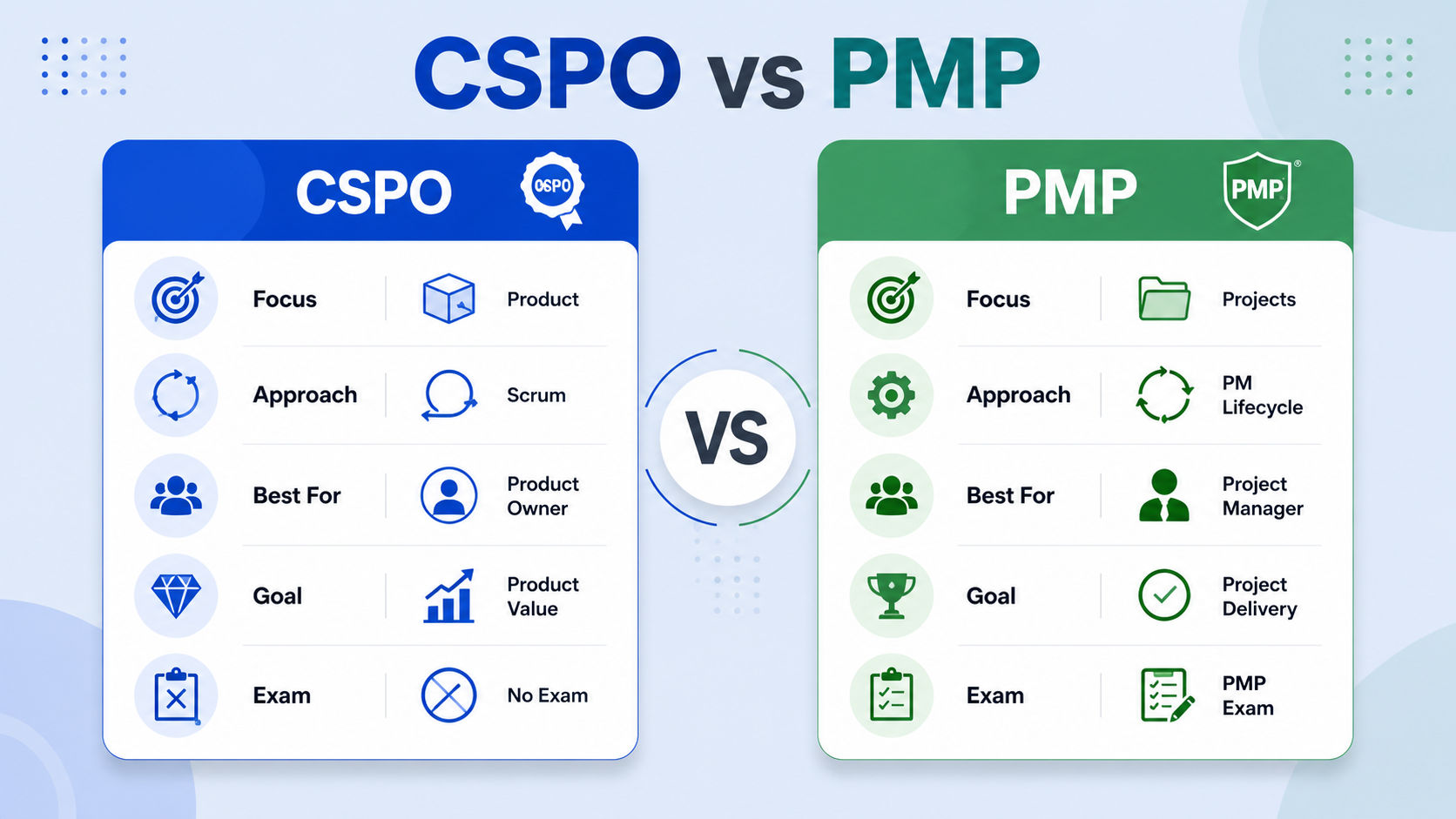
Key Difference: CSPO vs PMP
Factor |
CSPO |
PMP |
| Primary focus | Product Ownership | Project Management |
| Framework | Scrum / Agile | Predictive, Agile & Hybrid |
| Best suited for | Product Owners, Product Managers, Agile professionals | Project Managers, Programme professionals, delivery leaders |
| Main responsibility | Maximising product value | Delivering project outcomes |
| Exam | No traditional certification exam | PMP examination required |
| Experience requirement | No prior experience required for the course | Project management experience and training requirements apply |
| Learning approach | Scrum and product-focused | Broad project management |
| Career direction | Product and Agile roles | Project and programme management |
Also Read: CSPO vs PSPO
What Is CSPO Certification?
The Certified Scrum Product Owner (CSPO) certification is offered by Scrum Alliance and is one of the most widely recognized certifications for professionals interested in product ownership and Agile product development.
The course helps participants understand how to create product vision, manage and prioritize the Product Backlog, gather customer feedback, collaborate with Scrum Teams, and deliver products that provide real business value.
Who Should Pursue CSPO?
CSPO certification is a good fit for professionals who want to build or strengthen product management and Product Owner skills, including:
- Product Managers
- Product Owners
- Business Analysts
- Product Leaders
- Agile Professionals
- Entrepreneurs and Startup Founders
The certification is also suitable for professionals planning to move into product-focused roles or contribute to product strategy within Agile organizations.
Also Read: Who Should Get CSPO Certified?
What Skills Does CSPO Teach?
1. Product Ownership
Learn the key responsibilities of a Product Owner, including balancing customer needs, business goals, and team priorities to deliver successful products.
2. Product Vision
Understand how to create a clear product vision, set product goals, and align stakeholders around a shared direction.
3. User Stories
Develop the ability to write user stories, define acceptance criteria, and translate customer needs into clear development requirements.
4. Product Backlog Management
Learn how to create, organise, refine, and prioritise the Product Backlog to ensure teams focus on the highest-value work.
5. Stakeholder Communication
Build communication skills to collaborate with customers, business leaders, and Scrum Teams while managing feedback and expectations.
6. Value-Based Prioritisation
Learn how to prioritise features based on customer value, business impact, and product goals to maximise product success.
What Is PMP Certification?
The Project Management Professional (PMP) certification is offered by the Project Management Institute (PMI) and is one of the most recognized project management certifications worldwide. It validates the knowledge and skills needed to successfully plan, manage, and deliver projects across different industries.
PMP covers key areas such as project planning, resource management, risk management, budgeting, stakeholder communication, and project execution. The certification also includes Agile and hybrid project management approaches, making it relevant for today's work environments.
Who Should Pursue PMP?
PMP certification is a good choice for professionals responsible for managing projects from start to finish, including:
- Project Managers
- Program Managers
- Project Coordinators
- PMO Professionals
- Operations Managers and Team Leaders
The certification is ideal for professionals looking to strengthen project management skills, improve career opportunities, and manage projects more effectively.
Also Read: How to Get PMP Certification in 2026
What Skills Does PMP Teach?
Here are the core skills professionals gain through PMP certification:
1. Project Planning
Learn how to define project goals, create schedules, set milestones, and develop plans that keep projects on track.
2. Budget Management
Understand how to estimate costs, prepare budgets, monitor expenses, and control project spending.
3. Scope Management
Learn how to define project scope, manage requirements, handle change requests, and reduce scope creep.
4. Risk Management
Develop the ability to identify project risks, assess their impact, and create mitigation plans to reduce potential issues.
5. Project Governance
Understand governance frameworks, roles and responsibilities, compliance requirements, and how to align projects with business objectives.
6. Resource Management
Learn how to allocate people, time, budgets, and other resources efficiently to improve project performance.
7. Project Delivery and Monitoring
Build skills to monitor project progress, track performance, manage quality, communicate with stakeholders, and deliver projects on time and within budget.
Also Read: Benefits of PMP Certification
CSPO vs PMP: Detailed Comparison for Product-Focused Professionals
Choosing between CSPO and PMP depends on career goals, current responsibilities, and the type of work a professional want to do. Both certifications are valuable, but they focus on different areas. CSPO is centered around product ownership and customer value, while PMP focuses on managing projects and successful delivery.
1. Learning Focus
CSPO and PMP teach different skill sets.
CSPO focuses on building products that solve customer problems. The certification helps professionals understand customer needs, create product vision, manage the Product Backlog, write user stories, and decide which features should be developed first.
Key areas covered in CSPO include:
- Product strategy
- Customer focused thinking
- Backlog prioritisation
- Agile product ownership
- Stakeholder collaboration
PMP focuses on managing projects effectively. It teaches professionals how to plan projects, manage resources, control costs, handle risks, and ensure successful delivery.
Key areas covered in PMP include:
- Project planning
- Budget management
- Risk management
- Resource allocation
- Project governance
2. Career Alignment
The right certification depends largely on the career path.
CSPO is suitable for professionals who want to work in product focused roles. The certification supports careers such as:
- Product Owner
- Product Manager
- Associate Product Manager
- Agile Business Analyst
- Product Lead
PMP is better suited for professionals who manage projects, teams, timelines, and delivery processes. Common career paths include:
- Project Manager
- Program Manager
- PMO Manager
- Delivery Manager
- Operations Manager
3. Industry Recognition
Both CSPO and PMP are respected certifications, but they are recognised in different areas.
CSPO is popular among Agile organisations, technology companies, startups, and product teams. It shows knowledge of Scrum practices and product ownership.
PMP is recognised across multiple industries, including IT, healthcare, finance, construction, manufacturing, and government. It is considered a strong credential for project management professionals.
4. Agile Relevance
Agile knowledge is becoming important for many modern organisations.
CSPO is built around Scrum and Agile practices. It helps professionals understand:
- Scrum framework
- Sprint planning
- Product Backlog management
- Incremental delivery
- Customer feedback
PMP also includes Agile and hybrid approaches, but it covers a wider range of project management methods, including traditional approaches.
5. Real World Application
Both certifications provide practical knowledge that can be used at work.
CSPO skills are useful for activities such as:
- Prioritising product features
- Managing Product Backlogs
- Understanding customer feedback
- Creating product roadmaps
- Working with Scrum Teams
PMP skills help professionals with tasks such as:
- Creating project plans
- Managing risks
- Tracking project progress
- Controlling budgets
- Coordinating resources
6. Long Term Career Value
CSPO and PMP can both support career growth, depending on professional goals.
CSPO can help professionals move towards roles such as:
- Senior Product Owner
- Product Manager
- Senior Product Manager
- Director of Product
- Head of Product
PMP can support growth into roles such as:
- Senior Project Manager
- Program Manager
- Portfolio Manager
- PMO Director
- Operations Executive
Some professionals choose to earn both certifications because they develop different strengths. CSPO builds product and customer focused skills, while PMP strengthens project planning and delivery expertise.
Also Read: SAFe vs PMP
"Strengthen Agile and product management expertise with UpGrad KnowledgeHut Agile Management Training, covering certifications and courses for Product Owners, Scrum Masters, and Agile professionals."
Which Certification Is Better for Product-Focused Roles?
Choosing between CSPO and PMP depends on the role, daily responsibilities, and future career plans. For most product-focused roles, CSPO offers more direct value because it focuses on customer needs, product strategy, Agile ways of working, and Product Owner responsibilities.
PMP can still be useful in roles where project governance, planning, and large-scale delivery are important.
1. Product Owners
Product Owners are the primary audience for CSPO. The certification closely matches their daily responsibilities, including managing the Product Backlog, prioritising features, understanding customer needs, and working with Scrum Teams.
CSPO helps Product Owners improve skills in:
- Backlog prioritisation
- Product goal setting
- User story understanding
- Stakeholder collaboration
- Delivering customer value
Recommendation: Choose CSPO
Also Read: How to Become a Product Owner?
2. Senior Product Managers
Senior Product Managers handle broader responsibilities such as product strategy, business goals, stakeholder management, and cross-functional collaboration.
CSPO helps strengthen product thinking, while PMP can add value when managing large initiatives, complex delivery processes, or enterprise-level projects.
Recommendation: Choose CSPO First, Consider PMP Later
Also Read: What Skills are Required to Become a Product Manager?
3. Technical Product Managers
Technical Product Managers work closely with engineering teams and connect business goals with technical solutions. Their responsibilities often include roadmap planning, feature prioritisation, and Agile delivery.
CSPO aligns well with these responsibilities by focusing on customer value, Scrum practices, and collaboration with development teams.
Recommendation: Choose CSPO
4. Startup Professionals
Startup teams need professionals who can make quick decisions, understand customers, test ideas, and prioritise features effectively.
CSPO supports startup needs through focus areas such as:
- Customer feedback
- Product prioritisation
- Agile experimentation
- Product-market fit
Recommendation: Choose CSPO
5. Enterprise Product Teams
Enterprise product teams often balance customer needs with business processes, compliance, budgets, and large-scale delivery.
CSPO helps with product ownership and Agile collaboration, while PMP can support project planning, governance, and coordination across large teams.
Recommendation:
- Choose CSPO as a Primary Certification
- Consider PMP as an Additional Certification
6. Digital Product Leaders
Digital Product Leaders focus on product strategy, customer experience, innovation, and business growth. Their success depends on understanding users, making strategic decisions, and guiding product teams.
CSPO supports key leadership areas such as:
- Product vision
- Strategic prioritisation
- Customer understanding
- Agile leadership
- Stakeholder alignment
Recommendation: Choose CSPO
Common Mistakes When Choosing Between CSPO and PMP
Choosing the right certification can be challenging, especially when both CSPO and PMP have strong industry value. Many professionals make similar mistakes while deciding between the two options.
1. Assuming PMP Is Always the Better Certification
PMP is highly respected in project management, but it may not always be the best choice for product-focused roles. Professionals working in product management or Product Owner roles may find CSPO more relevant because it focuses on customer value, product strategy, and Agile product development.
2. Avoiding CSPO Because It Seems Easier
CSPO has a shorter learning path compared to many certifications, but that does not reduce its value. The certification teaches practical product ownership skills that are useful for professionals working with Scrum Teams and managing products.
3. Choosing PMP Without Relevant Project Experience
PMP requires more than just meeting eligibility criteria. The certification tests practical project management knowledge and decision-making. Without real project experience, understanding the concepts and applying them can become difficult.
4. Ignoring Company and Industry Requirements
The right certification often depends on the type of organisation and role.
- Agile product companies may value CSPO more for product roles.
- Traditional enterprises with strong project management structures may prefer PMP.
Checking job requirements and industry expectations before choosing a certification can help avoid the wrong decision.
5. Treating Certification as a Replacement for Experience
Certifications add value, but they cannot replace hands-on experience. CSPO becomes more useful when combined with real Product Backlog ownership, while PMP provides stronger value when supported by actual project delivery experience.
Conclusion
Overall, the choice between CSPO and PMP depends on the career path and role requirements. CSPO is the stronger option for Product Owners, Product Managers, and Agile professionals, with a focus on customer value, product strategy, Scrum, and Product Backlog management.
PMP is better suited to project management professionals handling budgets, risks, resources, planning, and delivery. For product-focused roles, CSPO offers more direct career relevance, while PMP can complement product expertise with broader project and delivery skills.
Have A Query? Get in Touch With Our Customer Support | upGrad KnowledgeHut
Frequently Asked Questions (FAQs)
Can CSPO and PMP certifications be pursued together?
Yes, CSPO and PMP can be pursued together because the certifications develop different skill sets. CSPO strengthens product ownership, Scrum, and customer-value skills, while PMP builds broader project planning and delivery expertise. Holding both can be useful for professionals working across product and project environments.
Which certification is more valuable for a Product Manager career in 2026?
CSPO is generally more directly relevant to a Product Manager career because of its focus on product ownership, customer needs, prioritization, and Agile product development. PMP can add value when Product Managers handle large initiatives, governance, or complex delivery processes. Career goals and job requirements should guide the choice.
Can CSPO help transition from a Business Analyst to a Product Owner role?
CSPO can support a transition from Business Analyst to Product Owner by building knowledge of Scrum, Product Backlog management, user stories, prioritization, and stakeholder collaboration. Existing Business Analyst skills can complement this learning. Practical product experience can further strengthen the transition.
Is CSPO recognised by employers outside the technology industry?
CSPO can be relevant beyond technology because Scrum and Agile practices are used across various industries and business functions. Organizations working on digital products, services, and customer-focused initiatives may value Scrum knowledge. Employer expectations can still vary by industry and role.
How can CSPO certification strengthen a Product Owner resume?
CSPO can demonstrate formal learning in Scrum and Product Ownership, particularly in areas such as backlog prioritization, product vision, stakeholder communication, and customer value. Adding relevant projects or practical examples alongside the certification can make a Product Owner resume more compelling.
Does PMP certification help professionals transition into Product Management?
PMP can provide transferable skills in stakeholder management, planning, risk management, resource coordination, and delivery. However, Product Management also requires product strategy, customer understanding, prioritization, and product discovery skills. Additional product-focused learning or experience can help bridge that gap.
Which certification is better for professionals with no Agile experience?
CSPO can be a suitable starting point for professionals with limited Agile experience who want to move into product-focused roles. The learning introduces Scrum, Product Ownership, Product Backlog management, and Agile product development. Practical exposure to Agile teams can further build confidence.
Can CSPO certification help increase earning potential in product roles?
CSPO can support career development by strengthening skills relevant to Product Owner and Agile product roles. However, certification alone does not guarantee a higher salary. Experience, role level, industry, location, product expertise, and demonstrated results generally have a stronger influence on earning potential.
How long does CSPO certification remain valid after completion?
CSPO certification is maintained through Scrum Alliance’s renewal process rather than being treated as a one-time credential with no ongoing requirements. Certified professionals are expected to renew their certification periodically and meet the applicable continuing education requirements. Current renewal rules should be checked with Scrum Alliance before planning certification maintenance.
What career opportunities are available after completing CSPO certification?
CSPO can support career paths such as Product Owner, Associate Product Manager, Product Manager, Agile Business Analyst, and other product-focused roles. Career progression can later extend towards Senior Product Owner, Senior Product Manager, Product Lead, or Head of Product positions, depending on experience and responsibilities.
1639 articles published
KnowledgeHut is an outcome-focused global ed-tech company. We help organizations and professionals unlock excellence through skills development. We offer training solutions under the people and proces...
Get Free Consultation
By submitting, I accept the T&C and
Privacy Policy
Ready to learn about Agile Certifications Roadmap?