
What Is the SAFe House of Lean?
Updated on Aug 03, 2026 | 221 views
Share:
Table of Contents
View all
- What is the SAFe House of Lean?
- Why is the House of Lean important in SAFe?
- What are the components of the SAFe House of Lean?
- Foundation: Lean leadership
- How the parts of the House of Lean work together
- How organizations use the SAFe House of Lean
- How the SAFe House of Lean connects with other SAFe concepts
- Common challenges and mistakes when implementing the House of Lean
- Why the House of Lean is important for the Leading SAFe Certification
- Conclusion
Quick Overview
- The SAFe House of Lean is a visual model in the Scaled Agile Framework (SAFe) that explains the Lean principles needed to achieve business agility and deliver continuous customer value.
- It is built on Lean Leadership, Respect for People and Culture, Flow, Innovation, and Relentless Improvement, which work together to create a strong Lean-Agile foundation.
- Inspired by the Toyota Production System, the House of Lean helps organizations reduce waste, empower teams, and continuously improve the way they deliver value.
- In this guide, you'll learn the key components of the House of Lean, why it is important in SAFe, how organizations apply it, and how it supports successful Agile transformation.
Build a strong understanding of the SAFe House of Lean and Lean-Agile principles with upGrad KnowledgeHut Leading SAFe Certification Training, designed to help you confidently apply SAFe practices in real-world organizations.
Master the Right Skills & Boost Your Career
Avail your free 1:1 mentorship session
What is the SAFe House of Lean?
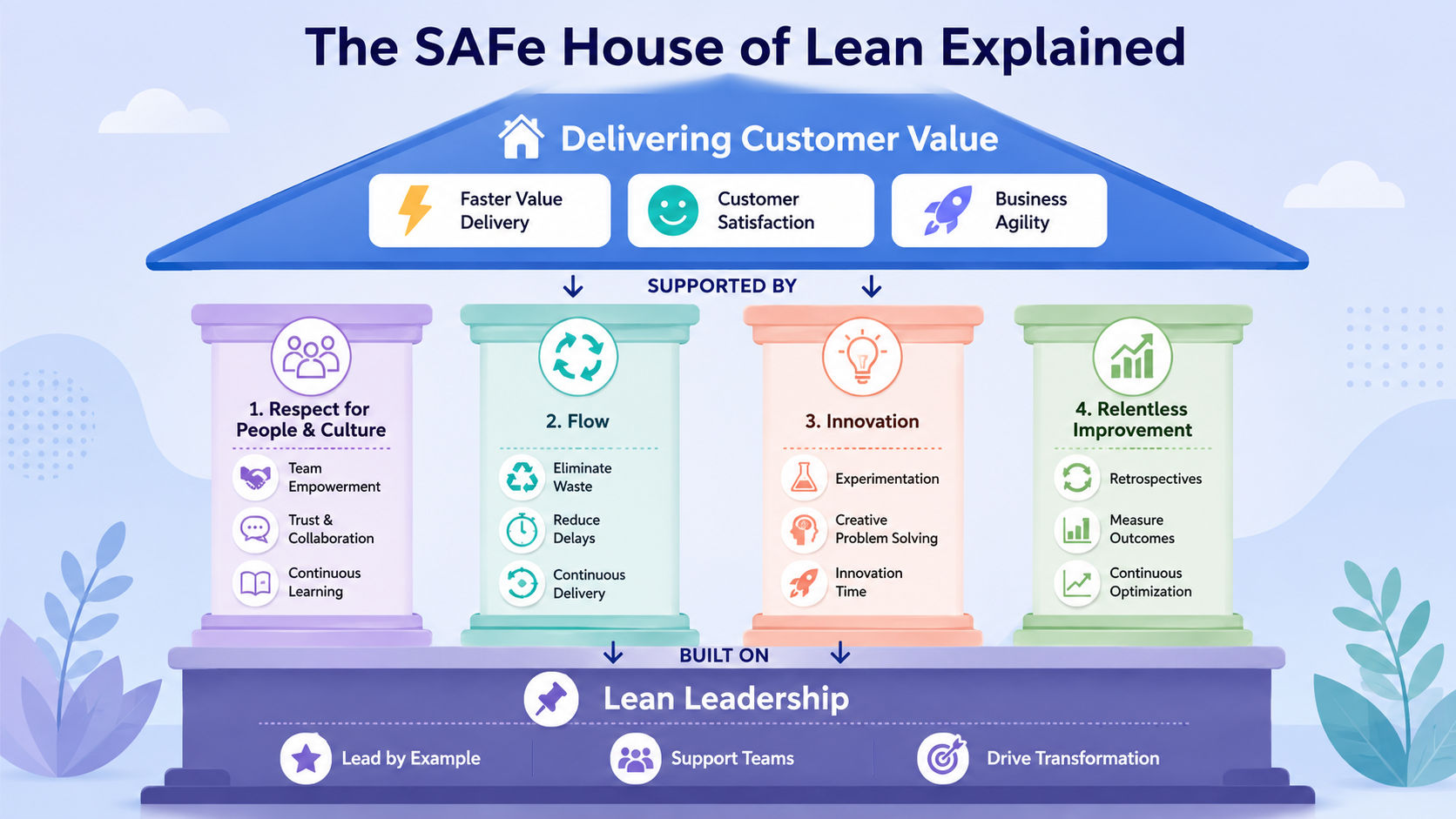
The SAFe House of Lean is a model in the Scaled Agile Framework that explains how Lean thinking helps organizations achieve business agility. It shows how leadership, practices, and goals work together to create a system focused on delivering value.
The House of Lean represents a structure where:
- Foundation: Lean-Agile leadership supports the entire system
- Pillars: Key Lean principles guide the way teams and organizations operate
- Roof: Represents the goal of delivering value efficiently and continuously
SAFe is built on Lean thinking because successful Agile transformation requires more than adopting processes or tools.
It requires changes in leadership approach, team collaboration, decision-making, and value delivery.
Why it is represented as a house?
The house structure makes Lean principles easier to understand:
- A strong foundation supports the entire system
- Strong pillars create stability
- A clear goal provides direction
The model highlights the importance of building a balanced approach where leadership, teams, and processes work together to achieve better outcomes.
Why is the House of Lean important in SAFe?
The House of Lean helps organizations understand that business agility is more than speed. It is about creating an environment where people can continuously improve and deliver value.
How lean thinking supports business agility
Lean thinking encourages organizations to focus on what truly matters to customers. By eliminating unnecessary activities and streamlining workflows, businesses can respond more quickly to market changes.
Business agility becomes possible when teams can adapt rapidly without sacrificing quality or customer satisfaction.
Why SAFe starts with a lean mindset
Many organizations struggle with Agile transformations because they focus only on processes and tools.
SAFe begins with a Lean mindset because sustainable change starts with how leaders and teams think. When people understand Lean principles, Agile practices become more effective and easier to scale.
Business benefits of adopting the House of Lean
Organizations that embrace the House of Lean often experience:
- Faster time-to-market
- Improved product quality
- Enhanced employee engagement
- Better collaboration across teams
- Increased customer satisfaction
- Stronger business adaptability
These benefits make Lean thinking a critical component of long-term success.
Also Read: How to Become a SAFe Scrum Master?
What are the components of the SAFe House of Lean?
The House of Lean consists of a strong foundation, four pillars, and a roof that represents the ultimate objective.
Foundation: Lean leadership
Lean leadership serves as the foundation because lasting transformation begins with leaders.
Leaders must:
- Model Lean behaviors
- Empower teams
- Support innovation
- Encourage learning
- Remove organizational obstacles
Without committed leadership, Lean initiatives often struggle to gain momentum.
Pillar 1: Respect for people and culture
People are the driving force behind innovation and value creation.
Empowering teams and building trust
High-performing teams thrive when they are trusted to make decisions and solve problems. Leaders who empower employees create an environment where ownership and accountability naturally develop.
Trust reduces bureaucracy and helps teams move faster while maintaining quality.
Creating a culture of continuous learning
Learning should never stop. Organizations that invest in training, coaching, and professional development create teams that can adapt to changing business needs.
Continuous learning also helps employees stay engaged and motivated.
Pillar 2: Flow
Flow focuses on moving value smoothly through the system with minimal interruptions.
Eliminating waste and delays
Waste can take many forms, including unnecessary meetings, excessive approvals, waiting times, and duplicated work.
By identifying and removing these obstacles, organizations can improve efficiency and reduce delivery times.
Improving continuous value delivery
Flow is not about simply working faster. It is about ensuring that valuable work reaches customers consistently and predictably.
A strong flow reduces bottlenecks and improves overall system performance.
Pillar 3: Innovation
Organizations that stop innovating often struggle to remain competitive.
Encouraging experimentation
Innovation flourishes when teams are encouraged to test ideas and learn from failures.
Experimentation allows organizations to discover new opportunities while minimizing risk through small, manageable changes.
Creating time and space for innovation
Innovation rarely happens when employees are overwhelmed by daily tasks.
Successful organizations intentionally allocate time for research, learning, and exploration to encourage creative problem-solving.
Pillar 4: Relentless improvement
Continuous improvement is a key characteristic of Lean organizations.
Applying continuous improvement practices
Teams should regularly examine their processes and identify opportunities to improve efficiency, quality, and outcomes.
Retrospectives, feedback loops, and performance reviews are common tools for driving improvement.
Measuring and learning from outcomes
Improvement efforts should be supported by data.
Organizations must measure results, evaluate progress, and use lessons learned to refine their approach over time.
Roof: Delivering customer value
The ultimate purpose of the House of Lean is delivering customer value.
Every decision, activity, and improvement should contribute to creating products and services that solve real customer problems and generate meaningful business results.
Also Read: SAFe Agilist Certification Renewal: Cost & Precess
How the parts of the House of Lean work together
Why every pillar matters
Each of the four pillars is important, and they all need to work together. Doing well in one area cannot make up for ignoring another. A balanced approach helps the whole Lean system stay strong.
For example, a company may have smooth and efficient workflows, but if employees do not feel respected or valued, motivation and teamwork will slowly decline.
In the same way, introducing new ideas without learning from past mistakes means the same problems will continue to happen.
How lean leadership supports every pillar
Good leadership is the foundation that keeps all the pillars strong. Leaders create a respectful workplace by listening to employees and building trust.
They help improve workflow by removing obstacles that slow people down. They also support new ideas by encouraging experiments and providing the resources needed to test them.
At the same time, they promote continuous improvement by using data and asking questions that help teams find better ways of working.
What happens when a pillar is missing
If one pillar is weak or missing, the whole Lean system becomes less effective.
For example, a company may have fast and efficient processes, but if it does not focus on innovation, it will keep producing the same products while competitors introduce better ones.
Over time, this can cause the company to lose its competitive advantage.
Strengthen your understanding of Lean principles and business agility with upGrad KnowledgeHut Agile Management Courses, designed for professionals leading Agile and SAFe initiatives.
How organizations use the SAFe House of Lean
Organizations can use Lean principles at different levels to improve the way they work.
1. Using the House of Lean at the team level
Teams use Lean practices to work better together, remove unnecessary work, and deliver quality results faster.
Common practices include getting regular feedback, using visual boards to track work, and holding team meetings to discuss what went well and what can be improved.
2. Using the House of Lean at the program and ART level
At the Agile Release Train (ART) level, Lean helps different teams work together toward the same goals.
This improves planning, increases transparency, and helps teams deliver value more consistently.
3. Using the House of Lean across the organization
When the entire organization follows Lean principles, business goals, budgeting, decision-making, and daily operations become better aligned.
As a result, the organization becomes more flexible, responds to change faster, and delivers greater value to customers.
4. Real-World example of the House of Lean
Imagine a software company that is struggling with slow product releases and unhappy customers.
The company decides to use the House of Lean. Leaders give teams more responsibility, remove delays in the workflow, set aside time for innovation, and encourage continuous improvement.
Over time, the company releases products more often, customers become more satisfied, and employees feel more engaged because they have clear goals and greater ownership of their work.
How the SAFe House of Lean connects with other SAFe concepts
The House of Lean is closely connected to several important ideas in SAFe. Together, they help organizations build a strong Lean and Agile culture.
1. House of Lean vs. Lean Thinking
Lean thinking is the overall approach of creating more value for customers while reducing waste.
The House of Lean shows how these Lean ideas can be put into practice within the SAFe framework.
2. House of Lean vs. SAFe Principles
SAFe principles provide practical guidelines for making decisions and applying Lean and Agile practices.
The House of Lean creates the culture and leadership needed to support these principles and make them successful.
3. House of Lean and Lean-Agile leadership
Lean-Agile leaders play an important role in supporting the House of Lean.
They lead by example, encourage Lean thinking, and help teams adopt better ways of working every day.
4. House of Lean and SAFe core values
The House of Lean also supports the four core values of SAFe:
- Alignment
- Built-in quality
- Transparency
- Program execution
When these concepts work together, they help organizations improve teamwork, deliver better results, and achieve long-term success.
Also Read: SAFe vs PMP
Common challenges and mistakes when implementing the House of Lean
1. Treating lean as a process instead of a mindset
One common mistake is treating Lean as a set of steps to follow rather than a way of thinking. Teams that only follow the process without understanding the reasoning behind it often abandon it the moment things get difficult.
2. Ignoring leadership's role in lean transformation
Some organizations expect teams to adopt Lean thinking on their own, without leadership changing how it operates.
Since leadership is the foundation, this almost always leads to a shaky, unstable transformation.
3. Focusing on outputs instead of customer value
It is easy to measure how much work got done. It is harder, but more important, to measure whether that work actually mattered to the customer.
Organizations that focus only on output volume often miss the actual point of the roof: real customer value.
4. Neglecting innovation and continuous improvement
Many organizations get comfortable once flow improves, and they stop pushing for innovation or improvement.
This creates a false sense of success, since competitors who keep improving will eventually catch up and overtake them.
Also Read: CSM vs SAFe
Why the House of Lean is important for the Leading SAFe Certification
The House of Lean is one of the key topics covered in the Leading SAFe training and certification program.
How the House of Lean is covered in the Leading SAFe course
A good Leading SAFe course explains the basics of Lean thinking and shows how the House of Lean helps organizations become more agile and deliver value at scale.
If you are preparing for the certification exam, it is important to understand how each part of the House of Lean works together to create better results for customers.
Skills you gain beyond the certification
Learning about the House of Lean helps you build practical skills that you can use in your daily work, including:
- Lean thinking
- Improving value streams
- Empowering teams
- Continuous improvement
- Making customer-focused decisions
These skills are useful not only for passing the certification exam but also for growing your career.
Who should learn the House of Lean?
The House of Lean is useful for many professionals, including:
- Project Managers
- Scrum Masters
- Product Managers
- Agile Coaches
- Business Leaders
- Transformation Teams
- Developers and Engineers
Anyone involved in Agile or Lean transformation can benefit from learning the House of Lean and applying its principles at work.
Conclusion
The SAFe House of Lean provides the foundation for building a Lean-Agile organization that consistently delivers customer value. By combining strong leadership with respect for people, continuous flow, innovation, and relentless improvement, it helps businesses become more adaptable and resilient.
Understanding these principles is essential for successfully implementing SAFe and creating lasting business agility. Whether you're beginning your Lean journey or preparing for a SAFe Certification, mastering the House of Lean is a valuable step toward driving meaningful organizational change.
Have A Query? Get in Touch With Our Customer Support | upGrad KnowledgeHut
Frequently Asked Questions (FAQs)
How long does it take to implement the SAFe House of Lean?
There isn't a fixed timeline because every organization is different. Some companies start seeing improvements within a few months, while a complete Lean transformation can take a year or more. The key is to treat it as an ongoing journey rather than a one-time project.
Do you need Agile experience before learning the House of Lean?
Not necessarily. The House of Lean is designed to introduce the mindset behind SAFe, making it suitable for beginners as well as experienced Agile professionals. Understanding its principles first often makes learning other SAFe concepts much easier.
How is the House of Lean different from Lean Six Sigma?
Although both focus on improving processes, they have different goals. Lean Six Sigma emphasizes reducing defects and improving quality through data-driven methods, while the House of Lean focuses on creating customer value, improving flow, and building a Lean culture within the SAFe framework.
Which SAFe roles should understand the House of Lean?
The House of Lean is valuable for everyone involved in a SAFe transformation. Product Managers, Product Owners, Scrum Masters, Release Train Engineers, Agile Coaches, business leaders, and team members all benefit from understanding its principles because they influence everyday decision-making.
Can an organization adopt the House of Lean without implementing the full SAFe framework?
Yes. Many organizations begin by applying Lean principles before rolling out SAFe across the business. Building a Lean mindset first often makes the transition to SAFe smoother and helps employees embrace change more effectively.
What are the biggest signs that an organization is missing Lean thinking?
Common warning signs include slow decision-making, frequent project delays, too many approval steps, poor collaboration between teams, and products that don't meet customer needs. These challenges often indicate that the organization is focusing on processes instead of delivering value.
Is the House of Lean included in the SAFe Agilist certification exam?
Yes. The House of Lean is one of the core concepts covered in the SAFe Agilist certification. Understanding its components and how they support Lean-Agile transformation is important for both the certification exam and applying SAFe successfully in the workplace.
What are some everyday examples of Lean thinking at work?
Lean thinking can be as simple as reducing unnecessary meetings, automating repetitive tasks, simplifying approval processes, encouraging employees to share improvement ideas, or fixing recurring issues instead of repeatedly addressing the same problems. Small changes like these often lead to significant long-term improvements.
Does the House of Lean support digital transformation initiatives?
Absolutely. Digital transformation isn't just about adopting new technology—it's also about changing how people work. The House of Lean helps organizations build the culture, leadership, and continuous improvement mindset needed to make digital transformation successful.
What's the best way to learn the SAFe House of Lean?
Reading about Lean principles is a good starting point, but structured learning provides a much deeper understanding. A recognized SAFe Course combines theory with real-world examples, practical exercises, and expert guidance, helping professionals apply the House of Lean confidently while preparing for SAFe Certification.
1639 articles published
KnowledgeHut is an outcome-focused global ed-tech company. We help organizations and professionals unlock excellence through skills development. We offer training solutions under the people and proces...
Get Free Consultation
By submitting, I accept the T&C and
Privacy Policy
Ready to learn about Agile Certifications Roadmap?