
How AI is Changing the Scrum Master Role in 2026
Updated on Jul 23, 2026 | 398 views
Share:
Table of Contents
View all
Master the Right Skills & Boost Your Career
Avail your free 1:1 mentorship session
Quick Overview
- Artificial intelligence is transforming the Scrum Master role by automating routine Agile tasks, allowing professionals to focus on coaching, leadership, and team collaboration rather than replacing them.
- AI tools can streamline meeting summaries, sprint planning, backlog refinement, reporting, and documentation, helping Scrum Masters spend more time on continuous improvement and stakeholder engagement.
- Skills such as coaching, conflict resolution, leadership, and team building remain essential, while familiarity with tools like ChatGPT, Jira AI, Microsoft Copilot, and Atlassian Intelligence is becoming increasingly valuable.
- In this guide, you'll learn how AI is changing the Scrum Master role, which responsibilities are being automated, the skills that remain irreplaceable, and how to prepare for Agile careers in 2026.
As the Scrum Master role evolves with AI, CSM® Certification Training remains a valuable starting point for learning the practices that AI is designed to support, not replace.
Why the Scrum Master Role Is Evolving in 2026
The Scrum Master role has changed significantly over the past few years. Earlier, much of the work involved facilitating Scrum events, updating project boards, preparing reports, and ensuring the team followed Scrum practices. While these responsibilities remain important, the introduction of AI powered tools has reduced the amount of time spent on repetitive administrative work.
A closer look at How AI is Changing the Scrum Master Role shows that the biggest shift is from routine administration toward coaching, collaboration, and strategic guidance.
Traditional Responsibilities of a Scrum Master
A Scrum Master plays an important role in helping Agile teams work effectively. Their primary responsibility is to ensure that Scrum principles are followed while creating an environment where teams can deliver value consistently.
Some of the core responsibilities include:
1. Sprint Planning
The Scrum Master facilitates Sprint Planning by helping the team define sprint goals, estimate work, and commit to realistic deliverables. They ensure discussions remain focused and that everyone understands the priorities for the upcoming sprint.
2. Daily Scrum
Daily Scrum meetings help team members share progress, discuss current work, and identify obstacles. The Scrum Master keeps these meetings productive and ensures that blockers are addressed quickly.
3. Sprint Review
During the Sprint Review, the Scrum Master helps organize demonstrations of completed work and encourages feedback from stakeholders. This feedback supports future planning and continuous improvement.
4. Retrospective
Sprint Retrospectives provide an opportunity for the team to reflect on what went well and what can be improved. The Scrum Master facilitates open discussions and helps the team identify practical actions for future sprints.
5. Removing Blockers
One of the most valuable responsibilities of a Scrum Master is removing obstacles that slow the team's progress. These challenges may involve communication gaps, resource constraints, unclear priorities, or external dependencies.
6. Agile Coaching
Scrum Masters coach team members on Agile values and Scrum practices. They encourage collaboration, continuous learning, and self-management while helping teams become more effective over time.
7. Stakeholder Collaboration
Successful Agile projects depend on strong communication between development teams, Product Owners, managers, and business stakeholders. Scrum Masters help maintain transparency, manage expectations, and encourage productive collaboration.
Why AI Became a Game Changer
Artificial intelligence has quickly become part of the modern Agile workplace. Instead of replacing Scrum Masters, it supports them by handling repetitive work and providing useful insights that improve decision making.
The discussion around How AI is Changing the Scrum Master Role is largely focused on how AI tools reduce repetitive work and improve access to project insights.
Several developments have accelerated this change.
1. Growth of Generative AI
Generative AI tools can summarize discussions, create reports, draft documentation, and organize information within seconds. Tasks that once required considerable manual effort can now be completed much faster, allowing Scrum Masters to spend more time working directly with their teams.
2. AI Inside Everyday Agile Tools
Many platforms already include built in AI features.
Examples include:
- Jira generating sprint summaries and issue insights.
- Azure DevOps assist with work tracking and project reporting.
- GitHub supports developers with intelligent coding suggestions.
- Slack summarizing conversations and highlighting important updates.
3. AI Assistants for Agile Teams
Modern AI assistants help teams by answering questions, organizing project information, preparing meeting notes, and identifying potential risks before they become major issues.
Instead of searching through multiple documents or dashboards, Scrum Masters can quickly access relevant information and spend more time supporting their teams.
As Scrum Master responsibilities evolve, the right certification matters more than ever. Read 8 Best Scrum Master Certifications to Pursue in 2026 to compare the leading options.
Industry Trends Driving This Transformation
The changing business environment is another reason why the Scrum Master role continues to evolve.
Several workplace trends help explain How AI is Changing the Scrum Master Role, including faster release cycles, AI-assisted development, and data-driven planning.
1. Faster Release Cycles
Organizations release new features and product updates more frequently than ever before. Scrum Masters must help teams maintain quality while keeping up with shorter delivery timelines.
2. AI Assisted Development
Development teams increasingly use AI to write code, generate test cases, review documentation, and identify defects. As developers become more productive, Scrum Masters help ensure that collaboration and communication remain effective across the team.
3. Data Driven Project Management
Modern project management relies heavily on data rather than assumptions. AI analyzes sprint performance, team capacity, delivery trends, and project risks, giving Scrum Masters valuable insights that support better planning and decision making.
Rather than collecting data manually, Scrum Masters can focus on understanding the insights and helping teams act on them.
4. Demand for Higher Productivity
Organizations are under constant pressure to deliver better products in less time. This has increased the demand for smarter workflows, better collaboration, and continuous improvement.
Also Read: Certified Scrum Master (CSM) Future: Trends & Predictions
What AI Can Automate for Scrum Masters
Artificial intelligence is helping Scrum Masters spend less time on repetitive administrative work and more time supporting their teams. Many Agile tools now include intelligent features that can organize information, generate reports, summarize meetings, and identify potential risks with minimal manual effort.
One of the clearest examples of How AI is Changing the Scrum Master Role is the automation of meeting preparation, reporting, documentation, and backlog support.
While AI cannot replace the judgment and leadership of a Scrum Master, it can significantly reduce the time spent on routine activities. This allows professionals to focus on coaching, collaboration, and continuous improvement.
Meeting Preparation
Preparing for Scrum meetings often involves reviewing sprint progress, gathering updates, and creating agendas. AI can complete much of this work within seconds.
AI can help with:
1. Agenda Generation
AI can create meeting agendas based on sprint goals, pending work items, and previous discussions. This saves time and ensures important topics are not overlooked.
Example: Before Sprint Planning, an AI assistant can generate an agenda that includes backlog priorities, team capacity, and unresolved blockers.
2. Sprint Summaries
Instead of manually reviewing completed work, AI can summarize the progress of the previous sprint by analyzing completed tasks, unresolved issues, and key achievements.
These summaries help teams prepare for Sprint Reviews more efficiently.
3. Meeting Reminders
AI powered project management tools can automatically send reminders for upcoming Scrum events, notify participants about schedule changes, and highlight any missing preparation before meetings begin.
Sprint Planning Assistance
Sprint Planning requires careful analysis of priorities, team capacity, and available resources. AI supports Scrum Masters by organizing project information and providing useful recommendations.
AI can assist with:
1. Story Grouping
AI can analyze similar user stories and group related work items together. This makes backlog organization faster and helps teams identify work that can be completed within the same sprint.
2. Sprint Recommendations
Based on previous sprint performance and backlog priorities, AI can recommend which user stories are most suitable for the next sprint.
These suggestions provide a useful starting point while leaving the final decision to the team.
3. Capacity Estimation
AI can estimate team capacity by reviewing historical workload, planned leave, and previous sprint data.
This helps Scrum Masters create more realistic sprint plans and avoid overcommitting the team.
4. Velocity Prediction
By analyzing previous sprint performance, AI can forecast expected team velocity and estimate how much work can realistically be completed.
These predictions support better planning without replacing the team's own estimates.
Daily Scrum Automation
Daily Scrum meetings generate valuable information, but documenting discussions can be time-consuming. AI simplifies this process by capturing and organizing important updates automatically.
AI can help with:
1. Meeting Notes
AI can record key discussion points during Daily Scrum meetings and prepare structured notes that are easy to review later.
2. Stand Up Summaries
Instead of manually writing updates, AI can summarize what each team member completed, what they plan to work on next, and any issues they reported.
This creates a clear record of daily progress.
3. Action Item Extraction
AI can identify tasks that require follow up and assign them to the appropriate team members.
This reduces the risk of important actions being forgotten after meetings.
4. Blocker Identification
AI can analyze recurring issues across multiple sprints and highlight blockers that continue affecting delivery.
This enables Scrum Masters to address problems earlier before they become larger challenges.
Retrospective Analysis
Sprint Retrospectives generate valuable feedback, but identifying patterns across several sprints can be difficult. AI helps by analyzing team feedback and highlighting meaningful trends.
AI can support retrospectives through:
1. Sentiment Analysis
AI can evaluate written feedback and identify whether overall team sentiment is improving or declining.
This helps Scrum Masters recognize potential concerns that may require attention.
2. Recurring Issue Detection
When similar problems appear repeatedly across multiple retrospectives, AI can highlight these recurring themes.
Examples include communication gaps, testing delays, or dependency issues.
3. Team Morale Insights
AI can identify changes in team participation, engagement, and collaboration by analyzing feedback over time.
These insights help Scrum Masters understand team health more effectively.
4. Trend Analysis
AI can compare retrospective data across several sprints to identify long term improvement areas and recurring strengths.
This supports continuous improvement with evidence rather than assumptions.
Backlog Refinement
Maintaining a clear and organized backlog requires ongoing effort. AI can simplify backlog refinement by improving the quality and consistency of user stories.
AI can assist with:
1. Story Rewriting
AI can rewrite user stories using clearer language while maintaining the original business objective.
This helps teams understand requirements more easily.
2. Acceptance Criteria Generation
Based on the user story, AI can suggest acceptance criteria that provide a strong starting point for discussions.
The Scrum team can then review and refine these suggestions before implementation.
3. User Story Improvement
AI can identify incomplete descriptions, missing business value, or unclear requirements and recommend improvements.
This helps reduce misunderstandings during development.
4. Duplicate Detection
Large product backlogs often contain similar or duplicate user stories.
AI can identify overlapping work items and suggest consolidation, making backlog management more efficient.
Documentation
Documentation is an essential part of Agile delivery, but creating reports manually can consume valuable time. AI can generate many of these documents automatically while keeping information consistent.
AI can help create:
1. Sprint Reports
AI can prepare sprint reports, summarize completed work, pending items, sprint goals, and team performance.
2. Release Notes
Based on completed user stories, AI can draft release notes that describe new features, improvements, and resolved issues.
The Scrum Master or Product Owner can review these notes before publication.
4. Progress Reports
AI can generate progress updates using sprint metrics, team velocity, and delivery status.
These reports help managers and stakeholders stay informed without requiring manual data collection.
5. Stakeholder Updates
AI can create concise project summaries tailored for business stakeholders, highlighting achievements, upcoming priorities, and potential risks.
This improves communication while reducing the administrative workload for Scrum Masters.
If you're building a long-term Agile career, read Career Path of a Certified Scrum Master: Certifications & Job Roles to explore progression opportunities beyond the Scrum Master role.
Tasks That AI Cannot Replace
Artificial intelligence can automate repetitive work and provide useful insights, but it cannot replace the human qualities that define an effective Scrum Master. Coaching people, building trust, resolving conflicts, and leading organizational change require empathy, experience, and sound judgment. These responsibilities depend on understanding people and context, something AI cannot fully achieve.
Any explanation of How AI is Changing the Scrum Master Role must also recognize the responsibilities that still require empathy, judgment, trust, and human interaction.
As organizations adopt AI across Agile teams, these human-centered responsibilities become even more valuable.
Coaching Individuals
One of the most important responsibilities of a Scrum Master is helping team members grow professionally. Every individual has different strengths, challenges, and learning styles, making personalized coaching an essential part of the role.
A Scrum Master supports individuals by:
- Mentoring team members
- Encouraging continuous learning
- Building confidence
- Helping people overcome challenges
- Supporting career development
For example, if a developer struggles to adapt to a new way of working, the Scrum Master can understand the underlying concerns and provide the right level of support. AI can identify patterns, but it cannot build genuine human relationships.
Building Team Trust
High performing Agile teams are built on trust, open communication, and mutual respect. Creating this environment requires consistent human interaction and leadership.
Important areas include:
- Psychological safety
- Open communication
- Team collaboration
- Healthy team dynamics
- Mutual respect
Trust develops over time through honest conversations and consistent support, something technology alone cannot provide.
Facilitating Difficult Conversations
Disagreements are a natural part of collaborative work. Scrum Masters often help teams resolve conflicts and reach decisions that benefit the project.
Examples include:
- Cross functional disagreements between development and testing teams
- Conflicting priorities between Product Owners and stakeholders
- Miscommunication within distributed teams
- Differences in technical approaches
- Team alignment during changing business priorities
While AI can summarize discussions or identify recurring issues, it cannot mediate sensitive conversations or build consensus between people.
Organizational Change Management
Many Scrum Masters play an active role in helping organizations adopt Agile ways of working. This involves guiding teams through change, improving processes, and encouraging collaboration across departments. Scrum Masters contribute by:
- Supporting Agile adoption
- Improving existing processes
- Helping teams embrace new practices
- Encouraging collaboration across departments
- Leading cultural transformation
Every organization has unique challenges, and successful change depends on adapting to those circumstances rather than following a standard process.
Ethical Decision Making
Artificial intelligence provides recommendations based on available data, but it cannot fully understand ethics, business priorities, or organizational culture.
Scrum Masters often make decisions that involve balancing technical needs, customer expectations, and team wellbeing. These situations require thoughtful judgment rather than automated recommendations.
To better understand the growing demand for Scrum Masters, explore The Increasing Role and Importance of Scrum Masters and how the role is evolving.
AI Skills Every Scrum Master Needs in 2026
As AI becomes a regular part of Agile delivery, Scrum Masters need to develop new skills alongside their existing Agile expertise. Employers are no longer looking only for professionals who understand Scrum. They also value candidates who can use AI tools responsibly, interpret AI generated insights, and help teams work more efficiently.
For professionals preparing for How AI is Changing the Scrum Master Role, skills such as prompt writing, data interpretation, AI governance, and responsible tool use are increasingly valuable.
Learning these skills does not mean becoming an AI engineer. Instead, it means knowing how to use AI to support better planning, collaboration, and decision making while keeping people at the center of Agile practices.
1. Prompt Engineering
Prompt engineering is the ability to write clear and specific instructions that help AI tools generate useful responses.
For Scrum Masters, this skill can save time when preparing meeting agendas, creating sprint summaries, refining user stories, or drafting stakeholder updates.
Example:
Instead of asking an AI tool to "summarize this sprint," a Scrum Master can provide context such as sprint goals, completed stories, pending work, and blockers. The result is a more accurate and meaningful summary.
Strong prompting helps Scrum Masters get better results from tools like ChatGPT, Microsoft Copilot, and Jira AI.
2. AI Assisted Backlog Management
Managing a product backlog often requires reviewing hundreds of user stories, identifying duplicates, and improving requirements.
AI can simplify this process by suggesting clearer user stories, generating acceptance criteria, and highlighting similar backlog items.
However, Scrum Masters should always review AI suggestions before implementation to ensure they align with business priorities and customer needs.
3. AI Powered Reporting
Preparing project reports is one of the most time-consuming administrative tasks for Scrum Masters.
Modern AI tools can automatically generate:
- Sprint reports
- Progress summaries
- Team performance updates
- Stakeholder reports
- Release summaries
Instead of spending hours compiling information, Scrum Masters can focus on interpreting the results and discussing improvements with the team.
4. AI Workflow Automation
Many Agile activities involve repetitive tasks that can now be automated.
Examples include:
- Sending meeting reminders
- Updating project boards
- Creating follow up tasks
- Sharing sprint updates
- Organizing documentation
- Notifying stakeholders
Understanding how these workflows operate helps Scrum Masters improve team efficiency while reducing manual effort.
5. Data Interpretation
AI can generate a large amount of project data, but the ability to interpret that information remains a human responsibility.
Scrum Masters should know how to analyze:
- Sprint velocity
- Team capacity
- Delivery trends
- Cycle time
- Lead time
- Risk indicators
Rather than accepting every AI recommendation, Scrum Masters should evaluate whether the insights accurately reflect the team's situation and business objectives.
6. AI Governance
As organizations increase their use of AI, responsible oversight becomes increasingly important.
Scrum Masters should understand basic AI governance principles such as:
- Data privacy
- Information security
- Transparency
- Responsible use of AI generated content
- Human review before important decisions
This knowledge helps teams use AI safely while maintaining trust among stakeholders.
7. Responsible AI Practices
Responsible AI means using artificial intelligence as a support tool rather than allowing it to make important decisions independently.
Scrum Masters should encourage teams to:
- Verify AI generated information
- Protect confidential business data
- Review AI recommendations carefully
- Maintain human oversight
- Consider ethical implications before acting on AI outputs
Best AI Tools Scrum Masters Should Learn
Artificial intelligence has become an important part of modern Agile project management. Many of the tools that Scrum Masters already use now include AI features that simplify planning, reporting, documentation, and collaboration. Learning how to use these tools effectively can save time and help teams work more efficiently.
Learning the right tools is a practical part of understanding How AI is Changing the Scrum Master Role in everyday Agile environments.
Below are some of the most useful AI tools for Scrum Masters in 2026.
Tool |
Best Use Case |
Free or Paid |
AI Features |
| Atlassian Intelligence | Jira and Confluence productivity | Paid | Issue summaries, documentation assistance, intelligent search |
| Microsoft Copilot | Meeting and document productivity | Paid | Meeting summaries, email drafting, report generation |
| ChatGPT | Content creation and Agile assistance | Free and Paid | Sprint planning, meeting summaries, user story improvement, brainstorming |
| GitHub Copilot | Development support | Paid | Code suggestions, documentation assistance |
| Jira AI | Agile project management | Paid | Sprint summaries, backlog recommendations, risk insights |
| Azure DevOps AI | Project tracking and reporting | Paid | Work tracking, reporting, delivery insights |
| ClickUp AI | Task and workflow management | Paid | Task generation, project summaries, workflow automation |
| Notion AI | Documentation and knowledge management | Free and Paid | Note generation, document summaries, content improvement |
| Miro AI | Team collaboration and workshops | Free and Paid | Brainstorming support, diagram generation, meeting summaries |
| Slack AI | Team communication | Paid | Conversation summaries, intelligent search, action item identification |
The right AI tool depends on the team's workflow, existing technology stack, and business needs. Many organizations use a combination of these platforms to automate repetitive work while improving collaboration and visibility across Agile projects.
While AI is changing Agile practices, the right certification still matters. Explore the Best Agile Management Certification Training Courses to find the best fit for your career goals.
Before vs After AI The Scrum Master Role
The introduction of AI has changed how Scrum Masters manage everyday responsibilities. While the core purpose of the role remains the same, many routine tasks are now faster and more efficient with AI support. This allows Scrum Masters to spend more time on leadership, coaching, and continuous improvement.
The before-and-after comparison clearly illustrates How AI is Changing the Scrum Master Role by showing how administrative tasks are becoming faster while leadership responsibilities remain central.
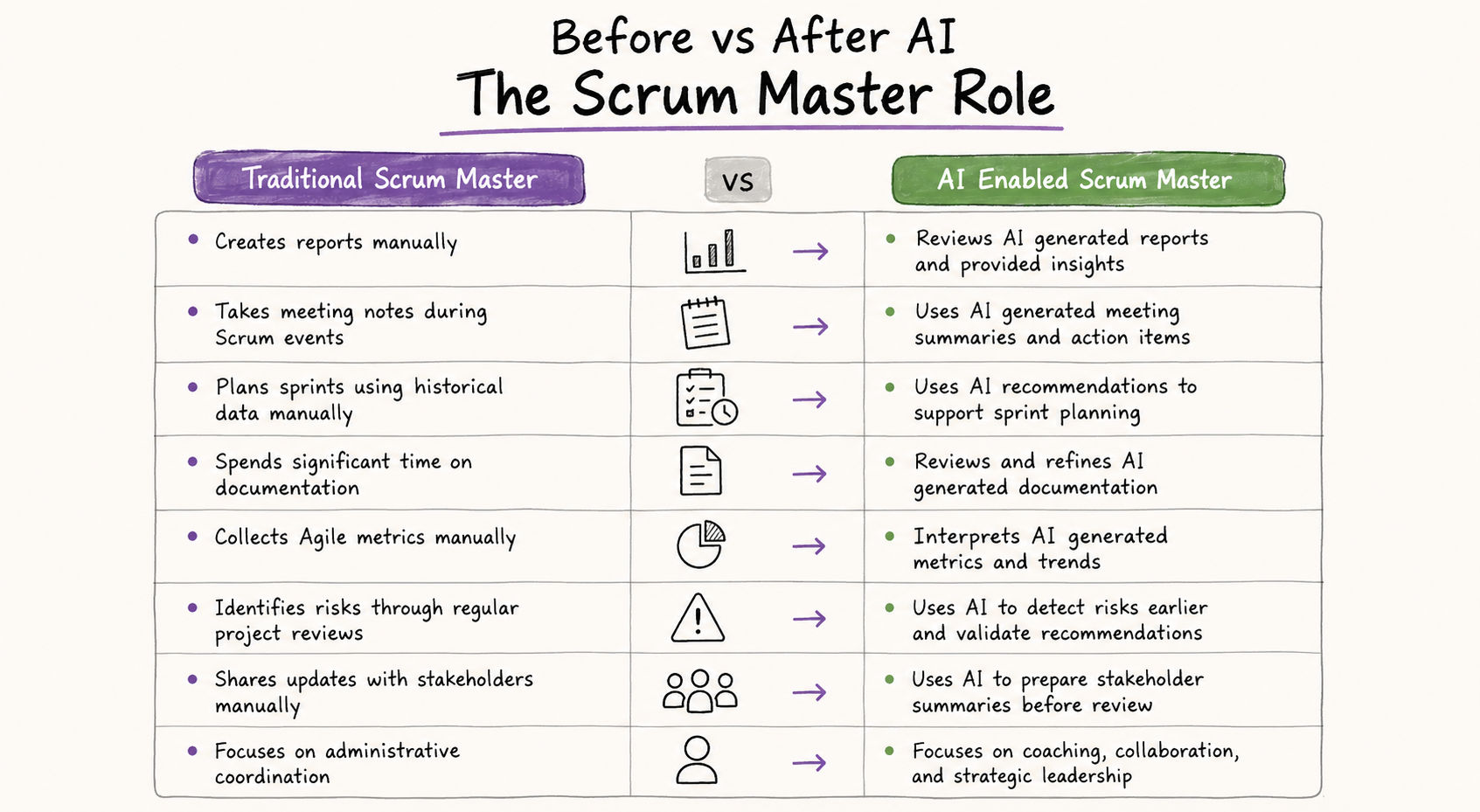
Artificial intelligence has changed how Scrum Masters work, but it has not changed why they are needed. The future of the role lies in combining AI driven efficiency with human qualities such as empathy, communication, leadership, and sound judgment.
Whether you're just starting out or looking to advance, the Guide to a Successful Career Path with the Scrum Alliance Certifications outlines a clear path for career progression in Agile.
Conclusion
Artificial intelligence is reshaping the Scrum Master role in 2026 by taking over repetitive administrative tasks and allowing professionals to focus on higher value responsibilities. Instead of spending hours preparing reports, updating project boards, or documenting meetings, Scrum Masters can dedicate more time to coaching teams, improving collaboration, and driving continuous improvement.
However, AI is a support tool, not a replacement for human leadership. Building trust, resolving conflicts, guiding organizational change, and making thoughtful decisions still require empathy, experience, and strong communication skills. These are qualities that technology cannot replicate.
Contact our upGrad KnowledgeHut experts for personalized guidance on choosing the right course, career path, and certification to achieve your goals.
Frequently Asked Questions
Will AI replace Scrum Masters in 2026?
No. AI can automate routine tasks such as meeting summaries, reporting, and backlog organization, but it cannot replace coaching, leadership, conflict resolution, or team building. Scrum Masters continue to play a critical role in helping Agile teams succeed.
How is AI changing the Scrum Master role?
AI is reducing the time spent on administrative work by automating documentation, sprint reporting, meeting notes, and project insights. This allows Scrum Masters to focus more on team coaching, stakeholder collaboration, and continuous improvement
What AI tools should Scrum Masters learn?
Some of the most useful tools include ChatGPT, Atlassian Intelligence, Microsoft Copilot, Jira AI, Azure DevOps AI, ClickUp AI, Notion AI, Miro AI, GitHub Copilot, and Slack AI. These tools help automate routine work and improve team productivity.
Do Scrum Masters need AI skills?
Yes. Understanding how to use AI tools, write effective prompts, interpret AI generated insights, and apply responsible AI practices has become increasingly valuable for Scrum Masters working in modern Agile environments.
Can AI conduct Scrum ceremonies?
AI can assist by creating agendas, summarizing discussions, capturing action items, and generating meeting notes. However, facilitating Scrum ceremonies, encouraging participation, and resolving team challenges still require a human Scrum Master.
Which Scrum Master tasks cannot be automated?
Tasks such as coaching individuals, building trust, resolving conflicts, managing organizational change, facilitating difficult conversations, and making ethical decisions depend on human judgment and cannot be fully automated.
Is prompt engineering useful for Scrum Masters?
Yes. Writing clear prompts helps Scrum Masters generate better sprint summaries, meeting agendas, stakeholder updates, user stories, and retrospective reports using AI tools, improving both quality and efficiency.
How can AI improve Sprint Planning?
AI can analyze historical sprint data, estimate team capacity, group similar user stories, predict velocity, and recommend suitable backlog items. These insights support planning, while the final decisions remain with the Scrum team.
Can AI improve Agile reporting?
Yes. AI can automatically generate sprint reports, release notes, progress updates, and stakeholder summaries, reducing manual effort and allowing Scrum Masters to focus on interpreting results and driving improvements.
How can Scrum Masters prepare for an AI enabled workplace?
Scrum Masters should continue strengthening their Agile knowledge while learning AI tools, improving data interpretation skills, understanding AI governance, and developing leadership, communication, and coaching abilities. Combining these skills will help them stay relevant as Agile practices continue to evolve.
1639 articles published
KnowledgeHut is an outcome-focused global ed-tech company. We help organizations and professionals unlock excellence through skills development. We offer training solutions under the people and proces...
Get Free Consultation
By submitting, I accept the T&C and
Privacy Policy
Ready to learn about Agile Certifications Roadmap?