
- Blog Categories
- Project Management
- Agile Management
- IT Service Management
- Cloud Computing
- Business Management
- BI And Visualisation
- Quality Management
- Cyber Security
- DevOps
- Most Popular Blogs
- PMP Exam Schedule for 2026: Check PMP Exam Date
- Top 60+ PMP Exam Questions and Answers for 2026
- PMP Cheat Sheet and PMP Formulas To Use in 2026
- What is PMP Process? A Complete List of 49 Processes of PMP
- Top 15+ Project Management Case Studies with Examples 2026
- Top Picks by Authors
- Top 170 Project Management Research Topics
- What is Effective Communication: Definition
- How to Create a Project Plan in Excel in 2026?
- PMP Certification Exam Eligibility in 2026 [A Complete Checklist]
- PMP Certification Fees - All Aspects of PMP Certification Fee
- Most Popular Blogs
- CSM vs PSM: Which Certification to Choose in 2026?
- How Much Does Scrum Master Certification Cost in 2026?
- CSPO vs PSPO Certification: What to Choose in 2026?
- 8 Best Scrum Master Certifications to Pursue in 2026
- Safe Agilist Exam: A Complete Study Guide 2026
- Top Picks by Authors
- SAFe vs Agile: Difference Between Scaled Agile and Agile
- Top 21 Scrum Best Practices for Efficient Agile Workflow
- 30 User Story Examples and Templates to Use in 2026
- State of Agile: Things You Need to Know
- Top 24 Career Benefits of a Certifed Scrum Master
- Most Popular Blogs
- ITIL Certification Cost in 2026 [Exam Fee & Other Expenses]
- Top 17 Required Skills for System Administrator in 2026
- How Effective Is Itil Certification for a Job Switch?
- IT Service Management (ITSM) Role and Responsibilities
- Top 25 Service Based Companies in India in 2026
- Top Picks by Authors
- What is Escalation Matrix & How Does It Work? [Types, Process]
- ITIL Service Operation: Phases, Functions, Best Practices
- 10 Best Facility Management Software in 2026
- What is Service Request Management in ITIL? Example, Steps, Tips
- An Introduction To ITIL® Exam
- Most Popular Blogs
- A Complete AWS Cheat Sheet: Important Topics Covered
- Top AWS Solution Architect Projects in 2026
- 15 Best Azure Certifications 2026: Which one to Choose?
- Top 22 Cloud Computing Project Ideas in 2026 [Source Code]
- How to Become an Azure Data Engineer? 2026 Roadmap
- Top Picks by Authors
- Top 40 IoT Project Ideas and Topics in 2026 [Source Code]
- The Future of AWS: Top Trends & Predictions in 2026
- AWS Solutions Architect vs AWS Developer [Key Differences]
- Top 20 Azure Data Engineering Projects in 2026 [Source Code]
- 25 Best Cloud Computing Tools in 2026
- Most Popular Blogs
- Company Analysis Report: Examples, Templates, Components
- 400 Trending Business Management Research Topics
- Business Analysis Body of Knowledge (BABOK): Guide
- ECBA Certification: Is it Worth it?
- Top Picks by Authors
- Top 20 Business Analytics Project in 2026 [With Source Code]
- ECBA Certification Cost Across Countries
- Top 9 Free Business Requirements Document (BRD) Templates
- Business Analyst Job Description in 2026 [Key Responsibility]
- Business Analysis Framework: Elements, Process, Techniques
- Most Popular Blogs
- Best Career options after BA [2026]
- Top Career Options after BCom to Know in 2026
- Top 10 Power Bi Books of 2026 [Beginners to Experienced]
- Power BI Skills in Demand: How to Stand Out in the Job Market
- Top 15 Power BI Project Ideas
- Top Picks by Authors
- 10 Limitations of Power BI: You Must Know in 2026
- Top 45 Career Options After BBA in 2026 [With Salary]
- Top Power BI Dashboard Templates of 2026
- What is Power BI Used For - Practical Applications Of Power BI
- SSRS Vs Power BI - What are the Key Differences?
- Most Popular Blogs
- Data Collection Plan For Six Sigma: How to Create One?
- Quality Engineer Resume for 2026 [Examples + Tips]
- 20 Best Quality Management Certifications That Pay Well in 2026
- Six Sigma in Operations Management [A Brief Introduction]
- Top Picks by Authors
- Six Sigma Green Belt vs PMP: What's the Difference
- Quality Management: Definition, Importance, Components
- Adding Green Belt Certifications to Your Resume
- Six Sigma Green Belt in Healthcare: Concepts, Benefits and Examples
- Most Popular Blogs
- Latest CISSP Exam Dumps of 2026 [Free CISSP Dumps]
- CISSP vs Security+ Certifications: Which is Best in 2026?
- Best CISSP Study Guides for 2026 + CISSP Study Plan
- How to Become an Ethical Hacker in 2026?
- Top Picks by Authors
- CISSP vs Master's Degree: Which One to Choose in 2026?
- CISSP Endorsement Process: Requirements & Example
- OSCP vs CISSP | Top Cybersecurity Certifications
- How to Pass the CISSP Exam on Your 1st Attempt in 2026?
- Most Popular Blogs
- Top 7 Kubernetes Certifications in 2026
- Kubernetes Pods: Types, Examples, Best Practices
- DevOps Methodologies: Practices & Principles
- Docker Image Commands
- Top Picks by Authors
- Best DevOps Certifications in 2026
- 20 Best Automation Tools for DevOps
- Top 20 DevOps Projects of 2026
- OS for Docker: Features, Factors and Tips
- More
- Agile & PMP Practice Tests
- Agile Testing
- Agile Scrum Practice Exam
- CAPM Practice Test
- PRINCE2 Foundation Exam
- PMP Practice Exam
- Cloud Related Practice Test
- Azure Infrastructure Solutions
- AWS Solutions Architect
- IT Related Pratice Test
- ITIL Practice Test
- Devops Practice Test
- TOGAF® Practice Test
- Other Practice Test
- Oracle Primavera P6 V8
- MS Project Practice Test
- Project Management & Agile
- Project Management Interview Questions
- Release Train Engineer Interview Questions
- Agile Coach Interview Questions
- Scrum Interview Questions
- IT Project Manager Interview Questions
- Cloud & Data
- Azure Databricks Interview Questions
- AWS architect Interview Questions
- Cloud Computing Interview Questions
- AWS Interview Questions
- Kubernetes Interview Questions
- Web Development
- CSS3 Free Course with Certificates
- Basics of Spring Core and MVC
- Javascript Free Course with Certificate
- React Free Course with Certificate
- Node JS Free Certification Course
- Data Science
- Python Machine Learning Course
- Python for Data Science Free Course
- NLP Free Course with Certificate
- Data Analysis Using SQL
Kano Model: How to Prioritise Product Features (With Example)
Updated on Nov 10, 2026
Share:
Table of Contents
View all
Quick Overview
- The Kano model is a product management framework that classifies product features based on their impact on customer satisfaction. It helps teams understand customer expectations and prioritise features that deliver meaningful value.
- Categories of the Kano model: The five categories are must-be features (basic expectations), performance features (improve satisfaction as performance increases), attractive features (unexpected benefits), indifferent features (have little impact on satisfaction), and reverse features (some customers dislike them).
- How does the Kano model work? It uses functional and dysfunctional survey questions to understand how customers feel when a feature is available and when it is absent. Teams combine the responses using a Kano evaluation matrix to classify each feature.
- This guide explains what the Kano model is, its five feature categories, how the evaluation process works, and how product managers can use practical examples from mobile apps, e-commerce platforms, and smartphones to prioritise features and improve product roadmaps.
Product managers looking to strengthen their approach to feature prioritization and customer-focused innovation can explore the AI Masters Program to build expertise in AI, machine learning, and emerging technologies shaping modern product development.
Master the Right Skills & Boost Your Career
Avail your free 1:1 mentorship session
What is the Kano model?
The Kano model is a product management framework that helps classify product features based on their impact on customer satisfaction. Developed by Japanese professor Noriaki Kano, it explains how different product attributes influence how customers feel about a product.
The framework groups features into five categories: must be, performance, attractive, indifferent, and reverse. Each category represents a different relationship between a product feature and customer satisfaction.
Product managers use the Kano model to:
- Understand what customers expect from a product.
- Identify features that have the greatest impact on satisfaction.
- Separate essential requirements from additional features.
- Avoid spending resources on features customers do not value.
- Make more informed product development decisions.
What is the purpose of the Kano model in product management?
The main purpose of the Kano model in product management is to help teams understand which product features matter most to customers. It provides a customer focused way to evaluate feature ideas instead of prioritizing them only based on business assumptions or internal preferences.
Its key uses include:
- Feature prioritization: Helps product managers decide which features should receive attention first.
- Customer satisfaction: Identifies features that can improve the overall product experience.
- Product planning: Supports better decisions when creating or updating a product roadmap.
- Resource allocation: Helps teams avoid investing too much time in features with limited customer value.
- Competitive differentiation: Highlights opportunities to introduce features that customers may not expect but appreciate.
Also read:Top Agile Prioritization Techniques: Methods & Tips
What are the five categories of the Kano model?
The Kano model divides product features into five categories based on how they influence customer satisfaction. Understanding these categories helps product teams distinguish between basic expectations and features that can make a product stand out.
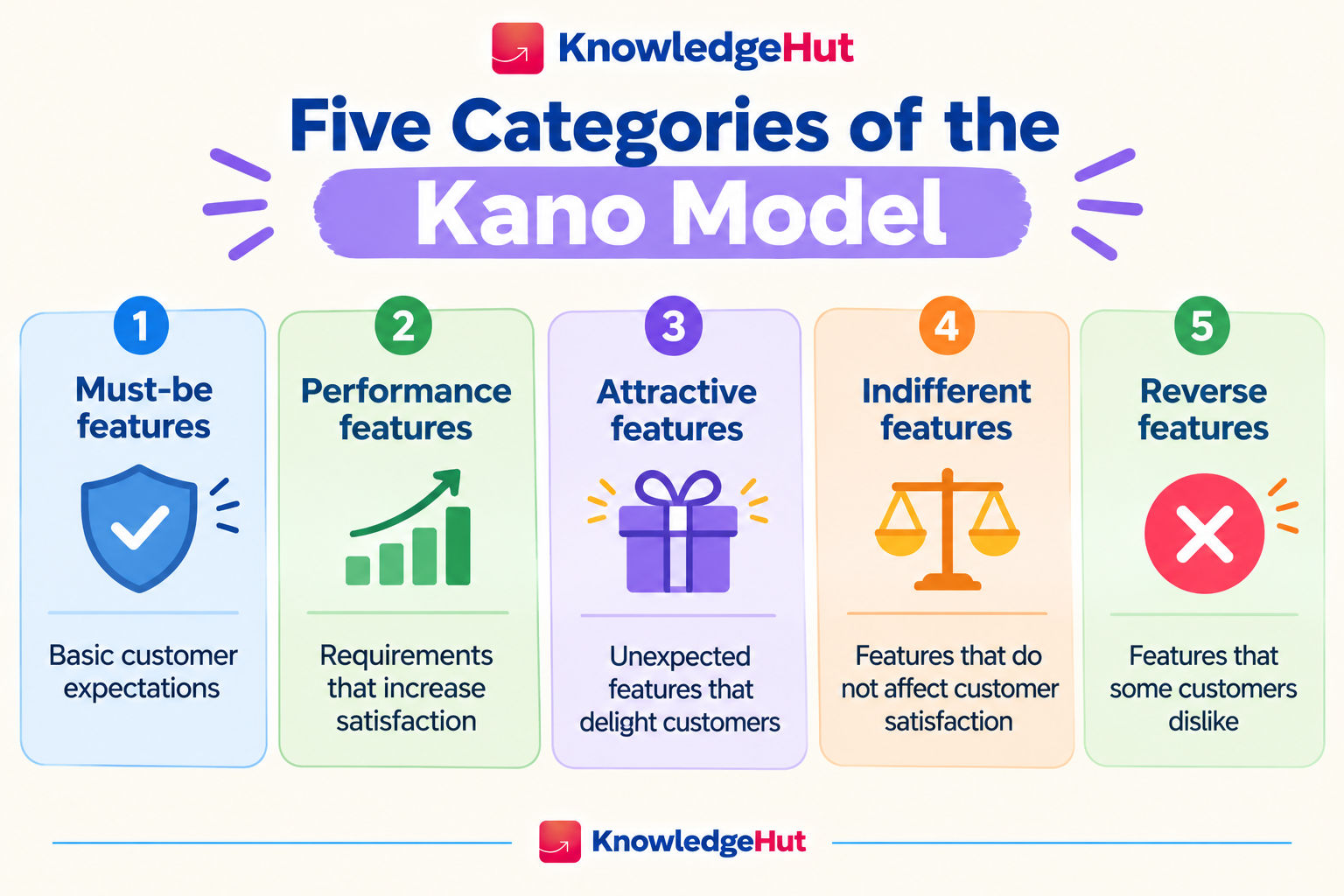
Must be features: Basic customer expectations
Must be features are the basic requirements customers expect a product to have. Customers may not feel especially satisfied when these features are available, but their absence can cause significant dissatisfaction.
For example, customers expect an e-commerce platform to process payments securely. If the payment system does not work properly, customers are likely to lose trust in the platform.
Common characteristics include:
- Customers consider these features essential.
- Their presence is often taken for granted.
- Their absence creates dissatisfaction.
- They should be addressed before optional enhancements.
Performance features: Requirements that increase satisfaction
Performance features are attributes where customer satisfaction generally increases as the product performs better. Customers notice these features and often compare them when choosing between competing products.
For example, smartphone users may value longer battery life. A phone that lasts longer between charges can offer a better experience.
Key characteristics include:
- Better performance generally leads to greater satisfaction.
- Customers can compare these features across products.
- They often influence purchasing decisions.
- Their improvement can strengthen a product's competitive position.
Attractive features: Unexpected features that delight customers
Attractive features are additional benefits that customers do not necessarily expect. Their presence can create a positive impression, while their absence usually does not cause dissatisfaction.
For example, a mobile banking app that offers personalized spending insights may pleasantly surprise users.
These features are useful because they can:
- Create a memorable customer experience.
- Differentiate a product from competitors.
- Exceed basic customer expectations.
- Encourage customers to explore more product capabilities.
Indifferent features: Features that do not affect customer satisfaction
Indifferent features are product attributes that have little or no impact on customer satisfaction. Customers generally do not care whether these features are available.
For example, a rarely used customization option may not influence how customers evaluate a product.
Product teams should examine these features carefully because they may consume development time without creating meaningful customer value.
Reverse features: Features that some customers dislike
Reverse features are attributes that can reduce customer satisfaction when they are included. Some customers may prefer a simpler product experience and dislike additional functionality.
For example, users who prefer a clean mobile interface may find excessive notifications or complicated menus frustrating.
Product managers should consider:
- Whether a feature creates unnecessary complexity.
- Whether different customer groups have different preferences.
- Whether the feature should be optional.
- Whether removing or simplifying it could improve the experience.
Product professionals can explore the PG Certificate in AI Powered Product and Design Thinking to learn how AI, customer insights, and design thinking can guide feature prioritization and create products that better meet user expectations.
How does the Kano model work?
The Kano model works by collecting customer feedback about individual product features and classifying each feature according to the responses. It uses two questions for every feature to understand how customers feel when the feature is present and when it is absent.
The results help product managers identify which features meet basic expectations, increase satisfaction, or have little value to customers.
1. Functional and dysfunctional customer survey questions
A Kano survey uses two types of questions to evaluate each product feature.
- Functional question: Asks how customers would feel if a particular feature were available.
- Dysfunctional question: Asks how customers would feel if the same feature were not available.
For example, a product team evaluating a dark mode option might ask:
- Functional: How would you feel if this app offered a dark mode?
- Dysfunctional: How would you feel if this app did not offer a dark mode?
Customers can select responses such as:
- I like it.
- I expect it.
- I am neutral.
- I can tolerate it.
- I dislike it.
2. Kano evaluation matrix for classifying product features
The Kano evaluation matrix is used to interpret the answers to functional and dysfunctional questions. It combines the two responses to determine the category of a product feature.
The matrix helps classify features into the five categories:
- Must be
- Performance
- Attractive
- Indifferent
- Reverse
3. Customer responses and feature classification
After collecting survey responses, product teams compare the answers for each feature using the evaluation matrix. The most suitable category is assigned based on the response combinations.
For example:
- If customers expect a feature and become dissatisfied without it, it may be classified as must be.
- If satisfaction improves when a feature is available, it may be classified as performance.
- If customers appreciate a feature they did not expect, it may be classified as attractive.
- If customers show little interest either way, it may be classified as indifferent.
- If customers prefer the product without a feature, it may be classified as reverse.
How to use the Kano model to prioritize product features
Product managers can use the Kano model as part of their feature prioritization process. It helps teams move from collecting ideas to understanding which features are likely to deliver the most customer value.
The process involves identifying possible features, collecting customer feedback, evaluating responses, and validating priorities before adding features to the roadmap.
1. Identify potential product features
Start by creating a list of features that could improve the product. These ideas may come from customer feedback, support requests, market research, competitor analysis, or internal product discussions.
While preparing the list:
- Focus on features connected to customer needs.
- Include both essential requirements and potential enhancements.
- Avoid adding unrelated ideas to the same evaluation.
- Make sure each feature is clearly described.
2. Design and conduct Kano surveys
Once the feature list is ready, prepare functional and dysfunctional questions for every feature. Keep the questions simple so customers can understand what they are being asked.
For better survey results:
- Use clear and unbiased language.
- Ask both functional and dysfunctional questions.
- Provide consistent response options.
- Collect feedback from relevant customer groups.
- Avoid making the survey unnecessarily long.
3. Analyze customer responses and classify features
After the survey, review the responses and use the evaluation matrix to classify each feature. This helps teams understand which product attributes are essential, which improve satisfaction, and which may not be worth developing.
During analysis:
- Group responses according to the five categories.
- Look for patterns across different customer groups.
- Identify features with mixed or unexpected responses.
- Review the number of responses supporting each classification.
- Investigate differences in customer preferences.
4. Prioritize features based on customer satisfaction
Use the classifications to decide which features deserve attention. Must be features usually need to be addressed first, while performance features can be prioritized based on their expected customer value.
A practical approach is to:
- Address essential customer expectations.
- Evaluate performance features based on their impact and development effort.
- Consider attractive features that can differentiate the product.
- Reassess indifferent features before allocating resources.
- Be cautious about reverse features that may create a poor experience.
5. Validate priorities before adding features to the product roadmap
Before finalizing the product roadmap, validate the shortlisted features with relevant stakeholders and available product data. Customer preferences are important, but they should be considered alongside business requirements and technical constraints.
Check whether:
- The feature supports the product strategy.
- The expected customer benefit justifies the development effort.
- The team has the resources to build and maintain it.
- The feature fits the product's current priorities.
- Further customer testing is required.
Product managers can strengthen their customer-centric approach to feature prioritization with CSPO® Certification Training, which builds practical skills in product ownership, backlog management, and delivering customer value.
What is an example of the Kano model?
The Kano model becomes easier to understand when applied to familiar products. The following examples show how different features can fall into different categories depending on customer expectations and preferences.
1. Kano model example for a mobile app
Consider a mobile banking app that wants to improve its user experience. The product team collects customer feedback about several possible features.
The features may be classified as follows:
- Must be: Secure login and reliable account access.
- Performance: Faster transaction processing and quicker app loading.
- Attractive: Personalized spending insights and smart savings suggestions.
- Indifferent: Decorative interface animations that do not improve usability.
- Reverse: Frequent promotional notifications that some users find distracting.
2. Kano model example for an e-commerce platform
An e-commerce platform wants to improve the shopping experience and understand which features customers value most.
Its features could be grouped as follows:
- Must be: Secure payment processing and accurate order information.
- Performance: Faster delivery and more accurate product search results.
- Attractive: Personalized product recommendations and early access to selected offers.
- Indifferent: Additional decorative elements that do not improve shopping.
- Reverse: Too many pop ups or promotional messages that interrupt browsing.
3. Kano model example for a smartphone
A smartphone manufacturer is planning its next product release and wants to understand which features matter to buyers.
Possible classifications include:
- Must be: Reliable calling, basic security, and a functional operating system.
- Performance: Battery life, camera quality, and processing speed.
- Attractive: Innovative camera modes or useful AI powered features.
- Indifferent: Features that customers rarely notice or use.
- Reverse: Unwanted preinstalled apps or unnecessary notifications.
4. Kano model feature prioritization matrix
A feature prioritization matrix brings the survey findings together so product managers can compare different features and make decisions.
The following table illustrates how a team might organize its findings:
Feature category |
Customer response |
Suggested priority |
| Must be | Expected as a basic requirement | Address first |
| Performance | Satisfaction increases with better performance | Prioritize based on impact |
| Attractive | Creates unexpected satisfaction | Consider for differentiation |
| Indifferent | Has little effect on satisfaction | Lower priority |
| Reverse | May reduce satisfaction | Review or make optional |
Also read: Top 10 Six Sigma Black Belt Tools You Need to Know
Conclusion
The Kano model helps product managers and development teams understand customer expectations and prioritize features based on their impact on satisfaction. It is especially useful when teams have multiple feature ideas but limited time and resources.
However, customer preferences should not be the only factor in product decisions. Consider business goals, development costs, and technical feasibility before finalizing the product roadmap. Start by collecting customer feedback and classifying features into the five Kano categories to focus on what customers truly value.
Have A Query? Get in Touch With Our Customer Support | upGrad KnowledgeHut
Frequently Asked Questions (FAQs)
1. How do you conduct a Kano analysis?
To conduct a Kano analysis, first identify the product features you want to evaluate. Create functional and dysfunctional questions for each feature and collect customer responses. Use the Kano evaluation matrix to classify the features and understand their impact on customer satisfaction.
2. What is the objective of the Kano model?
The objective of the Kano model is to understand how different product features influence customer satisfaction. It helps product managers distinguish between basic expectations, performance requirements, and unexpected features that delight customers. This makes feature prioritization more customer focused.
3. What are the advantages of the Kano approach?
The Kano approach helps teams prioritize features based on customer expectations and satisfaction. It supports better product planning, reduces investment in low value features, and identifies opportunities to differentiate a product. It also helps teams make more informed roadmap decisions.
4. What are the three types of product features defined in the Kano model?
The three commonly highlighted feature types are must be, performance, and attractive features. Must features meet basic expectations, performance features increase satisfaction as they improve, and attractive features provide unexpected benefits. The complete Kano model also includes indifferent and reverse categories.
5. What are the four categories of the Kano model customer satisfaction?
The Kano model is sometimes discussed using four broad customer response categories: must be, performance, attractive, and indifferent. However, the complete model includes a fifth category called reverse features, which may reduce satisfaction for certain customers.
6. How do you explain Kano analysis?
Kano analysis is a method of evaluating product features based on how customers feel when a feature is present or absent. It uses two survey questions and an evaluation matrix to classify features. The findings help teams understand which features matter most to customers.
7. How do you use Kano analysis?
Start by listing potential product features and preparing functional and dysfunctional survey questions. Collect customer responses, classify each feature using the Kano evaluation matrix, and compare the results. Use these findings alongside business goals and development feasibility to prioritize features.
8. What is the Kano model in design thinking?
In design thinking, the Kano model helps teams understand customer needs and identify features that can improve the user experience. It supports the ideation and prioritization stages by showing which product attributes meet expectations and which can delight users.
9. What is the Kano model used for in Six Sigma?
The Kano model can support Six Sigma projects by helping teams understand customer requirements and satisfaction. It helps identify essential product or service attributes that should be considered during quality improvement. Teams can use these insights alongside other Six Sigma tools.
10. What tools are used for the Kano model?
Kano analysis mainly uses customer surveys and an evaluation matrix to classify product features. Teams may also use spreadsheets, survey platforms, customer feedback tools, and data analysis software to collect responses and interpret results.
11. What is the purpose of Kano analysis in product management?
The purpose of Kano analysis in product management is to help teams decide which features should be developed, improved, or deprioritized. It connects customer feedback with product planning and helps ensure that development efforts focus on features that deliver meaningful customer value.
1661 articles published
KnowledgeHut is an outcome-focused global ed-tech company. We help organizations and professionals unlock excellence through skills development. We offer training solutions under the people and proces...
Get Free Consultation
By submitting, I accept the T&C and
Privacy Policy
Ready to learn about Agile Certifications Roadmap?