
CSPO Prerequisites Checklist: What Is Needed Before Enrolling in 2026
Updated on Jul 30, 2026 | 180 views
Share:
Table of Contents
View all
Quick Overview
- The Certified Scrum Product Owner (CSPO) certification through Scrum Alliance is relatively straightforward to pursue because there are no formal or strict prerequisites for enrolment.
- No specific educational or technical background is required. A particular degree, academic stream, coding experience, or technical qualification is not necessary for CSPO enrolment.
- No prior Agile or Product Owner experience is required. Previous Scrum experience, Agile work experience, or Product Owner experience is not mandatory, making CSPO suitable for freshers and career changers.
- No prior Scrum certification is required. CSM or another Agile credential does not need to be completed before enrolling in CSPO.
- In this guide, readers will learn about CSPO prerequisites, eligibility criteria, admission requirements, recommended preparation, and who should consider the certification.
"Looking for an authorised CSPO training option? Explore upGrad KnowledgeHut CSPO Certification Training to learn more about course details and enrolment."
Master the Right Skills & Boost Your Career
Avail your free 1:1 mentorship session
CSPO Prerequisites Checklist
Before enrolling in a CSPO certification course, understanding the basic eligibility requirements helps determine readiness. CSPO has simple prerequisites. Previous Scrum certification, work experience, specific educational qualifications, and coding skills are not required.
Mandatory CSPO Requirements
1. No Previous Scrum Certification Required
A CSM or any other Scrum certification is not required before joining a CSPO course. Scrum Alliance allows direct enrolment in an authorised CSPO training programme.
CSM and CSPO focus on different career roles. CSM covers Scrum Master responsibilities, while CSPO focuses on product ownership, customer value, product vision, stakeholder collaboration, and Product Backlog management.
2. No Work Experience Required
Previous work experience is not required for CSPO certification. The course is suitable for fresh graduates, career changers, and professionals moving into product-focused roles.
Professionals from business analysis, project management, product management, marketing, operations, technology, and Scrum Team backgrounds can pursue CSPO.
3. No Educational Qualification Required
CSPO does not require any specific degree or academic qualification. Candidates from different educational backgrounds can enroll in the certification course.
4. No Coding Knowledge Required
Programming or coding skills are not required for CSPO. The Product Owner role focuses on customer needs, product goals, prioritisation, Product Backlog management, stakeholder communication, and value creation.
Basic technology awareness can be useful, but coding experience is not a prerequisite.
5. Completion of Authorised CSPO Training
Completion of an authorised Scrum Alliance CSPO training course is required to earn the certification. Self-study, professional experience, or other Scrum certifications cannot replace the official training requirement.
5. Full Training Attendance Required
Completing the complete CSPO training programme is required. Attendance policies may vary by trainer, so course schedules and requirements should be checked before registration.
6. Basic Setup for Online Training
Online CSPO training generally requires:
- Laptop or desktop computer
- Reliable internet connection
- Microphone
- Webcam, if required
- Quiet learning environment
No specialised software or advanced technical equipment is required.
Recommended Preparation Before CSPO
1. Basic Scrum Knowledge
Advanced Scrum knowledge is not required before CSPO training. Basic familiarity with Scrum concepts can improve learning experience.
Important concepts include:
- Scrum framework
- Scrum Team
- Product Backlog
- Sprint
- Product Goal
- Scrum Events
2. Understanding the Product Owner Role
Basic knowledge of Product Owner responsibilities can help with CSPO training activities and discussions.
Important areas include:
- Product vision
- Customer needs
- Stakeholder collaboration
- Prioritisation
- Product Backlog management
- Value-based decision-making
Basic Scrum knowledge and product ownership awareness provide a strong foundation for starting CSPO training.
Who Should Take the CSPO Certification?
CSPO certification is a good choice for professionals who want to build Product Owner skills, explore Agile product roles, or improve collaboration with Scrum Teams. Since no previous Product Owner experience is required, the course is suitable for professionals from a wide range of backgrounds.
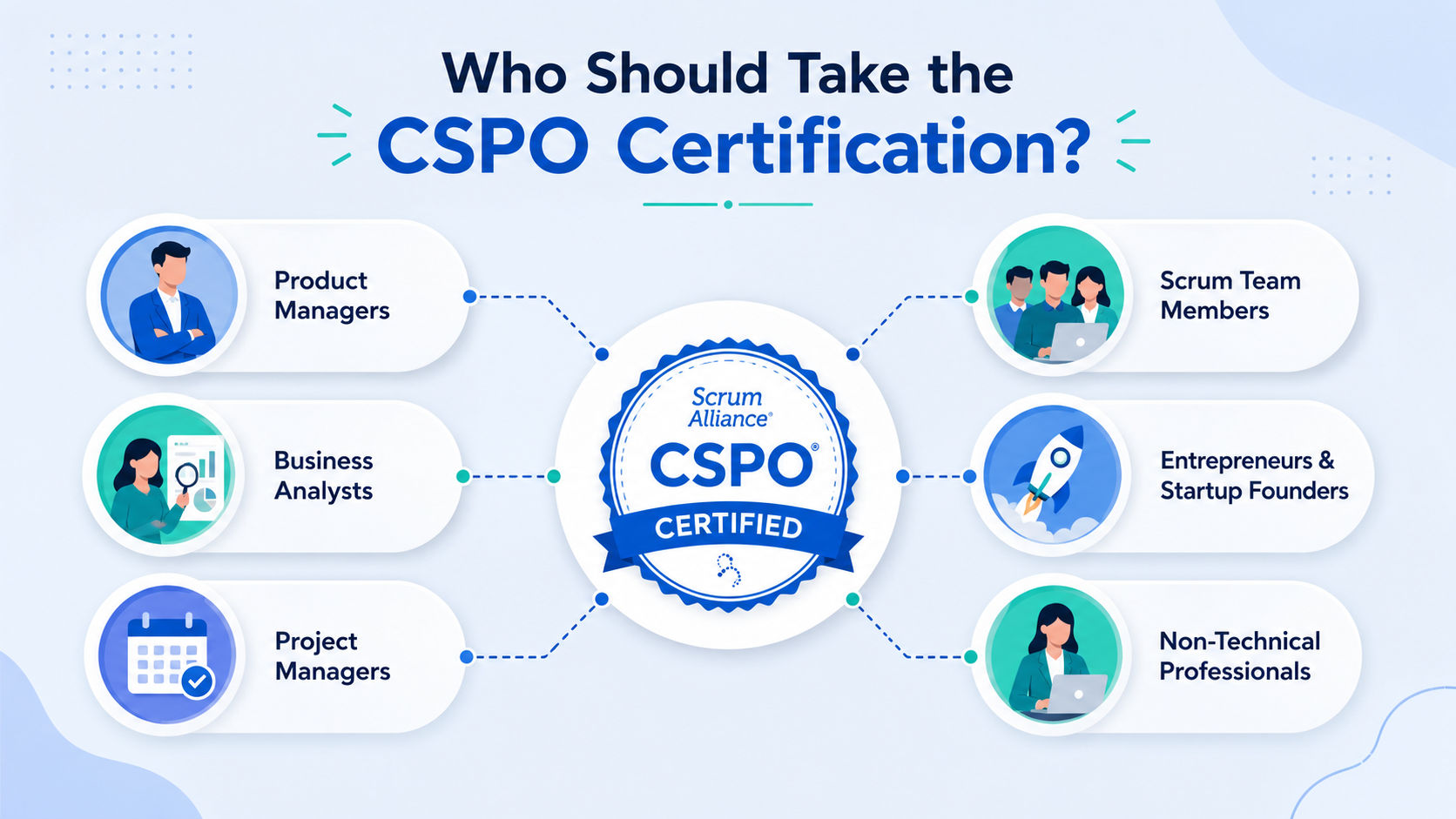
1. Product Managers
Product Managers can use CSPO to strengthen skills in product vision, backlog prioritisation, stakeholder collaboration, and delivering customer value. The certification is especially valuable for teams working with Scrum or Agile practices.
2. Business Analysts
A background in business analysis fits well with product ownership. CSPO helps Business Analysts understand Product Backlog management and prepares them for roles such as Product Owner or Associate Product Manager.
3. Project Managers
Project Managers planning to work in Agile environments can benefit from CSPO. The course introduces a product-focused approach that emphasises customer value, prioritisation, and continuous improvement instead of traditional project planning.
4. Scrum Team Members
Developers, testers, designers, and other Scrum Team members can gain a better understanding of how Product Owners make decisions, prioritise work, and align products with customer needs.
5. Entrepreneurs and Startup Founders
Building a successful product requires the right priorities. CSPO introduces practical techniques for understanding customers, defining product goals, managing backlogs, and focusing on features that deliver the most value.
6. Non-Technical Professionals
A technical background is not required for CSPO. Professionals from marketing, sales, finance, operations, customer support, and similar business functions can use the certification to move into Product Owner or product management roles.
Also Read: Who Should Get CSPO Certified?
Recommended Knowledge Before Taking a CSPO Course
CSPO has minimal prerequisites, but some basic knowledge can make the training easier to understand. The following areas are not required for admission. Basic familiarity with these concepts can provide a helpful foundation before starting a CSPO certification course.
1. Basic Scrum Concepts
Basic knowledge of Scrum can help in understanding CSPO training concepts. Familiarity with the Scrum framework, Scrum Team, accountabilities, Scrum Events, Product Backlog, Sprint, Product Goal, and Increment can be useful.
Advanced Scrum experience is not required. A basic understanding of Scrum terms and concepts is enough before enrolling in CSPO training.
2. Product Owner Responsibilities
Understanding the basic responsibilities of a Product Owner can help connect training concepts with real-world situations.
Important areas include:
- Product vision
- Customer needs
- Stakeholder collaboration
- Product goals
- Prioritisation
- Product Backlog ordering
Previous Product Owner experience is not required. Basic awareness of the role is recommended for CSPO training.
3. Agile Principles
Basic familiarity with Agile principles can provide useful context during CSPO training.
Important concepts include:
- Iterative delivery
- Customer feedback
- Collaboration
- Adaptability
- Continuous improvement
- Responding to changing requirements
Detailed knowledge of Agile methods is not required. A basic understanding of Agile thinking is sufficient before enrolment.
4. Product Backlog Fundamentals
Basic knowledge of the Product Backlog can support learning during CSPO discussions and activities.
Useful concepts include:
- Backlog items
- Prioritisation
- Product requirements
- Customer needs
- Value-based decision-making
Expert knowledge of backlog management is not required. CSPO training develops deeper understanding of Product Backlog management and Product Owner responsibilities.
"Build a strong Agile foundation with upGrad KnowledgeHut Agile Management Courses before enrolling in CSPO certification training."
Common Myths About CSPO Prerequisites
Several misconceptions can make CSPO eligibility requirements appear more difficult than they are. The CSPO prerequisites are beginner-friendly, with no requirement for prior Scrum certification, work experience, coding skills, or a specific educational qualification.
Below are the common myths about CSPO prerequisites:
1. CSM Is Required Before CSPO
No. CSM is not required before CSPO. CSPO can be pursued directly without completing Certified ScrumMaster (CSM) or any other Scrum certification.
2. Only Experienced Professionals Can Enroll
No. Previous work experience is not mandatory for CSPO. Fresh graduates, career changers, and professionals from business, marketing, operations, technology, project management, and other fields can enroll.
3. Coding Knowledge Is Mandatory
No. Coding skills are not required for CSPO. The certification focuses on product ownership, customer value, prioritisation, stakeholder collaboration, and Product Backlog management rather than programming.
4. A Degree Is Required
No. A specific degree or educational qualification is not required for CSPO admission. Candidates from any academic background can pursue certification.
5. CSPO Requires an Entrance Exam
No. CSPO does not have an entrance examination. Certification is earned by completing the required authorised CSPO training course rather than passing an admission test.
Conclusion
The CSPO prerequisites are simple and accessible, with no requirement for prior Scrum certification, work experience, a specific degree, or coding skills. The key requirement is completing an authorised CSPO training course and meeting the applicable attendance requirements.
Basic Scrum and Product Owner knowledge can make the training easier but remains recommended rather than mandatory. With minimal entry barriers, CSPO can be a practical starting point for professionals moving towards Product Owner and Agile product roles.
Have A Query? Get in Touch With Our Customer Support | upGrad KnowledgeHut
Frequently Asked Questions (FAQs)
How long does it take to complete CSPO certification?
The standard CSPO course involves 16 hours of training. The overall schedule can differ depending on the training provider and delivery format. Courses may be organised across multiple sessions or completed through a shorter intensive schedule.
How can a CSPO course be verified as authorized?
A CSPO course should be checked through the Scrum Alliance platform before enrolment. Trainer credentials and course details should also be verified before making payment. Checking authorization helps ensure that the selected course meets Scrum Alliance certification requirements.
What is the CSPO certification validity period?
CSPO certification is maintained through the Scrum Alliance renewal system. Certification holders should check the certification dashboard for the applicable renewal date and current requirements. Since certification policies can change, the latest Scrum Alliance guidance should be reviewed before renewal.
How often does CSPO certification need renewal?
CSPO certification requires periodic renewal through Scrum Alliance. Renewal involves meeting the applicable Scrum Alliance requirements within the specified renewal period. Current guidance should be checked for the latest renewal fees, timelines, membership requirements, and Scrum Education Unit requirements.
Can non-IT professionals pursue CSPO certification?
Yes, CSPO can be pursued by professionals outside the IT sector. Backgrounds in marketing, sales, finance, operations, business administration, customer service, and other functions can provide transferable skills for product ownership. Coding or software development experience is not a prerequisite.
What skills should be developed alongside CSPO certification?
Useful complementary skills include product discovery, customer research, stakeholder management, product analytics, communication, prioritization, user story development, and market analysis. Knowledge of tools such as Jira, Confluence, product analytics platforms, and collaboration software can also support practical Product Owner work.
How can the CSPO certificate be accessed after training?
CSPO certification details become available through the Scrum Alliance account after successful course completion and certification processing. The digital credential can be used on professional profiles, CVs, and other career documents. Certification records can also be managed through the Scrum Alliance platform.
What is the difference between CSPO and CSM certification?
CSPO focuses on Product Owner responsibilities, including product vision, customer value, prioritization, stakeholder collaboration, and Product Backlog management. CSM focuses on Scrum Master responsibilities, including Scrum facilitation, team effectiveness, and supporting Scrum adoption. The appropriate certification depends on the preferred Agile career direction.
What career opportunities are available after CSPO certification?
CSPO can support career paths such as Product Owner, Associate Product Manager, Business Analyst, Product Manager, and Agile product professional. Actual job requirements vary depending on the organization, industry, and seniority level. Practical product experience combined with CSPO knowledge can strengthen career opportunities.
What should be checked before paying for a CSPO course?
Scrum Alliance authorization and trainer credentials should be verified before payment. Course duration, delivery format, total fees, schedule, cancellation policy, attendance requirements, and certification process should also be reviewed. A clear understanding of course inclusions can help avoid unexpected costs or unsuitable training arrangements.
1639 articles published
KnowledgeHut is an outcome-focused global ed-tech company. We help organizations and professionals unlock excellence through skills development. We offer training solutions under the people and proces...
Get Free Consultation
By submitting, I accept the T&C and
Privacy Policy
Ready to learn about Agile Certifications Roadmap?