
- Home
- Blog
- Artificial Intelligence
- What is an AI Masters Program? A Complete Overview for 2026
What is an AI Masters Program? A Complete Overview for 2026
Updated on Jul 29, 2026 | 175 views
Share:
Table of Contents
View all
- What is an AI Masters Program?
- Why AI Masters Programs Are More Relevant Than Ever in 2026
- Who Should Pursue an AI Masters Program?
- Eligibility Requirements for an AI Masters Program
- What Will You Learn in an AI Masters Program?
- Skills You Gain During an AI Masters Program
- Career Opportunities After an AI Masters Program
- Is an AI Masters Program Worth It in 2026?
- Conclusion
Quick Overview
- An AI Master's Program is a postgraduate degree that builds advanced expertise in machine learning, deep learning, generative AI, and other core AI technologies.
- It combines technical coursework, hands-on projects, and research to prepare graduates for specialized AI careers across industries.
- AI Master's programs are increasingly relevant as organizations adopt AI at scale and demand professionals with advanced technical skills.
- In this guide, you'll learn what an AI Master's Program is, who should pursue it, eligibility requirements, the curriculum, career opportunities, and whether it is worth it in 2026.
If you're planning to build expertise in artificial intelligence, explore the AI Masters Program to gain relevant skills through a structured learning path.
What is an AI Masters Program?
An AI Masters Program is a postgraduate degree that provides advanced education in Artificial Intelligence, preparing students to design, build, evaluate, and deploy intelligent systems capable of solving complex business and technical problems.
Unlike undergraduate programs that introduce broad computing concepts, an AI Master's focuses specifically on developing expertise in AI technologies and their practical applications. Students gain deeper knowledge through advanced coursework, research, industry projects, and hands on learning experiences.
The primary objective is not simply to teach programming but to help students understand how intelligent systems learn from data, make predictions, automate decisions, and solve real world challenges responsibly.
Universities are increasingly offering dedicated AI programs because employers need professionals with specialized expertise rather than general software development knowledge. Industries including healthcare, banking, automotive, manufacturing, retail, logistics, and cybersecurity are actively investing in AI driven innovation.
Planning a career in AI? Read Microsoft AI Masters Program Graduate Salary & Career Outcomes [2026] to understand the roles, salaries, and opportunities available to graduates.
AI Masters Program Journey
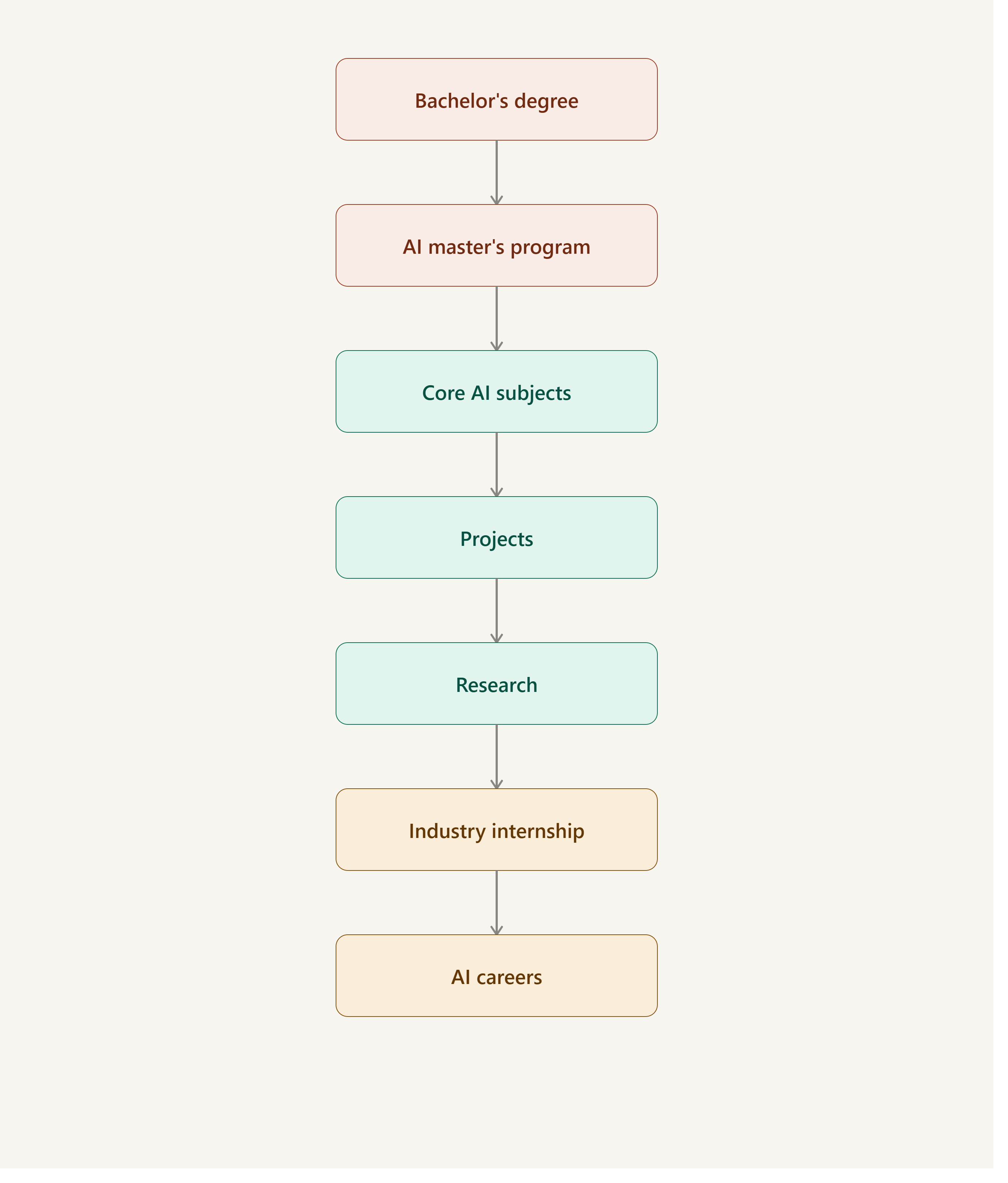
For example, a software engineering graduate pursuing an AI Master's may work on developing an intelligent medical image analysis system during the program. This experience combines classroom learning with practical problem solving, making graduates more prepared for industry roles.
This AI Masters Program Overview highlights that the degree is designed not only for academic learning but also for building practical skills that employers increasingly expect.
Why AI Masters Programs Are More Relevant Than Ever in 2026
The demand for AI professionals has grown rapidly over the past few years, and 2026 marks another significant milestone in that journey. Organizations are moving beyond experimenting with AI to integrate it into everyday business operations. As a result, the need for professionals with advanced AI knowledge continues to increase.
One major reason is the widespread adoption of Generative AI. Businesses now use AI to improve customer service, automate content creation, enhance software development, support decision making, and optimize operations. These changes require professionals who understand both AI technologies and responsible implementation.
Enterprise AI adoption has also expanded across industries. Financial institutions use AI for fraud detection, hospitals apply AI to assist medical diagnosis, retailers personalize customer experiences, and manufacturers improve predictive maintenance using intelligent systems.
At the same time, governments are introducing AI regulations that emphasize transparency, fairness, privacy, and accountability. Universities have updated their curricula to ensure graduates understand both the technical and ethical aspects of Artificial Intelligence.
Automation continues to reshape traditional job roles, while AI first companies are creating entirely new career opportunities. Research activity is also accelerating as organizations invest in advanced AI models and innovative applications.
This AI Masters Program Overview demonstrates why many students now view specialized AI education as a long term investment rather than simply another postgraduate degree.
Who Should Pursue an AI Masters Program?
An AI Master's is not limited to one type of learner. People from different educational and professional backgrounds pursue these programs for different reasons. The key is having the willingness to learn mathematics, programming, and analytical thinking while applying those skills to solve real problems.
This AI Masters Program Overview can help you determine whether the degree aligns with your career aspirations.
Fresh Graduates
Graduates in Computer Science, Information Technology, Data Science, Mathematics, Electronics, or related disciplines often pursue an AI Master's to specialize before entering the workforce. The program helps them build expertise that differentiates them in a competitive job market.
Software Engineers
Experienced software engineers frequently pursue AI degrees to move into Machine Learning, Generative AI, or AI platform development. Their programming background often makes it easier to understand advanced AI concepts while expanding into new career opportunities.
For example, a backend developer may transition into developing recommendation systems or AI powered enterprise applications after completing the program.
Data Analysts
Data analysts who already work with data visualization and business intelligence often pursue an AI Master's to develop predictive modeling and machine learning skills. This enables them to move beyond reporting toward building intelligent decision-making systems.
Data Scientists
Although Data Scientists already possess analytical expertise, an AI Master's provides deeper knowledge of advanced algorithms, neural networks, research methods, and AI deployment strategies that support more complex projects.
Researchers
Students interested in research careers often choose an AI Master's as preparation for doctoral studies. Research focused programs emphasize experimentation, innovation, and developing new AI methodologies.
Career Changers
Professionals from engineering, finance, healthcare, or other technical fields may pursue an AI Master's to transition into one of the fastest growing technology sectors. While additional preparation may be required, many universities welcome motivated applicants from diverse backgrounds.
For instance, a mechanical engineer working with industrial automation could specialize in intelligent robotics by completing an AI Master's.
Entrepreneurs
Entrepreneurs interested in building AI driven products can benefit from understanding how intelligent systems are designed, trained, and deployed. This knowledge helps them make better technology decisions while leading AI focused startups.
If several of these points describe your interests, this AI Masters Program Overview suggests that pursuing an AI Master's could be a strong step toward building a future focused career in Artificial Intelligence.
Eligibility Requirements for an AI Masters Program
The eligibility requirements for an AI Masters Program vary depending on the university, country, and program structure. However, most programs look for candidates who have a strong academic foundation, analytical ability, and an interest in technology.
While Computer Science graduates are common applicants, AI programs are increasingly accepting students from mathematics, engineering, physics, statistics, and other technical backgrounds. This broader approach reflects the interdisciplinary nature of Artificial Intelligence.
This AI Masters Program Overview helps students understand the typical requirements before applying and prepare the necessary academic and professional documents.
Requirement |
Common Expectation |
Notes |
| Academic Background | Bachelor's degree in Computer Science, Engineering, Mathematics, Statistics, or related fields | Some universities accept candidates from non technical backgrounds with relevant experience |
| Programming Knowledge | Basic understanding of programming concepts | Python is commonly preferred due to its use in AI development |
| Mathematics | Knowledge of linear algebra, calculus, and probability | Important for understanding machine learning algorithms |
| Statistics | Understanding of statistical concepts | Helps with data analysis and model evaluation |
| English Proficiency | Required for international programs | Tests such as IELTS or TOEFL may be accepted |
| GRE | Required by some universities | Requirements vary by institution |
| Portfolio | AI projects, research papers, or technical work | Demonstrates practical skills |
| Statement of Purpose | Required by many universities | Explains motivation and career goals |
A strong application is not only about meeting academic requirements. Universities often evaluate a candidate's problem solving ability, interest in AI, and willingness to learn.
For example, a mechanical engineering graduate may not have a Computer Science degree but can strengthen their application by completing Python projects, learning machine learning fundamentals, and building an AI based portfolio.
Academic Background
Most AI Master's programs prefer applicants with a bachelor's degree in fields related to technology, mathematics, or science. Common backgrounds include Computer Science, Information Technology, Electronics Engineering, Mathematics, Physics, and Statistics.
However, the field is becoming more accessible to professionals from different disciplines. Candidates with relevant work experience and demonstrated interest in AI may also qualify.
Programming Knowledge
Programming skills are an important part of AI education because students work with algorithms, datasets, and AI models. Python is the most commonly used language because of its extensive AI and machine learning libraries.
Applicants do not always need advanced programming experience before joining, but having basic coding knowledge can make the transition easier.
Mathematics and Statistics
Mathematics forms the foundation of Artificial Intelligence. Concepts such as linear algebra, probability, calculus, and statistics help students understand how machine learning models learn from data.
A strong mathematical foundation allows students to move beyond using AI tools and understand how these systems actually work.
English Proficiency
Students applying to international universities may need to demonstrate English language proficiency through tests such as IELTS or TOEFL. Requirements depend on the institution and country.
GRE Requirements
Some universities may require GRE scores, while others have removed this requirement. Applicants should check individual university guidelines before applying.
Portfolio and Projects
A strong portfolio can significantly improve an application. AI projects, coding assignments, research work, or internships demonstrate practical interest and technical capability.
For example, building a machine learning model to predict customer behavior or creating a chatbot using natural language processing can showcase practical AI skills.
Statement of Purpose
A Statement of Purpose explains why the applicant wants to study Artificial Intelligence, their career goals, and how the program fits into their professional journey.
A clear purpose statement helps universities understand the applicant's motivation and long term vision.
This AI Masters Program Overview shows that while technical knowledge is valuable, curiosity, problem solving ability, and commitment to learning are equally important for success.
Balancing work and learning is possible with the right approach. Read Can Working Professionals Learn AI While Working Full-Time? to discover practical strategies for upskilling without leaving your job.
What Will You Learn in an AI Masters Program?
An AI Masters Program combines theoretical knowledge with practical implementation. Students learn how intelligent systems are created, trained, tested, and deployed across different industries.
The curriculum usually includes foundational AI subjects, advanced specialization areas, research projects, and industry focused applications. The exact subjects vary by university, but most programs cover the core technologies shaping modern Artificial Intelligence.
This AI Masters Program Overview highlights the major subjects students typically study during their postgraduate journey.
Machine Learning
Machine Learning is one of the core subjects in an AI Master's curriculum. Students learn how algorithms identify patterns from data and make predictions or decisions without being explicitly programmed.
Topics usually include supervised learning, unsupervised learning, regression, classification, clustering, and model evaluation.
Deep Learning
Deep Learning focuses on advanced machine learning techniques inspired by the structure of the human brain. Students learn about deep neural networks and how they are used in areas such as image recognition, speech processing, and automation.
Neural Networks
Neural networks form the foundation of many modern AI applications. Students study different architectures, including convolutional neural networks and recurrent neural networks, and understand how these models process complex information.
Natural Language Processing
Natural Language Processing enables computers to understand and generate human language. Students explore applications such as chatbots, translation systems, sentiment analysis, and large language models.
For example, AI assistants that answer customer queries rely heavily on NLP techniques.
Computer Vision
Computer Vision focuses on helping machines interpret visual information from images and videos. Students learn about image classification, object detection, facial recognition, and medical image analysis.
Reinforcement Learning
Reinforcement Learning teaches machines how to make decisions through interaction and feedback. It is widely used in robotics, autonomous systems, and game playing applications.
Robotics
Robotics combines AI with engineering to create intelligent machines capable of performing tasks independently. Students learn about robot perception, movement, automation, and decision making.
Generative AI
Generative AI has become one of the most important additions to modern AI programs. Students learn concepts behind large language models, AI generated content, prompt engineering, and responsible use of generative technologies.
Many universities now include Generative AI because businesses are increasingly adopting these technologies across industries.
AI Ethics
AI Ethics focuses on responsible AI development. Students learn about fairness, transparency, privacy, bias reduction, and responsible deployment of AI systems.
As AI adoption grows, understanding ethical considerations has become an essential skill for AI professionals.
MLOps
MLOps focuses on deploying and managing machine learning models in real business environments. Students learn about model monitoring, automation, scalability, and maintaining AI systems after deployment.
An effective AI Masters Program Overview shows that the degree is not limited to learning algorithms. It combines technology, research, business applications, and responsible AI practices.
Not sure which AI certification is right for you? Read Top AI Certification Courses in 2026 and How to Pick the Right One to compare the leading options based on your experience and career goals.
Skills You Gain During an AI Masters Program
An AI Master's develops a combination of technical expertise, analytical thinking, communication ability, and business understanding. Successful AI professionals need more than coding skills because they often work on complex problems involving people, processes, and real world challenges.
Technical Skills
Students develop expertise in programming, machine learning algorithms, neural networks, data processing, AI frameworks, and model deployment. These skills prepare graduates to design and implement AI solutions.
Programming Skills
Programming remains a fundamental part of AI development. Students commonly work with Python and AI libraries used for machine learning, deep learning, and data analysis.
Research Skills
AI programs encourage experimentation and research. Students learn how to analyze existing approaches, test new ideas, and contribute to improving AI technologies.
Communication Skills
AI professionals often explain complex concepts to business teams and decision makers. Strong communication skills help bridge the gap between technical solutions and business objectives.
Deployment Skills
Building an AI model is only one part of the process. Students learn how to deploy, monitor, and maintain AI systems in real environments.
Problem Solving
AI professionals solve complex problems by analyzing data, identifying patterns, and designing efficient solutions. An AI Master's strengthens analytical thinking and decision making abilities.
Leadership Skills
Experienced AI professionals often lead teams, manage projects, and guide AI adoption within organizations. Leadership skills become increasingly valuable as AI moves from experimentation to enterprise implementation.
Responsible AI Skills
Students learn how to develop AI systems that are transparent, fair, secure, and aligned with ethical standards.
This AI Masters Program Overview makes it clear that successful AI careers require a balanced combination of technical depth and the ability to apply AI effectively in real world situations.
Career Opportunities After an AI Masters Program
An AI Masters Program can open doors to a wide range of career opportunities across technology, healthcare, finance, manufacturing, retail, and research industries. As organizations continue integrating Artificial Intelligence into their products and operations, professionals with advanced AI knowledge are becoming increasingly valuable.
The career opportunities after completing an AI Master's are not limited to programming roles. Graduates can move into engineering, research, consulting, product management, architecture, and leadership positions depending on their interests and experience.
This AI Masters Program Overview shows that the degree provides a foundation for both technical and strategic AI careers.
AI Engineer
AI Engineers design and develop intelligent systems that solve real world problems. They work with machine learning models, data pipelines, AI frameworks, and deployment systems to create practical AI applications.
For example, an AI Engineer may develop a recommendation system for an ecommerce platform or an automated document analysis tool for a financial organization.
Machine Learning Engineer
Machine Learning Engineers focus on building, training, optimizing, and deploying machine learning models. They work closely with data scientists and software engineers to convert AI concepts into scalable applications.
Their responsibilities often include model development, performance improvement, and integrating machine learning solutions into business systems.
Data Scientist
Data Scientists use data analysis, statistics, and machine learning techniques to identify patterns and generate insights. An AI Master's helps them move beyond traditional analytics by developing advanced predictive models.
They may work on customer behavior analysis, fraud detection systems, demand forecasting, or business intelligence solutions.
Computer Vision Engineer
Computer Vision Engineers specialize in creating AI systems that understand images and videos. They work on applications such as medical imaging, autonomous vehicles, security systems, and industrial automation.
For example, a Computer Vision Engineer may develop an AI system that detects defects in manufacturing products.
NLP Engineer
Natural Language Processing Engineers build systems that allow machines to understand and generate human language. They work on applications such as chatbots, search engines, translation systems, and AI assistants.
The growth of Generative AI has increased demand for professionals with NLP expertise.
Research Scientist
Research Scientists focus on developing new AI methods, improving existing models, and exploring advanced Artificial Intelligence techniques. These roles are common in universities, research labs, and technology companies.
Professionals interested in innovation and creating new AI solutions often choose this career path.
AI Consultant
AI Consultants help organizations identify opportunities where Artificial Intelligence can improve business operations. They combine technical understanding with business knowledge to recommend AI strategies and implementation approaches.
For example, an AI Consultant may help a retail company decide how to use AI for inventory optimization or customer personalization.
AI Product Manager
AI Product Managers combine product strategy with AI knowledge. They work with engineers, designers, and business teams to create AI powered products that solve customer problems.
This role is ideal for professionals interested in the intersection of technology, business, and user experience.
AI Solutions Architect
AI Solutions Architects design large scale AI systems and decide how different technologies should work together. They focus on architecture, scalability, security, and integration with existing business systems.
Experienced professionals often move into this role after gaining strong technical and business expertise.
Generative AI Engineer
Generative AI Engineers specialize in developing applications using technologies such as large language models, retrieval systems, AI agents, and automation frameworks.
As businesses increasingly adopt Generative AI, this role has become one of the fastest growing opportunities for AI professionals.
Robotics Engineer
Robotics Engineers combine Artificial Intelligence with mechanical systems to build intelligent machines. They work on automation, autonomous systems, industrial robots, and smart devices.
The career journey after an AI Master's depends on specialization, industry experience, and continuous skill development. This AI Masters Program Overview highlights that graduates can choose technical, research, business, or leadership focused career paths based on their interests.
Is an AI Masters Program Worth It in 2026?
The value of an AI Masters Program depends on individual career goals, existing experience, learning preferences, and long term ambitions. While an AI Master's can provide deep technical knowledge and open advanced career opportunities, it may not be the right choice for everyone.
In 2026, AI continues to expand across industries, creating demand for professionals who understand both AI technology and practical business applications. A specialized degree can help candidates build credibility, develop research skills, and gain structured knowledge that is difficult to acquire independently.
For example, someone aiming to become an AI Research Scientist may need deeper academic exposure that certifications alone may not provide.
On the other hand, professionals who already have strong technical backgrounds and only want to learn specific AI skills may find specialized certifications or focused AI courses more suitable.
Certifications can help professionals gain targeted skills faster, while an AI Master's provides broader knowledge, research exposure, and deeper specialization. Readers comparing different learning options can explore dedicated resources such as "AI Master's vs AI Certifications: Which Should You Choose?" for a detailed comparison.
The best decision depends on factors such as:
- Current educational background
- Career objectives
- Available time
- Budget considerations
- Preferred learning style
- Long term professional goals
This AI Masters Program Overview shows that the degree is most valuable when it supports a clear career direction rather than being pursued only because AI is popular.
Choosing the right AI course is the first step toward an AI career. Checkout Artificial Intelligence Courses with Certification Online to explore top certification options available online.
Conclusion
Artificial Intelligence has become one of the most influential technologies shaping the future of industries and careers. An AI Masters Program provides students with advanced knowledge in Machine Learning, Deep Learning, Generative AI, Natural Language Processing, Computer Vision, MLOps, and responsible AI development.
This AI Masters Program Overview explains that the degree is designed for learners who want structured education, practical experience, and deeper expertise in Artificial Intelligence.
Contact our upGrad KnowledgeHut experts for personalized guidance on choosing the right course, career path, and certification to achieve your goals.
Frequently Asked Questions
What is an AI Masters Program?
An AI Masters Program is a postgraduate degree focused on Artificial Intelligence concepts, technologies, and applications. It covers subjects such as Machine Learning, Deep Learning, Generative AI, Natural Language Processing, and AI deployment while preparing students for advanced AI careers.
How long does an AI Masters Program take?
Most AI Master's programs take one to two years to complete depending on the university, country, and learning format. Some programs may include internships, research projects, or industry collaborations that extend the duration.
Can non computer science graduates pursue an AI Master's?
Yes. Many universities accept students from engineering, mathematics, statistics, physics, and other technical backgrounds. Candidates may need to build foundational programming and mathematics skills before or during the program.
Is coding required for an AI Master's?
Yes, programming is an important part of AI education. Students commonly learn Python and work with machine learning libraries to build, test, and deploy AI models. However, beginners can develop coding skills during the program.
What subjects are covered in an AI Master's curriculum?
An AI Master's curriculum usually includes Machine Learning, Deep Learning, Neural Networks, Natural Language Processing, Computer Vision, Reinforcement Learning, Generative AI, AI Ethics, and MLOps.
Is an online AI Master's respected by employers?
Yes, many employers recognize online AI Master's programs, especially when they include practical projects, industry focused learning, and a strong curriculum. The reputation of the university and the skills gained also influence employer perception.
What jobs can I get after completing an AI Master's?
Graduates can pursue roles such as AI Engineer, Machine Learning Engineer, Data Scientist, NLP Engineer, Computer Vision Engineer, AI Consultant, Research Scientist, AI Product Manager, and AI Solutions Architect.
What is the average salary after an AI Master's?
Salary after an AI Master's depends on factors such as location, experience, specialization, and employer. Professionals with AI expertise often earn competitive salaries because of increasing demand across industries.
How is an AI Master's different from a Data Science Master's?
An AI Master's focuses more on intelligent systems, algorithms, automation, and advanced AI technologies. A Data Science Master's usually focuses more on analytics, statistics, data processing, and extracting insights from large datasets.
Is an AI Masters Program worth pursuing in 2026?
An AI Masters Program can be valuable for individuals seeking advanced AI careers, research opportunities, or leadership roles. The value depends on personal goals, existing skills, and how effectively the learner applies the knowledge gained.
1638 articles published
KnowledgeHut is an outcome-focused global ed-tech company. We help organizations and professionals unlock excellence through skills development. We offer training solutions under the people and proces...
Get Free Consultation
By submitting, I accept the T&C and
Privacy Policy