
- Blog Categories
- Project Management
- Agile Management
- IT Service Management
- Cloud Computing
- Business Management
- BI And Visualisation
- Quality Management
- Cyber Security
- DevOps
- Most Popular Blogs
- PMP Exam Schedule for 2025: Check PMP Exam Date
- Top 60+ PMP Exam Questions and Answers for 2025
- PMP Cheat Sheet and PMP Formulas To Use in 2025
- What is PMP Process? A Complete List of 49 Processes of PMP
- Top 15+ Project Management Case Studies with Examples 2025
- Top Picks by Authors
- Top 170 Project Management Research Topics
- What is Effective Communication: Definition
- How to Create a Project Plan in Excel in 2025?
- PMP Certification Exam Eligibility in 2025 [A Complete Checklist]
- PMP Certification Fees - All Aspects of PMP Certification Fee
- Most Popular Blogs
- CSM vs PSM: Which Certification to Choose in 2025?
- How Much Does Scrum Master Certification Cost in 2025?
- CSPO vs PSPO Certification: What to Choose in 2025?
- 8 Best Scrum Master Certifications to Pursue in 2025
- Safe Agilist Exam: A Complete Study Guide 2025
- Top Picks by Authors
- SAFe vs Agile: Difference Between Scaled Agile and Agile
- Top 21 Scrum Best Practices for Efficient Agile Workflow
- 30 User Story Examples and Templates to Use in 2025
- State of Agile: Things You Need to Know
- Top 24 Career Benefits of a Certifed Scrum Master
- Most Popular Blogs
- ITIL Certification Cost in 2025 [Exam Fee & Other Expenses]
- Top 17 Required Skills for System Administrator in 2025
- How Effective Is Itil Certification for a Job Switch?
- IT Service Management (ITSM) Role and Responsibilities
- Top 25 Service Based Companies in India in 2025
- Top Picks by Authors
- What is Escalation Matrix & How Does It Work? [Types, Process]
- ITIL Service Operation: Phases, Functions, Best Practices
- 10 Best Facility Management Software in 2025
- What is Service Request Management in ITIL? Example, Steps, Tips
- An Introduction To ITIL® Exam
- Most Popular Blogs
- A Complete AWS Cheat Sheet: Important Topics Covered
- Top AWS Solution Architect Projects in 2025
- 15 Best Azure Certifications 2025: Which one to Choose?
- Top 22 Cloud Computing Project Ideas in 2025 [Source Code]
- How to Become an Azure Data Engineer? 2025 Roadmap
- Top Picks by Authors
- Top 40 IoT Project Ideas and Topics in 2025 [Source Code]
- The Future of AWS: Top Trends & Predictions in 2025
- AWS Solutions Architect vs AWS Developer [Key Differences]
- Top 20 Azure Data Engineering Projects in 2025 [Source Code]
- 25 Best Cloud Computing Tools in 2025
- Most Popular Blogs
- Company Analysis Report: Examples, Templates, Components
- 400 Trending Business Management Research Topics
- Business Analysis Body of Knowledge (BABOK): Guide
- ECBA Certification: Is it Worth it?
- Top Picks by Authors
- Top 20 Business Analytics Project in 2025 [With Source Code]
- ECBA Certification Cost Across Countries
- Top 9 Free Business Requirements Document (BRD) Templates
- Business Analyst Job Description in 2025 [Key Responsibility]
- Business Analysis Framework: Elements, Process, Techniques
- Most Popular Blogs
- Best Career options after BA [2025]
- Top Career Options after BCom to Know in 2025
- Top 10 Power Bi Books of 2025 [Beginners to Experienced]
- Power BI Skills in Demand: How to Stand Out in the Job Market
- Top 15 Power BI Project Ideas
- Top Picks by Authors
- 10 Limitations of Power BI: You Must Know in 2025
- Top 45 Career Options After BBA in 2025 [With Salary]
- Top Power BI Dashboard Templates of 2025
- What is Power BI Used For - Practical Applications Of Power BI
- SSRS Vs Power BI - What are the Key Differences?
- Most Popular Blogs
- Data Collection Plan For Six Sigma: How to Create One?
- Quality Engineer Resume for 2025 [Examples + Tips]
- 20 Best Quality Management Certifications That Pay Well in 2025
- Six Sigma in Operations Management [A Brief Introduction]
- Top Picks by Authors
- Six Sigma Green Belt vs PMP: What's the Difference
- Quality Management: Definition, Importance, Components
- Adding Green Belt Certifications to Your Resume
- Six Sigma Green Belt in Healthcare: Concepts, Benefits and Examples
- Most Popular Blogs
- Latest CISSP Exam Dumps of 2025 [Free CISSP Dumps]
- CISSP vs Security+ Certifications: Which is Best in 2025?
- Best CISSP Study Guides for 2025 + CISSP Study Plan
- How to Become an Ethical Hacker in 2025?
- Top Picks by Authors
- CISSP vs Master's Degree: Which One to Choose in 2025?
- CISSP Endorsement Process: Requirements & Example
- OSCP vs CISSP | Top Cybersecurity Certifications
- How to Pass the CISSP Exam on Your 1st Attempt in 2025?
- Most Popular Blogs
- Top 7 Kubernetes Certifications in 2025
- Kubernetes Pods: Types, Examples, Best Practices
- DevOps Methodologies: Practices & Principles
- Docker Image Commands
- Top Picks by Authors
- Best DevOps Certifications in 2025
- 20 Best Automation Tools for DevOps
- Top 20 DevOps Projects of 2025
- OS for Docker: Features, Factors and Tips
- More
- Agile & PMP Practice Tests
- Agile Testing
- Agile Scrum Practice Exam
- CAPM Practice Test
- PRINCE2 Foundation Exam
- PMP Practice Exam
- Cloud Related Practice Test
- Azure Infrastructure Solutions
- AWS Solutions Architect
- IT Related Pratice Test
- ITIL Practice Test
- Devops Practice Test
- TOGAF® Practice Test
- Other Practice Test
- Oracle Primavera P6 V8
- MS Project Practice Test
- Project Management & Agile
- Project Management Interview Questions
- Release Train Engineer Interview Questions
- Agile Coach Interview Questions
- Scrum Interview Questions
- IT Project Manager Interview Questions
- Cloud & Data
- Azure Databricks Interview Questions
- AWS architect Interview Questions
- Cloud Computing Interview Questions
- AWS Interview Questions
- Kubernetes Interview Questions
- Web Development
- CSS3 Free Course with Certificates
- Basics of Spring Core and MVC
- Javascript Free Course with Certificate
- React Free Course with Certificate
- Node JS Free Certification Course
- Data Science
- Python Machine Learning Course
- Python for Data Science Free Course
- NLP Free Course with Certificate
- Data Analysis Using SQL
- Home
- Blog
- Artificial Intelligence
- How AI Search Engines Are Changing Digital Marketing Strategies
How AI Search Engines Are Changing Digital Marketing Strategies
Updated on Aug 12, 2026 | 0.5k+ views
Share:
Table of Contents
View all
- What are AI search engines and how do they work?
- What changes are AI search engines bringing to digital marketing?
- How is AI search for changing SEO strategies?
- How is AI search transforming content marketing?
- How is AI search changing other digital marketing channels?
- How can businesses adapt their digital marketing strategy?
- How to measure digital marketing performance in AI search?
- What will the future of digital marketing look like with AI search?
- Conclusion
Quick Overview
- AI search engines are changing digital marketing by shifting the focus from traditional keyword rankings toward search intent, conversational queries, brand mentions, and AI citations.
- Marketers now need to optimize content for both traditional SEO and Generative Engine Optimization (GEO) to improve visibility across search results and AI generated answers.
- Topical authority, structured content, original insights, digital PR, and third-party mentions are becoming increasingly important for building brand visibility.
- This guide explains how AI search is changing SEO, content marketing, paid search, social media, brand marketing, measurement, and overall digital marketing strategy.
Build practical digital marketing skills with AI Driven Digital Marketing Training.
What are AI search engines and how do they work?
AI search engines use artificial intelligence to understand the meaning and context behind a search query. They can interpret conversational questions, identify relevant information, and generate direct answers instead of relying only on traditional lists of links.
What Is an AI Search Engine?
An AI search engine combines search technology with AI models to understand queries and generate more contextual responses.
Key characteristics include:
• Conversational search
• Context aware answers
• Synthesized information
• Source references
• Follow up questions
• Natural language interaction
Explore AI Search Optimization to understand how businesses can improve visibility across AI-powered search platforms.
AI Search Engines vs Traditional Search Engines
| Factor | Traditional Search | AI Search |
| Results | Links and webpages | Synthesized answers and sources |
| User interaction | Keyword queries | Conversational queries |
| Search process | Query to results | Query to interpretation to answer |
| Optimization | SEO | SEO and AI visibility |
How AI Search Generates Answers
AI search systems generally interpret the query, identify relevant information, process available sources, and generate a response.
This changes the role of digital marketing because content may need to be useful not only for ranking but also for being understood, selected, and referenced by AI systems.
The Rise of ChatGPT, Gemini, and Perplexity
Platforms such as ChatGPT, Gemini, and Perplexity have increased interest in conversational and answer-based search.
For marketers, this means visibility can increasingly depend on whether a brand is:
• Recognized as a relevant entity
• Mentioned by credible sources
• Associated with important topics
• Represented accurately across the web
Learn how marketers can optimize content for AI Powered Search Results and improve brand visibility across AI search platforms.
What changes are AI search engines bringing to digital marketing?
The biggest change in AI search engines digital marketing is the movement from ranking for individual keywords toward becoming a useful and trusted source across an entire topic.
Search visibility increasingly depends on relevance, context, authority, and the ability of content to answer real questions.
1. Shift From Keywords to Search Intent
Traditional optimization often focused heavily on target keywords. AI search places greater emphasis on what the searcher actually wants to accomplish.
The progression is moving from:
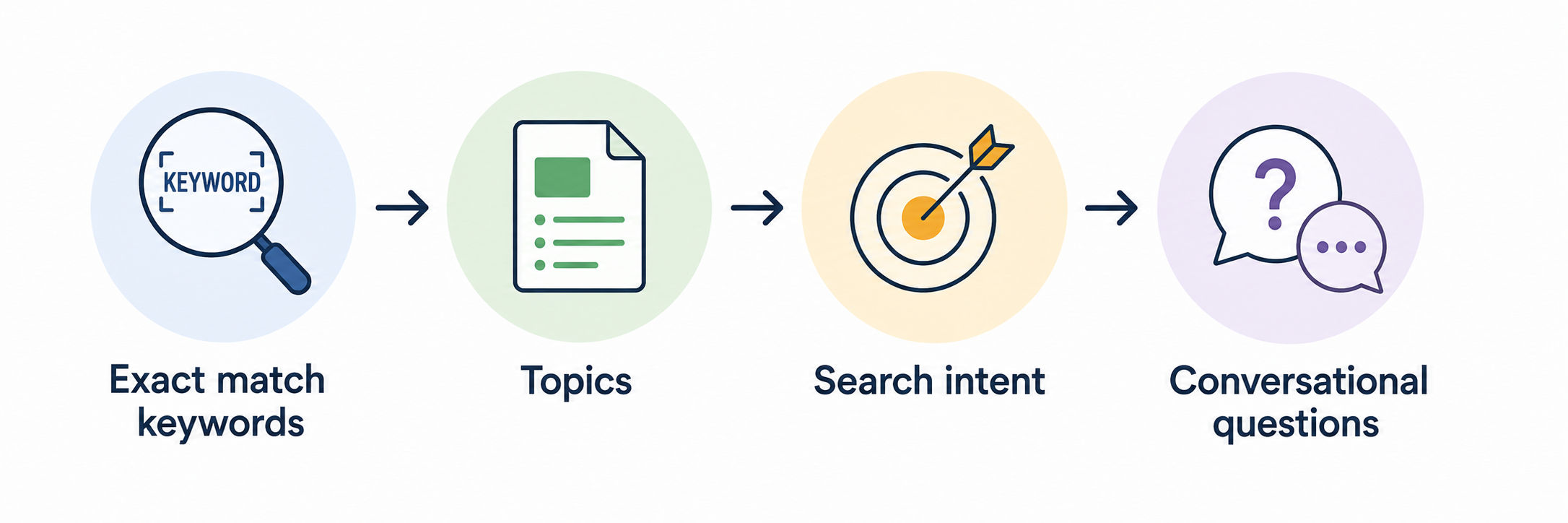
Marketers should therefore create content that addresses related questions and the different stages of a search journey.
2. Changes in Organic Traffic and Click Through Rates
AI generated answers can provide information directly within the search experience. This may reduce the need for users to click through individual webpages for simple questions.
Marketers should pay attention to:
• Zero click behavior
• Changes in organic traffic
• Changing search journeys
• Branded search growth
• Visibility within AI generated answers
3. The Growing Importance of Brand Mentions
AI systems may use information from multiple sources when generating answers. As a result, brand visibility is no longer limited to a company's own website.
Unlinked mentions, reviews, industry publications, expert discussions, and third-party references can contribute to broader brand recognition and authority.
4. Changes Across the Digital Marketing Funnel
AI search can influence multiple stages of the customer journey.
Awareness: Brands need to appear when people explore a topic.
Consideration: Helpful comparisons, guides, reviews, and expert content can influence evaluation.
Conversion: Strong brand visibility and trustworthy information can support purchase decisions.
Retention: Useful content and personalized communication can support existing customers.
How is AI search for changing SEO strategies?
AI search is not replacing SEO. Instead, it is expanding the optimization process. Traditional technical SEO and content fundamentals remain important, while marketers also need to consider AI visibility and generative search behavior.
From Keyword Optimization to Topical Authority
Instead of producing separate pages for every keyword variation, marketers can build comprehensive topic coverage.
This involves:
• Topic clusters
• Supporting articles
• Internal linking
• Related entities
• Consistent subject coverage
Optimizing Content for AI Generated Answers
Content should make important information easy to understand and extract.
Useful approaches include:
• Answering questions directly
• Using descriptive headings
• Providing concise definitions
• Supporting claims with reliable information
• Maintaining factual accuracy
Entity Recognition and Brand Authority
Brands should build clear associations between their name, products, services, expertise, and important industry topics.
Consistent information across reputable sources can make associations easier for search systems to understand.
Building Semantic Relationships Between Topics
Content should connect related concepts naturally rather than treating every keyword as an isolated target.
For example, a central topic can connect with:
• Definitions
• Processes
• Comparisons
• Benefits
• Challenges
• Use cases
SEO and GEO Integration
SEO and Generative Engine Optimization can work together.
SEO focuses strongly on discoverability and search rankings, while GEO considers visibility within AI generated responses. A strong strategy can combine technical SEO, authoritative content, structured information, brand building, and AI visibility.
Explore how Generative AI is reshaping Search Experience Optimization (SXO) and changing the way brands create search experiences.
How is AI search transforming content marketing?
Content marketing is moving toward more useful, answer focused, and context-rich content. Simply producing large volumes of keyword focused articles may not be enough to build strong visibility.
1. Creating Answer Focused Content
Content should address the questions audiences actually ask.
Strong formats include:
• Direct answers
• Clear definitions
• Question based sections
• Concise explanations
• Comparison tables
• Step by step guidance
This structure can make content easier for both readers and AI systems to understand.
2. Adding First Hand Experience and Original Insights
Original information can make content more valuable and differentiated.
Marketers can strengthen content through:
• Original research
• Expert opinions
• Case studies
• Proprietary data
• Real world observations
Content that contributes something new has greater potential to stand apart from generic information.
3. Creating Structured and Context Rich Content
Clear organization helps readers understand information quickly.
Useful elements include:
• Logical heading hierarchy
• Tables
• Lists
• Definitions
• Supporting context
• Relevant entities
4. Building Content That Earns AI Citations
AI citations are more likely to be useful when content is accurate, relevant, and supported by credible information.
Marketers should prioritize:
• Factual accuracy
• Original information
• Strong sources
• Clear attribution
• Comprehensive coverage
Explore whether AI will replace SEO specialists and content marketers and how these roles are evolving with AI.
How is AI search changing other digital marketing channels?
The impact of AI search extends beyond SEO. Changes in how audiences discover and evaluate information can influence paid search, social media, email marketing, influencer activity, and brand reputation.
1. Paid Search and Advertising
AI generated answers may change how users interact with search advertisements.
Marketers may need to reconsider:
• Search ad visibility
• Click behavior
• Query targeting
• Campaign strategy
• Audience intent
2. Social Media Marketing
Social platforms increasingly function as discovery channels. Community discussions, reviews, recommendations, and brand mentions can influence how audiences perceive a business.
Social content can therefore contribute to broader brand visibility beyond traditional search results.
3. Email Marketing
AI can support more personalized email experiences through:
• Audience segmentation
• Content recommendations
• Personalized messaging
• Customer lifecycle communication
This can help marketers deliver more relevant information at different stages of the customer journey.
4. Influencer and Brand Marketing
Third-party sources can influence brand authority and reputation.
Reviews, expert mentions, influencer discussions, industry publications, and community conversations can all contribute to how a brand is discovered and understood.
Build in demand skills with Artificial Intelligence Courses with Certification Online and prepare for AI focused career opportunities.
How can businesses adapt their digital marketing strategy?
Businesses should treat AI search as an extension of their existing digital marketing strategy rather than a separate channel.
Audit Content for AI Search Visibility
A content audit can examine:
• Existing rankings
• AI citations
• Brand mentions
• Content gaps
• Search intent coverage
This helps identify areas where existing content can be strengthened.
Strengthen Topical Authority
Businesses can build authority through topic clusters, supporting content, internal linking, and consistent coverage of relevant entities.
The goal is to become a useful source across an entire subject rather than ranking for only one isolated query.
Create Answer First Content
Important sections should directly address questions such as:
• What is it?
• Why does it matter?
• How does it work?
• What are the benefits?
• What are the limitations?
• How does it compare with alternatives?
Optimize for Conversational Search
Natural language queries should be considered alongside traditional keyword research.
Content can address complete questions and conversational variations instead of focusing only on short keyword phrases.
Build Brand Authority Beyond Your Website
Brand authority can be strengthened through:
• Industry publications
• Expert contributions
• Reviews
• Digital PR
• Third party mentions
• Relevant communities
Combine SEO, GEO, Content, and Digital PR
A stronger strategy connects these activities instead of managing them separately.
SEO can support discoverability, content can provide useful information, GEO can improve AI search visibility, and digital PR can strengthen brand authority.
How to measure digital marketing performance in AI search?
Traditional SEO metrics alone may not provide a complete picture of AI search engines for digital marketing performance. Businesses should combine visibility, engagement, brand, and conversion metrics.
1. AI Search Visibility
Track how frequently a brand appears in AI-generated responses for relevant queries.
2. AI Citations and Source Mentions
Monitor:
• Citation frequency
• Cited pages
• Citation context
• Competing sources
3. Brand Mentions
Track brand references across AI platforms, publications, reviews, communities, and other third party sources.
4. AI Referral Traffic
Where measurable, businesses can monitor traffic originating from AI platforms and compare it with other acquisition channels.
5. Branded Search Growth
Increasing brand visibility may contribute to more people searching directly for the brand, products, or services.
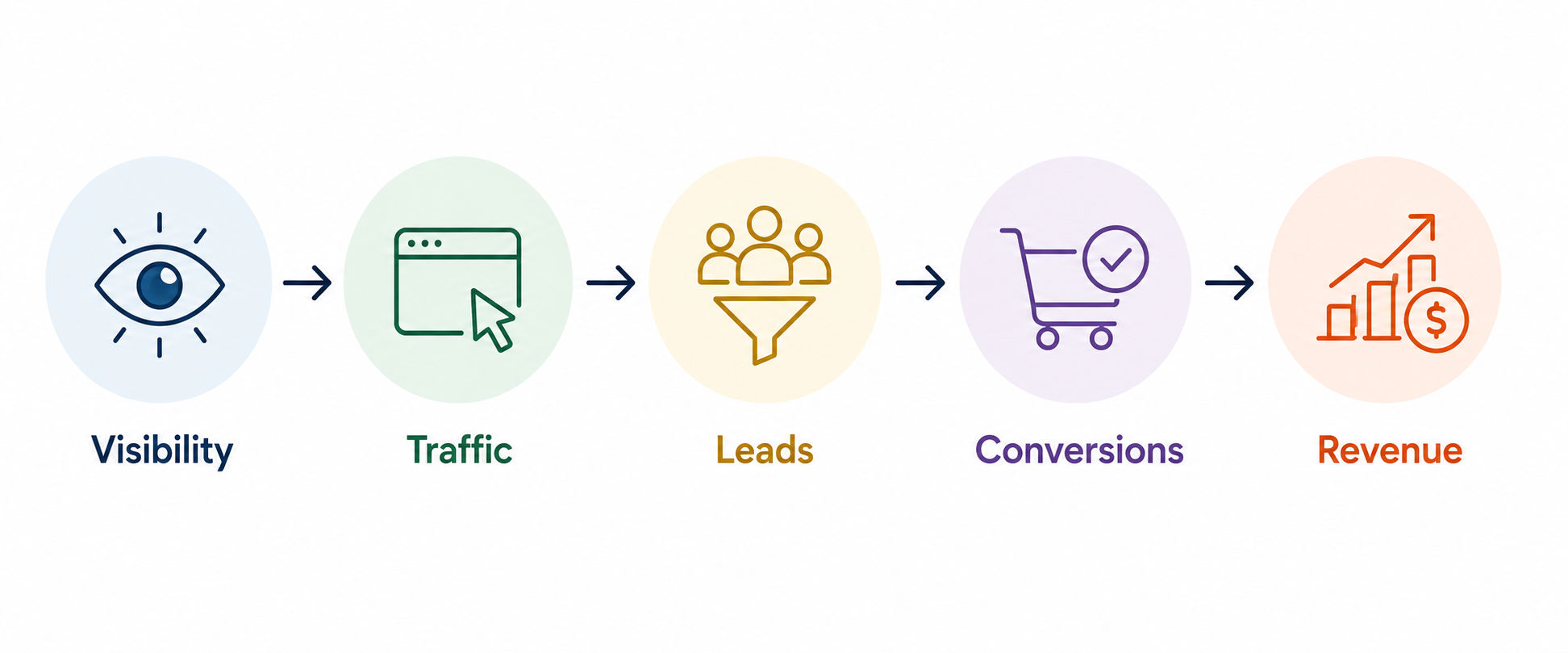
6. Conversions and Assisted Conversions
The ultimate objective is connecting visibility with business outcomes:
What will the future of digital marketing look like with AI search?
The future of AI search engines for digital marketing will likely involve closer integration between search, content, brand building, and customer experiences.
1. Search Will Become More Conversational
Users are increasingly able to ask detailed questions using natural language rather than short keyword phrases.
2. AI Will Become Part of the Customer Journey
AI can influence discovery, research, comparison, and decision making, making visibility throughout the customer journey increasingly important.
3. Brand Authority Will Become More Important
Brands with strong reputations, credible mentions, useful content, and consistent information can be better positioned for AI driven discovery.
4. Search and Content Strategies Will Converge
Search optimization and content marketing will increasingly work together around user intent, topical authority, and useful information.
5. Marketers Will Optimize for Both People and AI Systems
The strongest approach will focus first on creating genuinely useful content while also making that content clear, structured, authoritative, and accessible to AI systems.
Explore how AI is changing digital marketing careers in 2026 and discover the skills marketers need to stay competitive.
Conclusion
AI search engines digital marketing is shifting beyond traditional keyword focused SEO toward search intent, useful content, brand authority, and AI visibility.
The strongest approach combines SEO, GEO, content marketing, and digital PR. Businesses should focus on authoritative content, strong brand mentions, and measurable AI search visibility.
Contact our upGrad KnowledgeHut experts for personalized guidance on choosing the right course, career path, and certification to achieve your goals.
Frequently Asked Questions (FAQs)
Why does a brand appear in AI search but not in traditional Google results?
AI search and traditional Google search evaluate and present information differently. A brand may have strong mentions, citations, or third-party coverage that make it relevant to AI answers even without strong traditional rankings.
Why do AI search engines cite some websites but ignore higher ranking pages?
AI search does not simply reproduce traditional ranking positions. It can prioritize sources based on relevance, authority, context, and how well they support the generated answer.
Can a brand be mentioned by AI search engines without receiving a website click?
Yes. A brand can be mentioned in an AI generated answer without the user visiting its website. This makes brand mention an important visibility signal alongside referral traffic and traditional rankings.
How can businesses correct inaccurate information shown about their brand in AI search?
Businesses should first identify the inaccurate information and review the sources that may be contributing to it. Maintaining accurate information across the website, business profiles, reviews, and credible third-party sources can help reinforce the correct brand information.
How does AI search affect branded and non-branded searches?
AI search can influence both types of searches by introducing brands during informational or comparison queries. A user may discover a brand through an AI answer before performing a later branded search, making both visibility and brand demand important metrics.
Can small businesses compete with established brands in AI search results?
Yes, competition can be challenging. Small businesses can strengthen their position through specialized expertise, original information, credible third party mentions, reviews, and strong topical relevance rather than relying only on domain size or rankings.
How do reviews and third-party websites influence AI search visibility?
Reviews and third-party websites can provide external information about a brand that AI systems may use when forming answers. Consistent, credible references across independent sources can strengthen brand recognition and authority.
How often should content be updated for AI search visibility?
There is no universal update schedule. Content should be reviewed whenever important facts, products, services, statistics, or industry developments change. Accuracy and freshness matter, particularly topics, were information changes frequently.
How can marketers identify which content is being cited by AI search engines?
Marketers can test relevant customer queries across AI search platforms and record which pages and domains are cited. Dedicated AI visibility tools can also track citations, mentions, competitors, and citation share across multiple AI platforms.
Does appearing in an AI citation always lead to traffic or conversions?
No. A citation can provide visibility without generating a click, lead, or conversion. Research also shows that a citation does not always include an explicit brand mention, so marketers should measure citations alongside mentions, traffic, branded searches, and conversions.
1639 articles published
KnowledgeHut is an outcome-focused global ed-tech company. We help organizations and professionals unlock excellence through skills development. We offer training solutions under the people and proces...
Get Free Consultation
By submitting, I accept the T&C and
Privacy Policy