
- Home
- Blog
- Data Science
- AI Masters Program for Working Professionals: What to Expect in 2026
AI Masters Program for Working Professionals: What to Expect in 2026
Updated on Aug 01, 2026 | 191 views
Share:
Table of Contents
View all
- What Will You Learn Throughout the AI Masters Program?
- Tools & Technologies You'll Gain Hands-On Experience With
- Hands-On AI Projects You'll Build
- What Is the Learning Experience Like for Working Professionals?
- Skills You'll Build by the End of the Program
- Career Opportunities After Completing an AI Masters Program
- Do You Need Prior AI or Coding Experience?
- Is an AI Masters Program Worth It for Working Professionals?
- Wrapping Up
Quick Overview
- An AI Master's program for working professionals in 2026 offers flexible online learning, hands-on Generative AI training, and real-world projects, helping learners build practical AI skills while continuing their careers.
- The AI Masters Program takes learners from Python fundamentals to advanced Generative AI, RAG systems, and autonomous AI agent development, making it suitable for both beginners and experienced professionals.
- Through hands-on projects and real-world tools like LangChain, LlamaIndex, Docker, and vector databases, learners gain practical experience building AI chatbots, retrieval systems, and intelligent agents.
- The flexible learning format combines live instruction, self-paced study, labs, assignments, and capstone projects, allowing working professionals to develop job-ready AI skills without pausing their careers.
- By the end of the program, participants build a strong portfolio and acquire in-demand skills that can lead to roles such as AI Engineer, Generative AI Developer, Prompt Engineer, Machine Learning Engineer, and AI Solutions Architect.
Build in-demand AI skills with expert-led training, hands-on projects, and flexible online learning. Enroll in the Generative AI Masters Program today and take the next step toward a successful AI career.
What Will You Learn Throughout the AI Masters Program?
Think of the learning journey as a staircase rather than a single leap. You start with the basics and climb steadily toward more advanced, real-world applications:
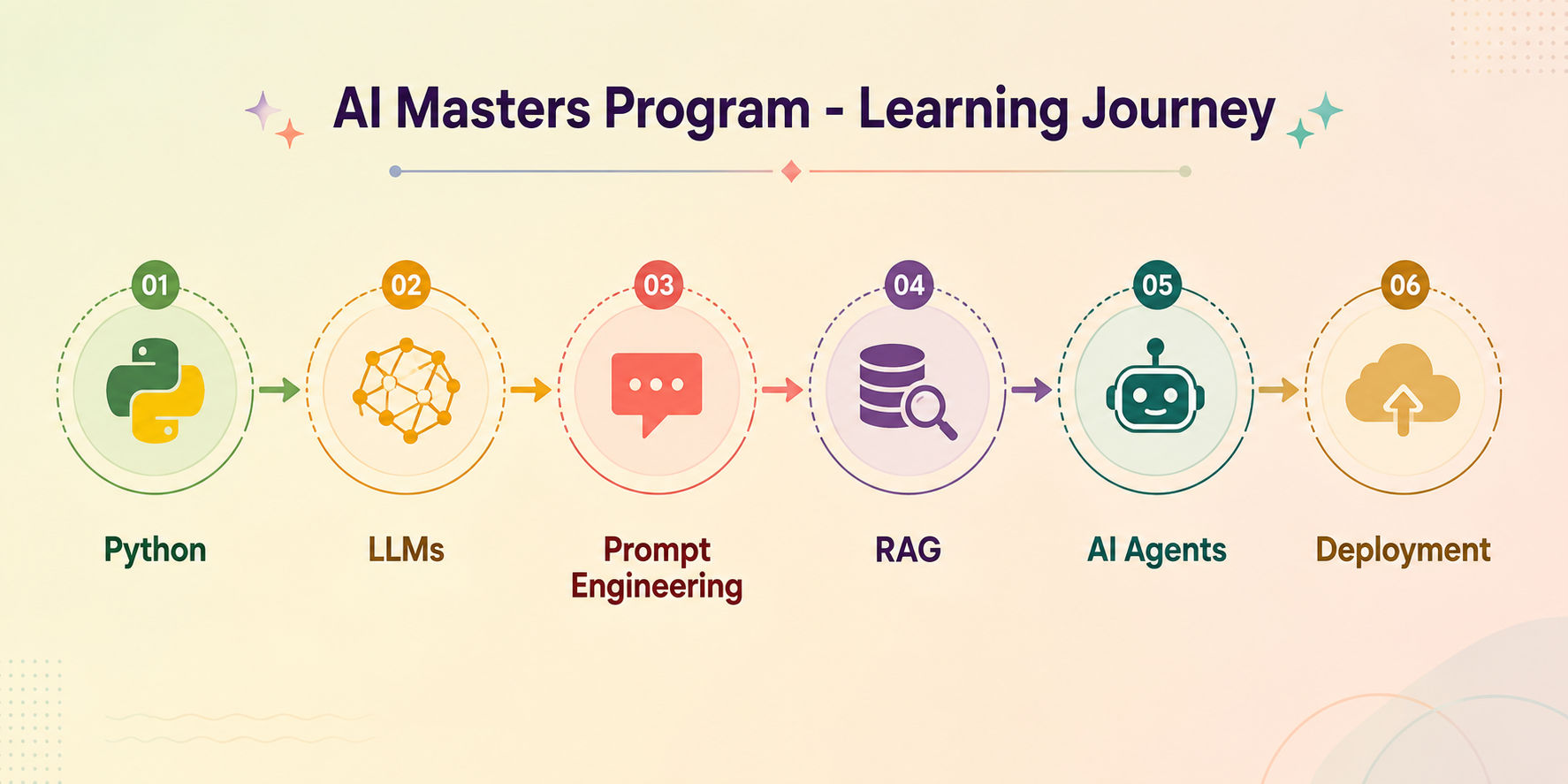
Each step builds on the last, so even if you're starting from zero, you're never thrown into the deep end. Let's break down what each course actually covers.
Course 1: Python Fundamentals for AI
Rather than teaching Python as an abstract programming language, this course frames everything around AI development from day one. You'll cover core fundamentals, data structures, and functions, but with a clear purpose: building the coding foundation you need to actually work with AI tools later in the program.
By the end, you should be comfortable writing Python code specifically for AI projects — not just solving textbook exercises.
Course 2: Generative AI & Prompt Engineering
This is where things get genuinely exciting. Course 2 introduces the technology behind tools like ChatGPT and the broader wave of generative AI applications transforming business today. You'll dig into Large Language Models (LLMs), learn the art and science of prompt engineering, and explore how AI content generation actually works under the hood.
By the end of this course, you'll be able to design effective prompts and start integrating generative AI into real workflows, a skill that's quickly becoming as fundamental as knowing Excel.
Course 3: Applied Agentic AI Development
This is arguably the most future-facing part of the curriculum. Instead of stopping at chatbots, Course 3 pushes you into building autonomous AI systems, agents that can plan, reason, and execute multi-step tasks on their own.
You'll work with multi-agent systems, tool calling, workflow automation, and agent orchestration, using frameworks like CrewAI, LangChain, and LlamaIndex. By the time you finish, you'll be able to build autonomous AI assistants capable of handling real tasks with minimal supervision, a skillset that's rapidly moving from "nice to have" to "expected" in AI-related roles.
Master in-demand data science skills through hands-on learning and expert guidance. Enroll in our Data Science Certification Courses today and accelerate your journey toward a successful data career.
Tools & Technologies You'll Gain Hands-On Experience With
Technology |
Why You'll Learn It? |
Real-World Application |
|---|---|---|
Python |
Core language for AI development |
Build scripts and AI applications |
GitHub |
Version control and collaboration |
Manage code, build your portfolio |
Docker |
Package apps for consistent deployment |
Ship AI models to production |
LangChain |
Chain LLM calls, prompts, and tools |
Build chatbots and AI workflows |
LlamaIndex |
Connect LLMs to external data |
Power RAG systems on your own data |
Pinecone |
Managed vector database at scale |
Fast retrieval for search and RAG |
ChromaDB |
Lightweight vector database |
Prototype and test retrieval systems |
FAISS |
Efficient similarity search library |
Build high-performance search features |
CrewAI |
Orchestrate multiple AI agents |
Coordinate multi-agent task systems |
AutoGen |
Enable autonomous agent workflows |
Automate multi-step task execution |
Wondering how these tools fit into the overall learning journey? Explore the AI Masters Curriculum Guide to see how each module builds the skills needed for real-world AI development.
Hands-On AI Projects You'll Build
Theory only takes you so far, what really builds confidence (and impresses employers) is a portfolio of AI systems you've actually built yourself. Here are the three flagship projects you'll create throughout the program.
Project |
Technologies Used |
Portfolio Value |
|---|---|---|
AI Chatbot |
Prompt Engineering, LangChain, OpenAI APIs, Vector Search |
Demonstrates your ability to build intelligent, context-aware conversational systems |
RAG System |
Embeddings, Knowledge Retrieval, Vector Databases, LlamaIndex |
Proves you can ground AI outputs in real data, a top enterprise AI use case |
Autonomous AI Agent |
CrewAI, Task Planning, Tool Calling, Workflow Automation |
Shows you can design self-directed AI systems that plan and execute tasks independently |
What Is the Learning Experience Like for Working Professionals?
This is probably the part you're most curious about. Because let's be honest: committing to a Masters Program while holding down a full-time job is intimidating. The good news is that this program is structured with exactly that challenge in mind.
Here's what the workload actually looks like:
- 40+ hours of live, instructor-led training
- 80+ hours of self-paced learning
- 30+ hands-on AI labs
- 150+ quizzes and assessments
- 15+ practice assignments
- 5+ capstone projects
That mix of live and self-paced content is intentional. It means you're not stuck trying to match a rigid classroom schedule, but you're also not left completely alone to figure things out.
- A Flexible Learning Format That Fits Around Your Job
Classes typically run on weekends, and sessions are recorded so you can revisit them whenever you need a refresher. Self-paced exercises let you move at your own speed, fitting learning into early mornings, lunch breaks, or whatever pocket of time your schedule allows.
- Learn by Building, Not Just Watching
The heavy emphasis on labs, assignments, and capstone projects means you're not passively absorbing lectures. You're actively building things, which is ultimately how AI skills stick.
- Guidance From AI Experts
Instructor-led sessions give you the chance to ask questions in real time, get your doubts resolved, and pick up the kind of practical mentorship that's hard to replicate through self-study alone.
Skills You'll Build by the End of the Program
By the time you wrap up, you'll walk away with a well-rounded skill set spanning technical ability, applied AI development, and workplace-ready judgment.
Skills Gained |
Practical Workplace Application |
|---|---|
Python for AI |
Write and maintain code for AI-driven tools and internal automation |
Prompt Engineering |
Craft reliable prompts that get consistent, high-quality outputs from AI models |
LLM Workflows |
Design and manage processes that integrate large language models into products |
RAG Implementation |
Build systems that ground AI responses in accurate, company-specific data |
AI Agent Development |
Create agents that automate multi-step tasks with minimal supervision |
Building AI Chatbots |
Deploy conversational assistants for customer support or internal helpdesks |
Designing AI Assistants |
Develop tools that help teams work faster across day-to-day tasks |
Developing Retrieval Systems |
Enable teams to search and query internal knowledge bases accurately |
Creating Autonomous Workflows |
Automate repetitive, multi-step processes across business functions |
AI Solution Design |
Translate business problems into practical, well-scoped AI solutions |
Portfolio Development |
Present completed AI projects credibly in interviews and performance reviews |
Problem-Solving with AI |
Apply AI tools to troubleshoot and improve existing processes |
Production-Ready Application Thinking |
Build AI systems that are reliable, scalable, and ready for real deployment |
Career Opportunities After Completing an AI Masters Program
So where does all this actually lead? Here's a look at the roles this kind of training prepares you for.
Career Role |
What It Does? |
Skills from the Program |
|---|---|---|
AI Engineer |
Builds and deploys AI-powered systems and applications |
Python, LLM workflows, AI application development |
Generative AI Developer |
Designs and builds generative AI applications for real-world use |
Prompt engineering, LLM development, Generative AI |
Prompt Engineer |
Crafts and optimizes prompts to get reliable, high-quality AI outputs |
Prompt engineering, LLM workflows |
AI Developer |
Works across the full AI stack, from data retrieval to agent design |
Python, RAG implementation, AI agent development |
Machine Learning Engineer |
Applies AI and ML concepts to build intelligent, data-driven systems |
Python, LLM workflows, AI solution design |
AI Solutions Architect |
Designs end-to-end AI systems tailored to business needs |
AI solution design, RAG implementation, agent development |
If you're comparing different career-focused education options, check out AI Masters Program vs MBA in AI: Which Is Better for Your Career? to understand the differences in curriculum, outcomes, and career paths.
Do You Need Prior AI or Coding Experience?
This is probably the biggest hesitation people have, so let's address it directly.
- If you're new to AI: You're covered. The Python Fundamentals module builds a strong coding foundation from the ground up, so you're not expected to walk in already knowing how to code.
- If you're already a developer: You'll likely move faster through the early material and can focus your energy on the more advanced content, LLMs, RAG, and Agentic AI, where the real differentiation happens.
- If you're transitioning from another technical role: Coming from cloud computing, analytics, QA, DevOps, or automation? You already have relevant problem-solving instincts and technical intuition. This program helps you translate that existing expertise into AI-specific skills, rather than starting from scratch.
New to AI? Learn what an AI Master's Program includes, who it's for, and why it's becoming a popular choice for professionals in 2026.
Is an AI Masters Program Worth It for Working Professionals?
Here's the honest takeaway: in 2026, AI literacy is quickly becoming table stakes across a huge range of industries, not just in traditional tech roles. The professionals who stand out aren't necessarily the ones who know AI in the abstract, but the ones who can actually build with it, explain it, and apply it to real problems.
A well-structured AI Masters Program gives you exactly that combination: flexibility to fit around a demanding job, hands-on projects that double as portfolio proof, and a skill set that spans technical depth and practical business application. Whether you're completely new to AI, already coding professionally, or pivoting from an adjacent technical field, the path is designed to meet you where you are.
The bigger risk in 2026 isn't spending a few months upskilling. It's watching this shift happen from the sidelines while everyone else builds the skills that are quickly becoming essential. If you've been on the fence, this is about as good a time as any to stop watching and start building.
Still unsure if this program is right for you? Find out who benefits the most from an AI Master's Program before making your decision.
Still deciding if this program is the right choice? Read our guide to understand who should pursue an AI Master's Program, and who may be better served by a different learning path.
Wrapping Up
An AI Masters Program offers a clear learning path from Python basics to advanced Generative AI, RAG, and AI agent development. Through hands-on projects, industry tools, and expert guidance, you gain practical skills that can be applied in real business environments. Whether you are a beginner, a developer, or a working professional changing careers, the program helps you build confidence, strengthen your portfolio, and prepare for the growing demand for AI professionals across industries.
Have A Query? Get in Touch With Our Customer Support | KnowledgeHut
Frequently Asked Questions (FAQs)
1. Will I receive a certification after completing the AI Masters Program?
Yes, most AI Masters Programs provide a completion certificate that validates your training in AI, Generative AI, RAG, and Agentic AI concepts. A certification can strengthen your resume, showcase your commitment to professional development, and help demonstrate your skills to potential employers during job applications and interviews.
2. Does the program include career support or job placement assistance?
Many AI Masters Programs offer career-focused resources such as resume reviews, LinkedIn optimization, interview preparation, portfolio guidance, and career coaching. While a job is not guaranteed, these services can help learners present their skills effectively and improve their chances of securing AI-related opportunities.
3. What hardware or system requirements are needed for the program?
Most learners can complete the program with a modern laptop, stable internet connection, and sufficient memory for development tools. Cloud-based platforms are often used for resource-intensive tasks, reducing the need for expensive hardware while allowing students to practice real-world AI development.
4. How long does it typically take to complete the entire program?
Completion time depends on the learner's schedule and pace. Working professionals often finish within a few months by balancing live classes, self-paced learning, labs, assignments, and projects. Consistent weekly study habits usually lead to better outcomes and smoother progress through the curriculum.
5. Are there opportunities to collaborate with other learners?
Yes, many programs provide access to student communities, discussion forums, group projects, and networking events. Collaborating with peers helps learners exchange ideas, solve technical challenges, receive feedback, and build professional relationships that can be valuable throughout their AI careers.
6. How often is the curriculum updated to reflect AI industry changes?
Reputable AI programs regularly update content to keep pace with evolving technologies, frameworks, and best practices. This ensures learners stay current with developments in Generative AI, LLMs, AI agents, and emerging tools, making their skills more relevant to industry requirements.
7. Does the program cover AI ethics, privacy, and responsible AI usage?
Many modern AI programs include discussions around data privacy, bias mitigation, responsible AI development, and ethical decision-making. Understanding these topics is essential for building trustworthy AI systems and ensuring AI solutions are deployed in a safe, compliant, and responsible manner.
8. Will I need to pay for additional AI tools or cloud services?
Some tools used during training may offer free tiers, while advanced features or higher usage limits could require paid subscriptions. Program providers often recommend cost-effective options, allowing learners to practice and build projects without making significant investments in external services.
9. Can I apply the skills learned to industries outside of technology?
Absolutely. AI skills are becoming valuable across industries such as healthcare, finance, retail, manufacturing, education, and marketing. The ability to automate workflows, analyze information, and build AI-driven solutions can help professionals improve efficiency and solve business challenges in diverse fields.
10. What kind of support is available if I get stuck during the program?
Learners typically have access to instructors, mentors, support teams, discussion boards, and recorded sessions. These resources help resolve technical issues, clarify concepts, review project work, and ensure students can continue progressing even when they encounter difficult topics or assignments.
1639 articles published
KnowledgeHut is an outcome-focused global ed-tech company. We help organizations and professionals unlock excellence through skills development. We offer training solutions under the people and proces...
Get Free Consultation
By submitting, I accept the T&C and
Privacy Policy