
RTE vs Agile Coach: What Is the Difference and Which Role Pays More in 2026?
Updated on Jul 30, 2026 | 225 views
Share:
Table of Contents
View all
Quick Overview
- An RTE focuses on coordinating large-scale Agile delivery across an Agile Release Train, while an Agile Coach focuses on improving Agile practices, team effectiveness, leadership, and organisational transformation.
- An RTE typically works within SAFe, facilitating PI Planning, managing dependencies and risks, improving delivery flow, and aligning multiple Agile teams.
- An Agile Coach works with teams, leaders, and organisations to strengthen Agile adoption, collaboration, behaviours, and continuous improvement.
- RTE suits delivery and coordination-focused professionals, while Agile Coach suits professionals interested in coaching, leadership development, and organisational change.
- This guide covers the differences between RTE & Agile Coach, their responsibilities, career paths, 2026 salary potential, and the better fit for different career goals.
Build expertise in large-scale Agile delivery with the upGrad KnowledgeHut SAFe Release Train Engineer Certification Training, designed to develop practical RTE and ART leadership skills.
Master the Right Skills & Boost Your Career
Avail your free 1:1 mentorship session
RTE vs Agile Coach: What Is the Difference?
At a high level, both roles help organisations become more effective with Agile. The difference lies in where they create impact.
A Release Train Engineer concentrates on keeping a large Agile delivery engine running smoothly. An Agile Coach focuses on helping people, teams, and leaders improve how they think, collaborate, and deliver.
Factor |
RTE (Release Train Engineer) |
Agile Coach |
Primary Focus |
ART delivery, flow, and alignment | Agile maturity and continuous improvement |
Scope |
Agile Release Train or programme level | Teams, leaders, and the wider organisation |
Framework |
Closely tied to SAFe | Framework-agnostic |
Core |
Facilitator, coordinator, and servant leader | Coach, mentor, and change agent |
Key Stakeholders |
Scrum Masters, Product Management, Architects, Business Owners | Teams, Scrum Masters, Product Owners, Managers, Executives |
Typical Responsibilities |
PI Planning, dependency management, risk tracking, ART events | Coaching, training, leadership development, Agile adoption |
Delivery Involvement |
Directly supports delivery predictability and execution | Indirectly improves delivery through better ways of working |
Success Measure |
Better flow, alignment, and programme outcomes | Stronger Agile culture, leadership, and team effectiveness |
Best Environment |
Large-scale SAFe organisations | Agile transformation and coaching-focused organisations |
What Is a Release Train Engineer (RTE)?
A Release Train Engineer is the servant leader and coach responsible for facilitating and improving the performance of an Agile Release Train (ART) within the SAFe framework.
The role is particularly relevant to organizations where several Agile teams need to work together towards common business and product outcomes.
An RTE does not simply track whether teams have completed their tasks. The role is about making the whole ART work better as a system.
What Does an RTE Do?
A successful SAFe Release Train Engineer (RTE) spends most of their time helping different teams work together smoothly, stay on the same page, and deliver on their promises.
Instead of bossing people around like a traditional manager, an RTE leads by coaching, guiding, and supporting others.
Also Read: How to Become a Release Train Engineer in 2026?
Key Responsibilities
- Guiding Big Planning Sessions: Helping teams plan their work together during large quarterly planning events.
- Running Meetings: Leading sync-up meetings for Scrum Masters and coordinating team schedules.
- Solving Roadblocks: Helping teams untangle issues when they get stuck waiting on each other.
- Managing Risks: Spotting trouble early and figuring out how to fix it before it ruins the project.
- Tracking Progress: Measuring how well work flows and helping teams predict deadlines more accurately.
- Coaching Leaders and Teams: Helping Scrum Masters, Product Managers, and Architects work better together.
- Pushing for Improvement: Constantly finding ways to make the work process smoother and faster.
What Does an RTE Do Day to Day?
An RTE's typical day is usually packed with coordination, problem-solving, and communication:
- Team Coordination: Check team health reports, catch up with Scrum Masters, and watch out for delivery risks
- Clearing Roadblocks: Fix cross-team bottlenecks, run coordination meetings, and talk with Product Managers.
- Stakeholder Alignment: Update business leaders on progress, study workflow data, and coach teams on Agile habits.
- Keeping Things on Track: Constantly keep an eye on project risks, delivery speed, and communication between groups.
Also Read: What Does an RTE Do Day-to-Day?
Is an RTE a Project Manager or a Scrum Master?
An RTE is a bit like both, but on a much larger scale. You do not need to be a deep tech expert to do the job, though understanding technology definitely helps.
Who Do They Work With?
An RTE works closely with almost everyone, including Agile teams, Scrum Masters, Product Managers, System Architects, Business Owners, and Lean Portfolio Managers. They sit right at the center, making sure the entire team runs like a well-oiled machine.
What Is an Agile Coach?
An Agile Coach helps people, teams, and organisations improve the way they work by applying Agile principles and practices.
Unlike an RTE, an Agile Coach is not limited to one framework. They can work with Scrum, Kanban, SAFe, Lean, hybrid models, or custom Agile approaches.
The role goes beyond running meetings. An Agile Coach focuses on improving mindset, collaboration, leadership, and team performance.
Also Read: How to Become Agile Coach?
What Does an Agile Coach Do?
An Agile Coach works with everyone in a company from brand-new project teams all the way up to top executives.
Their main goal is not just to finish projects faster. Instead, they help the entire company build lifelong habits, so work becomes smoother and more effective over the long run.
Key Responsibilities
- Coaching Teams: Helping groups work better together and follow Agile practices.
- Mentoring Leaders: Guiding Scrum Masters, Product Owners, and managers on how to lead the Agile way.
- Running Workshops: Facilitating team retrospectives and learning sessions.
- Removing Roadblocks: Spotting big-picture issues inside the company that slow people down.
- Driving Culture Change: Helping people change their daily habits, mindsets, and how they communicate.
- Challenging Bad Habits: Gently pushing back on old, inefficient processes and pushing for continuous improvement.
Where Does an Agile Coach Work?
An Agile Coach operates across three different levels of a company. The higher they go, the more strategic their job becomes:
Level 1: Team
- What they focus on: Daily collaboration, Scrum rules, team vibes, retrospectives, and overall team performance.
Level 2: Leadership
- What they focus on: Helping managers and leaders shift their mindsets, make better Agile decisions, and clear away company roadblocks.
Level 3: Organisation
- What they focus on: Large-scale Agile transformations, company culture, new operating models, and enterprise-wide ways of working.
What Does an Agile Coach Do Day to Day?
A typical day for an Agile Coach is filled with guidance, observation, and problem-solving:
- Watching how teams interact and communicate during meetings.
- Coaching Scrum Masters and mentoring senior leaders.
- Running interactive workshops and training sessions.
- Looking at workflow data to spot hidden bottlenecks.
- Designing learning programs to help the company grow.
- Helping people resolve personal or behavioral challenges at work.
Pros and Cons of RTE and Agile Coach
RTE: Pros and Cons
Pros of Becoming an RTE
- Clear Role Definition: The position possesses a well-defined spot inside the SAFe setup, making success easy to measure.
- Large Scale Leadership: Daily tasks involve multiple teams, product managers, business owners, and scrum masters.
- Natural Career Growth: Moving from a Scrum Master to an RTE provides a smooth path within SAFe careers.
- Visible Results: Improvements in project flow, risk management, and delivery speed tie directly to business outcomes.
- Great for Coordinators: Bringing people together and solving complex puzzles makes this job rewarding.
Cons of Becoming an RTE
- Tied to SAFe: Relevance remains highest in companies utilizing SAFe or similar large-scale frameworks.
- High Pressure: Dealing with multiple teams, dependencies, and leadership expectations feels exhausting.
- Less Focus on Individual Coaching: Attention stays pulled toward delivery trains rather than deep one on one mentoring.
- No Formal Authority: Fixing every problem directly proves impossible; success relies entirely on influencing others without direct management power.
Looking to advance an Agile career? Explore upGrad KnowledgeHut Agile Management Certification Courses to develop skills across Scrum, SAFe, and Agile leadership.
Agile Coach: Pros and Cons
Pros of Becoming an Agile Coach
- Flexible Career Paths: Coaching, consulting, and change management skills transfer into almost any industry or role.
- Wider Impact: Work spans from everyday teams up to top executives instead of focusing on one delivery train.
- People Focused: Mentoring, listening, and watching growth make this job fulfilling.
- Not Tied to One Framework: Movement happens easily between Scrum, Kanban, SAFe, Lean, and hybrid setups.
- Big Picture Influence: Experienced professionals help reshape company culture, leadership styles, and overall operations.
Cons of Becoming an Agile Coach
- Job Title Confusion: The title means different things everywhere. One place wants a basic team helper, while another demands an enterprise transformation expert.
- Slow Results: Changing company culture and human behavior takes a long time, so instant wins rarely happen.
- No Formal Authority: Driving change and guiding people requires influencing without direct management power.
- Requires High Soft Skills: Knowing Agile rules falls short; listening, empathy, diplomacy, and conflict resolution prove essential for handling resistance.
Also Read: Agile Coach vs Scrum Master
RTE vs Agile Coach: Career Path and Growth
Both paths overlap at times, yet each builds distinctly different professional strengths.
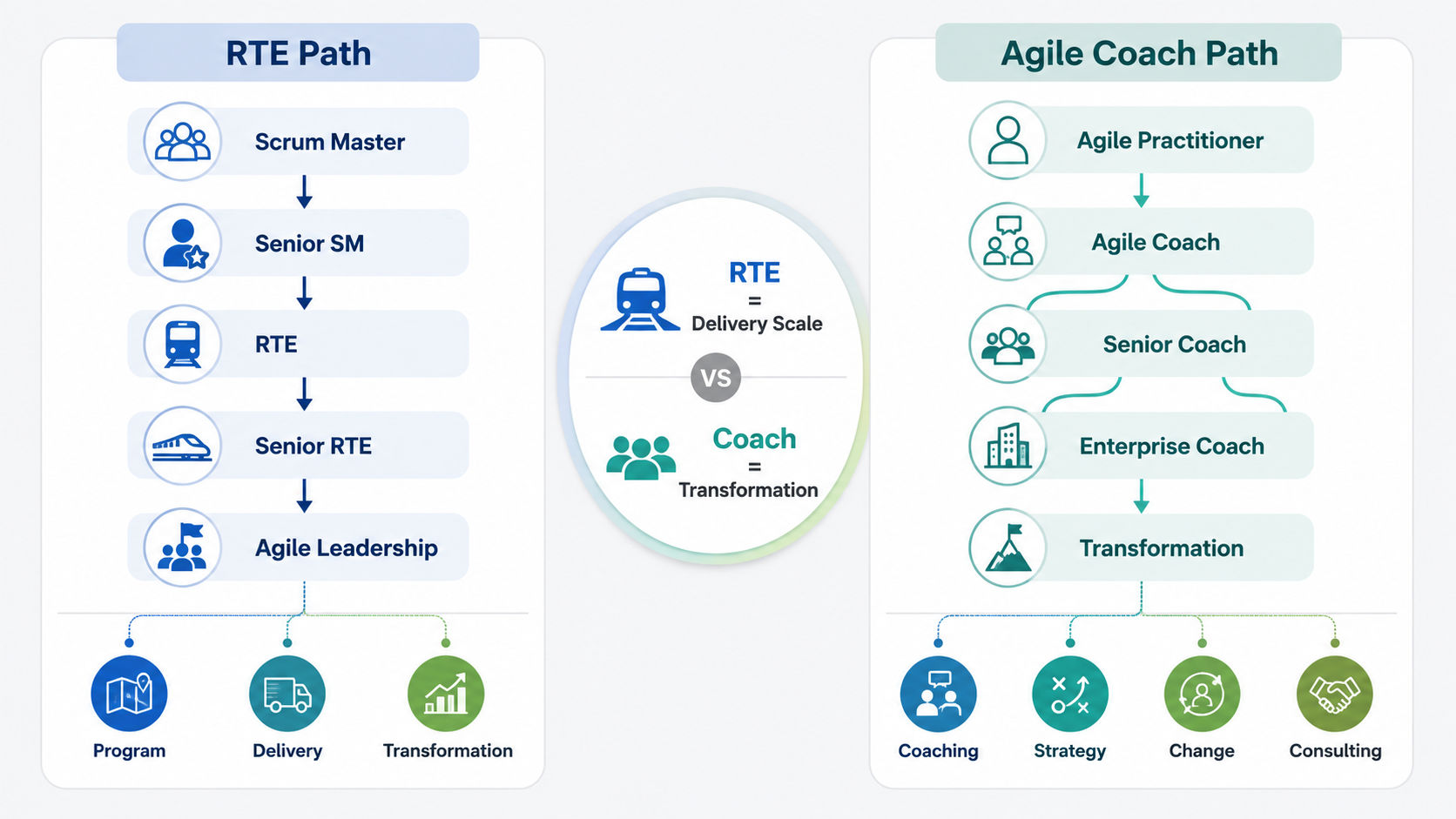
RTE Career Path
An RTE career path typically follows a structured climb:
Scrum Master → Senior Scrum Master → RTE → Senior RTE → Enterprise or Portfolio Agile Leadership
From this foundation, professionals often pivot toward adjacent roles:
- Programme Manager
- Agile Delivery Lead
- Transformation Lead
- SAFe Practice Consultant
- Lean Portfolio Management roles
- Digital transformation leadership
Choosing the RTE track suits anyone wanting to step out of single team delivery and move directly into large scale coordination and program management.
Agile Coach Career Path
An Agile Coaching progression looks a bit more fluid:
Scrum Master or Agile Practitioner → Agile Coach → Senior Agile Coach → Enterprise Agile Coach → Transformation or Agile Leadership
Experienced coaches frequently branch out into specialized consulting and leadership areas:
- Enterprise Agile Coach
- Transformation Consultant
- Agile Practice Lead
- Organisational Change roles
- Leadership enablement
- Agile transformation strategy
- Independent consulting
This progression lacks strict linearity of the RTE route. That flexibility simply matches the broader, systems-level nature of coaching and enterprise transformation work.
RTE vs Agile Coach: Which Role Pays More in 2026?
Both RTEs and Agile Coaches are well-paid Agile professionals. However, salaries depend on factors such as experience, industry, company, and location. There is no clear winner, as both roles offer competitive pay.
Average Salary in 2026
Role |
India |
United States |
| Release Train Engineer (RTE) Salary |
|
$130,028 per year |
| Agile Coach Salary |
|
$139,505 per year |
Source: Glassdoor & Ziprecruiter
When an RTE Pays More
- Managing very large or multiple Agile Release Trains (ARTs) within massive enterprises.
- Working in high-paying sectors like finance, banking, or enterprise technology.
- Holding advanced, specialized SAFe certifications (such as SAFe Program Consultant) alongside extensive program management experience.
When an Agile Coach Pays More
- Operating at an enterprise or portfolio level rather than focusing on a single product line or train.
- Consulting directly on company-wide agile transformations, structural operating models, and executive leadership development.
- Guiding systemic cultural and behavioral changes across multiple business units.
RTE vs Agile Coach: Which Role Is Better for You?
The right choice comes down to personal strengths and daily preferences:
Choose RTE If You
- Enjoy structured program-level coordination
- Like facilitating large-scale Agile events
- Feel comfortable working with delivery metrics
- Enjoy solving cross-team dependencies
- Want to specialize in SAFe environments
- Prefer measurable delivery outcomes
Choose Agile Coach If You
- Prefer people development
- Enjoy diagnosing systemic problems
- Want broader organizational influence
- Like mentoring managers and leaders
- Feel passionate about transformation work
- Want less dependence on a single framework
Conclusion
The RTE and Agile Coach roles differ mainly in their area of impact, with RTEs focused on large-scale delivery, ART coordination, and SAFe execution, while Agile Coaches focus on people, leadership, Agile maturity, and organisational transformation.
RTE offers a strong career path for professionals interested in programme-level delivery and structured SAFe environments. Agile Coaching provides broader opportunities across transformation, consulting, and leadership development.
Both paths offer strong career growth and competitive salaries, making the right choice dependent on skills, interests, and long-term career goals.
Have A Query? Get in Touch With Our Customer Support | upGrad KnowledgeHut
Frequently Asked Questions (FAQs)
What skills are most important for an RTE in 2026?
Strong facilitation, stakeholder management, conflict resolution, systems thinking, and delivery planning are important for an RTE. SAFe knowledge, dependency management, risk management, and the ability to work with multiple Agile teams can further strengthen an RTE profile.
What skills are most important for an Agile Coach in 2026?
An Agile Coach needs more than knowledge of Scrum or Agile ceremonies. Coaching, active listening, facilitation, empathy, leadership development, conflict management, and organisational change skills are particularly valuable for working with teams and senior stakeholders.
Can a Scrum Master move into an RTE role without programme management experience?
A Scrum Master can transition into an RTE role, but experience with multiple teams, cross-team dependencies, stakeholder coordination, and large-scale Agile delivery can make the transition easier. Building SAFe knowledge and programme-level facilitation skills can also help bridge the gap.
Can a Scrum Master become an Agile Coach without being an RTE first?
Yes, an RTE position is not a mandatory step toward Agile Coaching. Scrum Masters can move directly into coaching by developing deeper skills in mentoring, facilitation, team dynamics, leadership coaching, and organisational change.
Is RTE experience useful for becoming an Enterprise Agile Coach?
RTE experience can provide valuable exposure to large-scale delivery, leadership, stakeholder management, and organisational impediments. Professionals can build on this experience by developing stronger coaching, transformation, and leadership-development capabilities.
Can an Agile Coach transition into an RTE role?
Yes, an Agile Coach can move into an RTE position, particularly when experience includes large-scale Agile environments and cross-team coordination. Additional knowledge of SAFe, ART events, PI Planning, delivery metrics, and dependency management can support the transition.
Which role is better for someone with a project management background?
An RTE can be a natural fit for project or programme professionals who enjoy coordination, risk management, stakeholder alignment, and delivery planning. Agile Coaching may suit project managers who prefer developing people, improving collaboration, and supporting broader organisational change.
What should be included in an RTE resume?
An RTE resume should highlight measurable outcomes rather than only listing Agile ceremonies. Experience with PI Planning, ART coordination, dependency resolution, risk management, delivery predictability, stakeholder alignment, flow improvement, and SAFe implementations can make the profile stronger.
What should be included in an Agile Coach resume?
An Agile Coach resume should demonstrate coaching impact through specific examples. Team improvements, leadership coaching, Agile adoption, organisational transformation, process improvements, conflict resolution, and measurable changes in collaboration or delivery effectiveness can strengthen the profile.
How can professionals decide between RTE and Agile Coach as a career switch?
Start by comparing preferred responsibilities rather than job titles. Professionals who enjoy delivery coordination, dependencies, metrics, and SAFe may lean toward RTE, while those who enjoy coaching, leadership development, behavioural change, and organisational transformation may find Agile Coaching more suitable.
1639 articles published
KnowledgeHut is an outcome-focused global ed-tech company. We help organizations and professionals unlock excellence through skills development. We offer training solutions under the people and proces...
Get Free Consultation
By submitting, I accept the T&C and
Privacy Policy
Ready to learn about Agile Certifications Roadmap?