
- Home
- Blog
- Artificial Intelligence
- How Business Analysts Can Move into AI Product Management: A Complete Career Transition Guide
How Business Analysts Can Move into AI Product Management: A Complete Career Transition Guide
Updated on Jul 28, 2026 | 264 views
Share:
Table of Contents
View all
- Step-by-Step Roadmap for Moving into AI Product Management
- Why This Transition Makes Sense in 2026
- Why Business Analysts Have an Advantage in AI Product Management
- Skills Business Analysts Need to Learn for AI Product Management
- Best Certifications and Courses for Business Analysts Entering AI Product Management
- Salary Expectations and Career Growth
- Common Mistakes Business Analysts Make When Transitioning
- Conclusion
Quick Overview
- Business Analysts can move into AI Product Management by building on existing strengths in data analysis, problem-solving, requirements gathering, stakeholder management, and process improvement while developing AI and product management skills.
- Transitioning from a Business Analyst (BA) to an AI Product Manager (AI PM) is one of the most practical and promising career moves in today’s technology landscape.
- Business Analysts already possess many core AI PM skills, including data analysis, structured problem-solving, requirements gathering, process understanding, and stakeholder communication.
- The transition mainly involves building AI literacy, strengthening product thinking, and understanding AI product strategy.
- This complete guide covers the skills, step-by-step roadmap, certifications, salary expectations, career growth, and common mistakes to help Business Analysts successfully transition into AI Product Management.
Turn existing Business Analysis experience into a future-ready AI Product Management career with the upGrad KnowledgeHut AI Product Management Course. Build practical skills in AI, product strategy, and AI-driven product development.
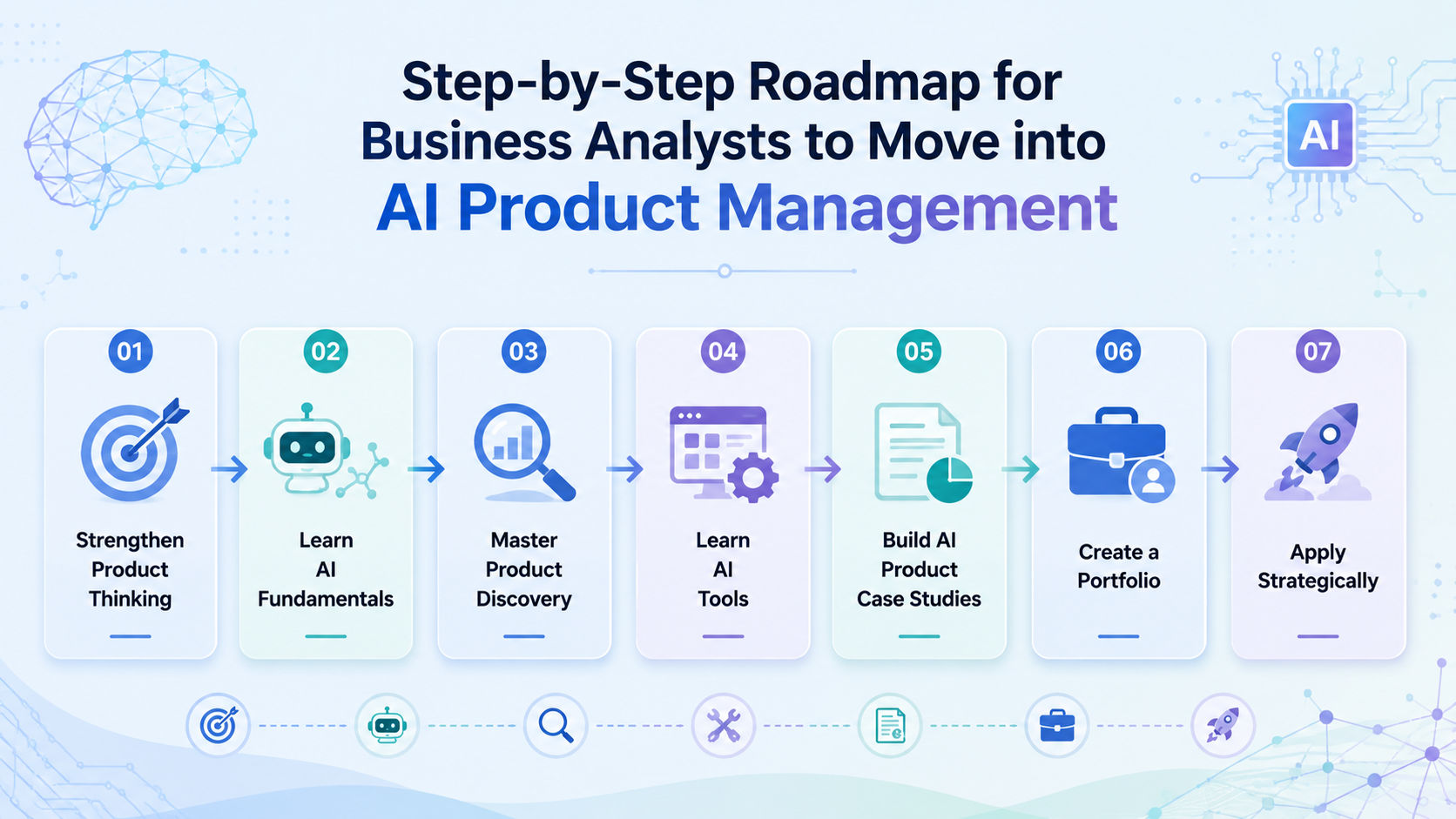
Step-by-Step Roadmap for Moving into AI Product Management
Moving from business analysis to AI product management requires no restart from zero. The strongest approach builds on existing business analysis experience while slowly adding product management, AI, and portfolio skills.
The following roadmap offers a practical path from a current business analyst role to an AI product manager position.
Step 1: Strengthen Product Thinking
The first step is to move beyond analysing what a business needs and start thinking about what product should be built, why it matters, and what outcome it should create.
Build knowledge regarding:
- Product strategy and vision
- Customer personas and user needs
- Product roadmapping
- Feature prioritization
- Product-market fit
- Product metrics and KPIs
- Agile product development
- Business case development
Example: A business analyst spots that a customer support team spends too much time answering repetitive questions. Product thinking goes further by exploring whether an AI assistant cuts response time, what customers actually need, how success measures, and whether the investment makes business sense.
Step 2: Learn AI Fundamentals
AI product managers do not need to become machine learning engineers. However, a solid understanding of AI remains essential for making product decisions and talking with technical teams.
Start with concepts such as:
- Machine learning
- Generative AI
- Large Language Models (LLMs)
- Natural Language Processing (NLP)
- Computer vision
- Predictive analytics
- Retrieval-Augmented Generation (RAG)
- Prompt engineering
- Model training and evaluation
- AI hallucinations
- AI bias and responsible AI
The focus centers on what AI can do, where it works well, where it fails, and how AI features translate into product traits.
Example: An AI product manager should understand why a chatbot might generate incorrect information, why high-quality data matters, and when a traditional software solution beats an AI solution.
Step 3: Master Product Discovery
Product discovery is especially important when moving into AI Product Management because not every business problem requires AI.
Learn how to:
- Conduct customer interviews
- Identify pain points
- Define user problems
- Validate product ideas
- Analyze competitors
- Identify AI use cases
- Test assumptions
- Define user personas
- Create user journeys
- Measure customer demand
A strong discovery process starts with the problem rather than the technology.
Example: Instead of starting with “How can generative AI improve customer service?”, start with “Why are customer support resolution times increasing?” Data and customer research then reveal whether an AI assistant, better knowledge management, or a completely different solution fits best.
This approach shows the business-first thinking expected from an AI product manager.
Step 4: Learn AI Tools
Hands-on experience with AI tools makes AI concepts easier to understand and gives practical experience for future product roles.
Explore tools such as:
- ChatGPT
- Claude
- Gemini
- Microsoft Copilot
- NotebookLM
- AI automation platforms
- No-code AI tools
- Analytics and data visualization tools
Go beyond basic prompting. Experiment with creating workflows, analyzing information, summarizing customer feedback, generating product requirements, researching competitors, and automating repetitive tasks.
Example: A simple AI workflow could analyze hundreds of customer reviews, identify common complaints, group them into themes, and highlight the most frequent product issues.
This hands-on practice helps build a key AI product manager skill: understanding how AI improves real business processes and customer experiences.
Also Read: How to use ChatGPT in Product Management?
Step 5: Build AI Product Case Studies
Practical case studies bridge the gap between business analysis experience and AI product management.
Choose 2 to 3 realistic business problems and develop an AI-powered product solution for each.
A case study includes:
- Business problem: What problem needs solving?
- Target users: Who experiences the problem?
- User research: What evidence supports the problem?
- AI opportunity: Why does AI suit the solution?
- Product concept: What should the product do?
- User journey: How will customers use it?
- MVP: What belongs in the first version?
- Product roadmap: What comes next?
- Success metrics: How will performance measure?
- Risks: What could go wrong with the AI solution?
Example: A case study could focus on an AI customer support assistant. The project defines the customer problem, proposes an LLM-based solution, creates user stories, identifies required data, sets response-quality metrics, and outlines an MVP roadmap.
A well-made case study provides tangible proof of product thinking instead of just listing AI skills on a resume.
Step 6: Create a Portfolio
A portfolio turns learning into visible proof of capability.
A strong AI product management portfolio includes:
- 2 to 3 AI product case studies
- Product requirement documents
- User personas
- Customer journey maps
- Product roadmaps
- Prioritization frameworks
- AI use-case assessments
- Product metrics
- Prototype screens
- AI workflow examples
Each project clearly explains the problem, solution, product decisions, and expected business impact. Avoid creating a portfolio that only shows AI-generated content.
The strongest portfolio shows independent product thinking, clear reasoning, and practical decision-making.
Step 7: Apply Strategically
The final step turns new skills into career opportunities. A business analyst does not necessarily need to apply only for direct AI product manager positions.
Relevant roles include:
- Associate Product Manager
- Product Manager
- AI Product Manager
- AI Product Analyst
- Product Owner
- AI Product Strategy Analyst
- Generative AI Product Manager
Internal opportunities also prove valuable. A business analyst working in a company already adopting AI might find chances to support AI initiatives, product discovery, automation projects, or digital transformation programs.
When applying, position existing business analysis experience around business impact and product skills, rather than presenting the transition as a complete career change.
Why This Transition Makes Sense in 2026
The year 2026 brings a strong time for business analysts to move into AI product management. AI now forms a daily part of business strategy, creating high demand for workers who understand both business needs and new technology.
AI Has Become a Business Imperative
Companies across industries are using AI to improve efficiency, enhance customer experiences, and drive business growth. This has created a growing need for AI Product Managers who can turn AI capabilities into valuable business solutions.
Companies Need Business-First AI Product Managers
Successful AI products solve real business problems, not just technical ones. Business Analysts already have experience understanding business needs, gathering requirements, and working with stakeholders, making this transition a natural fit.
Overlapping Strengths Between Business Analysts and Product Managers
The move into AI Product Management builds on skills already developed through Business Analysis. Problem-solving, data analysis, stakeholder management, requirements gathering, and understanding business needs are relevant to both roles.
The main shift involves taking greater ownership of product strategy, prioritisation, and outcomes.
Career Growth Opportunities Are Expanding
As more companies develop AI-powered products, opportunities for AI Product Managers are expanding across industries. Roles such as AI Product Manager, Generative AI Product Manager, AI Product Lead, and AI Product Strategy Manager are becoming part of the evolving product landscape.
This creates a strong long-term career path for Business Analysts with the right combination of business, product, and AI skills.
Why Business Analysts Have an Advantage in AI Product Management
Many employers view the move from Business Analysts to AI Product Management as a natural progression because the two roles share several core competencies.
While AI Product Managers need additional product and AI knowledge, Business Analysts already bring many of the skills required to succeed.
1. Business Problem Solving
At their core, Business Analysts are trained problem-solvers. They identify business challenges, analyze root causes, and recommend solutions based on data and stakeholder input.
This mindset is critical in AI Product Management, where the goal is not to build AI for the sake of innovation, but to solve meaningful business and customer problems.
2. Requirements Gathering
Requirements gathering is one of the most transferable skills a Business Analyst can bring into product management.
Business Analysts excel at:
- Understanding stakeholder needs
- Asking the right questions
- Clarifying objectives
- Translating business requirements into actionable outcomes
These abilities help AI Product Managers define product requirements that align with both user needs and business goals.
3. Stakeholder Communication
AI products often involve cross-functional collaboration between business leaders, engineers, data scientists, designers, and end users.
Business Analysts are already experienced in communicating with diverse stakeholders, managing expectations, and ensuring everyone stays aligned. This makes them highly effective in AI Product Management environments.
4. User Story Writing
Many Business Analysts have experience creating user stories, acceptance criteria, and functional requirements.
As AI Product Managers, these skills help in:
- Defining product features
- Communicating product needs to development teams
- Ensuring customer requirements are accurately represented
Strong user story writing directly contributes to better product execution.
5. Process Optimization
Business Analysts spend much of their careers analyzing workflows and identifying opportunities for improvement.
This experience becomes especially valuable when developing AI solutions because many AI products are designed to automate, streamline, or enhance existing business processes.
A BA's ability to identify inefficiencies often leads to stronger AI product opportunities.
6. Data-Driven Decision Making
Successful Business Analysts rely on data to evaluate problems and recommend solutions.
Similarly, AI Product Managers use data to:
- Prioritize features
- Measure product success
- Evaluate user behavior
- Support strategic decisions
This analytical mindset gives Business Analysts a significant advantage when transitioning into product roles.
7. Agile Experience
Many Business Analysts already work within Agile environments and collaborate closely with product, engineering, and delivery teams.
Experience with:
- Scrum ceremonies
- Backlog refinement
- Sprint planning
- Iterative development
helps create a smoother transition into AI Product Management, where Agile practices are commonly used to build and improve products.
Build stronger Agile skills with upGrad KnowledgeHut Agile Management Training and strengthen the foundation needed for a smooth transition into AI Product Management.
Skills Business Analysts Need to Learn for AI Product Management
Business Analysts already have strong skills in problem-solving, stakeholder management, and business analysis. However, moving into AI Product Management requires developing knowledge in a few additional areas.
AI Fundamentals
A technical or data science background is not required, but understanding the basics of AI is essential for making informed product decisions and working effectively with technical teams.
Important topics include:
- Machine Learning (ML): Understand how models learn from data, identify patterns, and make predictions.
- Generative AI: Learn how AI creates text, images, code, and other types of content.
- Large Language Models (LLMs): Understand how models like ChatGPT process prompts and generate human-like responses.
- Natural Language Processing (NLP): Learn how AI understands, analyses, and responds to human language.
- Retrieval-Augmented Generation (RAG): Understand how AI combines language models with external data sources to produce more accurate answers.
- AI Agents: Learn how autonomous AI systems complete tasks, make decisions, and interact with other applications.
The focus should be on understanding AI capabilities, limitations, and real business applications rather than building AI models.
Product Management Fundamentals
One of the biggest changes is moving from gathering business requirements to taking ownership of product success and business outcomes.
Key areas to learn include:
- Product discovery
- Customer research
- Market validation
- Product roadmapping
- Feature prioritisation
- Product lifecycle management
- Product metrics and KPIs
These skills help transform business problems into products that create value for customers and the business.
AI Product Strategy
AI Product Managers need to know where AI creates value and where traditional software may be a better solution.
Important skills include:
- Identifying high-value AI use cases
- Aligning AI initiatives with business goals
- Evaluating technical feasibility and business impact
- Defining AI product vision and strategy
- Prioritising AI opportunities based on customer and business needs
A business-first approach is essential for building successful AI products.
Metrics and Experimentation
AI products improve through continuous testing, measurement, and learning.
Key topics include:
- Product KPIs and success metrics
- A/B testing
- Product experimentation
- Model performance evaluation
- Customer adoption and engagement metrics
- Data-driven decision-making
Measuring outcomes helps ensure AI products deliver meaningful business value.
AI Governance and Responsible AI
Responsible AI is becoming a core responsibility for AI Product Managers as AI adoption continues to grow.
Important areas include:
- AI bias and fairness
- Data privacy and security
- Regulatory compliance
- Transparency and explainability
- Risk management
- Ethical AI practices
Understanding these topics helps build AI products that are trustworthy, compliant, and aligned with business and customer expectations.
Best Certifications and Courses for Business Analysts Entering AI Product Management
Certifications alone are not enough to become an AI Product Manager, but they can build essential knowledge and demonstrate a commitment to moving from Business Analysis into AI Product Management.
The best learning programs combine product management, AI fundamentals, and practical experience.
Product Management Certifications
For Business Analysts, product management should be the first area of focus. Learning product thinking helps bridge one of the biggest skill gaps between Business Analysis and AI Product Management.
Popular certifications include:
- Product School Product Manager Certification
- Certified Scrum Product Owner (CSPO)
- Pragmatic Institute Product Certifications
- AIPMM Certified Product Manager (CPM)
These programs cover important topics such as product discovery, customer research, product roadmapping, feature prioritisation, and product strategy.
AI Fundamentals Certifications
An AI Product Manager does not need advanced data science skills, but a solid understanding of AI concepts is essential.
Recommended learning options include:
- Generative AI Fundamentals
- AI for Business Professionals
- Machine Learning Fundamentals
- Prompt Engineering courses
- Large Language Model (LLM) foundations
Choose courses that focus on business applications of AI instead of highly technical model development.
AI Product Management Programs
AI Product Management courses combine product management with AI knowledge, making them highly relevant for Business Analysts.
Look for programs that cover:
- AI product lifecycle
- Generative AI product development
- AI use case identification
- AI product metrics and experimentation
- Responsible AI and AI governance
These courses focus on building and managing AI-powered products, not just understanding AI technology.
Business-to-Product Transition Learning Paths
A structured learning path is often more valuable than completing many unrelated certifications.
A practical approach includes:
- Learn Product Management fundamentals.
- Build AI and Generative AI knowledge.
- Study AI Product Strategy.
- Create AI product case studies.
- Gain hands-on experience through AI projects.
This combination develops both product thinking and practical AI skills. Most employers place greater value on real projects, case studies, and problem-solving ability than on certifications alone.
Build practical AI knowledge with upGrad KnowledgeHut Artificial Intelligence Courses and strengthen the AI skills needed for a transition into AI Product Management.
Salary Expectations and Career Growth
One of the biggest reasons professionals consider moving from Business Analysts to AI Product Management is the combination of stronger career growth, greater strategic ownership, and higher earning potential.
Salary Growth from Business Analyst to AI Product Manager
| Experience | Business Analyst Salary Range | AI Product Manager Salary Range |
| 1-3 Years | ₹ 5- ₹9 LPA | ₹12- ₹27.5 LPA |
| 4-6 Years | ₹6- ₹12 LPA | ₹17.6- ₹37.3 LPA |
| 7-9 Years | ₹8- ₹15 LPA | ₹23.5- ₹32.3 LPA |
| 10-14 Years | ₹9- ₹18.4 LPA | ₹20- ₹76.5 LPA |
Source: Glassdoor
While compensation varies significantly by region, industry, company size, and experience level, AI Product Management roles typically command a premium because they combine product leadership with AI expertise.
Typical Career Progression
Most professionals do not move directly from Business Analyst to Senior AI Product Manager. Instead, the career path often looks like this:
- Business Analyst (BA)
- Senior Business Analyst
- Associate AI Product Manager
- AI Product Manager
- Senior AI Product Manager
- AI Product Lead / Head of AI Products
Each step generally brings increased responsibility for product strategy, business outcomes, stakeholder management, and AI-driven innovation.
Common Mistakes Business Analysts Make When Transitioning
Moving from Business Analysis to AI Product Management is easier with the right approach. Many Business Analysts spend too much time learning technical skills while overlooking the product management and business skills that are most important for the role.
1. Learning Coding Before Product Management
Learning to code can be helpful, but it should not be the first priority. AI Product Managers are responsible for defining product strategy, understanding customer needs, prioritising features, and delivering business value. A basic understanding of technology is enough to work effectively with engineering teams.
2. Ignoring Customer Discovery
Not every business problem needs an AI solution. Starting with technology instead of customer needs often leads to products that fail to deliver value. Strong AI products begin with customer research, problem validation, and product discovery before choosing the right solution.
3. Building No Portfolio
Certifications show learning, but a portfolio demonstrates practical skills. AI product case studies, product roadmaps, user personas, and AI use-case assessments provide clear evidence of product thinking and can strengthen job applications.
4. Only Collecting Certificates
Completing many courses without applying the knowledge is a common mistake. A few relevant certifications combined with hands-on projects, case studies, and practical experience are usually more valuable than a long list of certificates.
5. Skipping AI Ethics
Responsible AI is an important part of AI Product Management. Understanding topics such as AI bias, data privacy, security, transparency, and ethical AI helps build products that are trustworthy, compliant, and reliable.
6. Thinking AI Product Management Is the Same as Machine Learning Engineering
AI Product Managers are not Machine Learning Engineers. The role focuses on product strategy, customer problems, business goals, feature prioritisation, and collaboration with technical teams.
AI knowledge is important, but building and training machine learning models is usually handled by AI engineers and data scientists.
Conclusion
The transition from Business Analysts to AI Product Management is a practical career move, not a complete career restart. Existing strengths in business analysis, stakeholder management, problem-solving, and data-driven thinking provide a strong foundation.
Adding AI knowledge, product strategy, and hands-on experience can bridge the remaining skill gaps. With the right learning path and portfolio, Business Analysts can confidently pursue growing AI Product Management opportunities.
Have A Query? Get in Touch With Our Customer Support | upGrad KnowledgeHut
Frequently Asked Questions (FAQs)
How long does it take to move from Business Analyst to AI Product Manager?
The timeline depends on existing product experience, AI knowledge, and the amount of practical learning completed. For many Business Analysts, building the required skills can take several months with consistent learning and hands-on projects.
Can a Business Analyst transition to AI Product Management without changing industries?
Yes. Industry knowledge can actually make the transition easier. A BA working in banking, healthcare, retail, or another sector can target AI products within the same industry and use existing domain expertise as an advantage.
Should Business Analysts switch to a Product Owner role before becoming an AI Product Manager?
Not necessarily. A Product Owner role can provide useful product experience, but it is not a mandatory step. Business Analysts with strong product skills and relevant AI projects can also apply directly for suitable AI product roles.
Can domain expertise help Business Analysts get AI Product Manager jobs?
Yes. Strong domain knowledge can help identify valuable AI use cases that others may overlook. Combining industry expertise with AI knowledge can create a strong profile for specialised AI product roles.
What kind of AI projects should a Business Analyst add to a portfolio?
Projects should focus on real business problems rather than simply showcasing AI tools. Examples include an AI customer support assistant, document analysis solution, recommendation product, or workflow automation tool with clear product goals and success metrics.
How can Business Analysts gain AI Product Management experience without a PM job?
Practical experience can come from internal AI initiatives, freelance projects, case studies, hackathons, or personal projects. Taking an existing business problem and developing an AI product proposal can also demonstrate product thinking.
Can Business Analysts move into AI Product Management internally?
Internal transitions can be an effective route because existing knowledge of company processes, customers, and products can reduce the learning curve. Supporting an AI initiative or automation project can help create a pathway into a product role.
Which industries offer good opportunities for Business Analysts moving into AI Product Management?
AI product opportunities are growing across financial services, healthcare, retail, SaaS, consulting, logistics, manufacturing, and technology. Industry experience can help Business Analysts target AI products where existing domain knowledge adds value.
Should Business Analysts learn prompt engineering before applying for AI Product Manager roles?
Prompt engineering is useful, especially for roles involving generative AI products, but it should not become the entire learning focus. Product strategy, customer discovery, AI fundamentals, and business understanding remain more important for long-term AI PM success.
What is the biggest advantage Business Analysts have when moving into AI Product Management?
The biggest advantage is the ability to understand business problems before jumping to solutions. Strong stakeholder management, analytical thinking, process knowledge, and requirements experience provide a valuable foundation for building AI products that solve meaningful problems.
1639 articles published
KnowledgeHut is an outcome-focused global ed-tech company. We help organizations and professionals unlock excellence through skills development. We offer training solutions under the people and proces...
Get Free Consultation
By submitting, I accept the T&C and
Privacy Policy