
- Blog Categories
- Project Management
- Agile Management
- IT Service Management
- Cloud Computing
- Business Management
- BI And Visualisation
- Quality Management
- Cyber Security
- DevOps
- Most Popular Blogs
- PMP Exam Schedule for 2025: Check PMP Exam Date
- Top 60+ PMP Exam Questions and Answers for 2025
- PMP Cheat Sheet and PMP Formulas To Use in 2025
- What is PMP Process? A Complete List of 49 Processes of PMP
- Top 15+ Project Management Case Studies with Examples 2025
- Top Picks by Authors
- Top 170 Project Management Research Topics
- What is Effective Communication: Definition
- How to Create a Project Plan in Excel in 2025?
- PMP Certification Exam Eligibility in 2025 [A Complete Checklist]
- PMP Certification Fees - All Aspects of PMP Certification Fee
- Most Popular Blogs
- CSM vs PSM: Which Certification to Choose in 2025?
- How Much Does Scrum Master Certification Cost in 2025?
- CSPO vs PSPO Certification: What to Choose in 2025?
- 8 Best Scrum Master Certifications to Pursue in 2025
- Safe Agilist Exam: A Complete Study Guide 2025
- Top Picks by Authors
- SAFe vs Agile: Difference Between Scaled Agile and Agile
- Top 21 Scrum Best Practices for Efficient Agile Workflow
- 30 User Story Examples and Templates to Use in 2025
- State of Agile: Things You Need to Know
- Top 24 Career Benefits of a Certifed Scrum Master
- Most Popular Blogs
- ITIL Certification Cost in 2025 [Exam Fee & Other Expenses]
- Top 17 Required Skills for System Administrator in 2025
- How Effective Is Itil Certification for a Job Switch?
- IT Service Management (ITSM) Role and Responsibilities
- Top 25 Service Based Companies in India in 2025
- Top Picks by Authors
- What is Escalation Matrix & How Does It Work? [Types, Process]
- ITIL Service Operation: Phases, Functions, Best Practices
- 10 Best Facility Management Software in 2025
- What is Service Request Management in ITIL? Example, Steps, Tips
- An Introduction To ITIL® Exam
- Most Popular Blogs
- A Complete AWS Cheat Sheet: Important Topics Covered
- Top AWS Solution Architect Projects in 2025
- 15 Best Azure Certifications 2025: Which one to Choose?
- Top 22 Cloud Computing Project Ideas in 2025 [Source Code]
- How to Become an Azure Data Engineer? 2025 Roadmap
- Top Picks by Authors
- Top 40 IoT Project Ideas and Topics in 2025 [Source Code]
- The Future of AWS: Top Trends & Predictions in 2025
- AWS Solutions Architect vs AWS Developer [Key Differences]
- Top 20 Azure Data Engineering Projects in 2025 [Source Code]
- 25 Best Cloud Computing Tools in 2025
- Most Popular Blogs
- Company Analysis Report: Examples, Templates, Components
- 400 Trending Business Management Research Topics
- Business Analysis Body of Knowledge (BABOK): Guide
- ECBA Certification: Is it Worth it?
- Top Picks by Authors
- Top 20 Business Analytics Project in 2025 [With Source Code]
- ECBA Certification Cost Across Countries
- Top 9 Free Business Requirements Document (BRD) Templates
- Business Analyst Job Description in 2025 [Key Responsibility]
- Business Analysis Framework: Elements, Process, Techniques
- Most Popular Blogs
- Best Career options after BA [2025]
- Top Career Options after BCom to Know in 2025
- Top 10 Power Bi Books of 2025 [Beginners to Experienced]
- Power BI Skills in Demand: How to Stand Out in the Job Market
- Top 15 Power BI Project Ideas
- Top Picks by Authors
- 10 Limitations of Power BI: You Must Know in 2025
- Top 45 Career Options After BBA in 2025 [With Salary]
- Top Power BI Dashboard Templates of 2025
- What is Power BI Used For - Practical Applications Of Power BI
- SSRS Vs Power BI - What are the Key Differences?
- Most Popular Blogs
- Data Collection Plan For Six Sigma: How to Create One?
- Quality Engineer Resume for 2025 [Examples + Tips]
- 20 Best Quality Management Certifications That Pay Well in 2025
- Six Sigma in Operations Management [A Brief Introduction]
- Top Picks by Authors
- Six Sigma Green Belt vs PMP: What's the Difference
- Quality Management: Definition, Importance, Components
- Adding Green Belt Certifications to Your Resume
- Six Sigma Green Belt in Healthcare: Concepts, Benefits and Examples
- Most Popular Blogs
- Latest CISSP Exam Dumps of 2025 [Free CISSP Dumps]
- CISSP vs Security+ Certifications: Which is Best in 2025?
- Best CISSP Study Guides for 2025 + CISSP Study Plan
- How to Become an Ethical Hacker in 2025?
- Top Picks by Authors
- CISSP vs Master's Degree: Which One to Choose in 2025?
- CISSP Endorsement Process: Requirements & Example
- OSCP vs CISSP | Top Cybersecurity Certifications
- How to Pass the CISSP Exam on Your 1st Attempt in 2025?
- Most Popular Blogs
- Top 7 Kubernetes Certifications in 2025
- Kubernetes Pods: Types, Examples, Best Practices
- DevOps Methodologies: Practices & Principles
- Docker Image Commands
- Top Picks by Authors
- Best DevOps Certifications in 2025
- 20 Best Automation Tools for DevOps
- Top 20 DevOps Projects of 2025
- OS for Docker: Features, Factors and Tips
- More
- Agile & PMP Practice Tests
- Agile Testing
- Agile Scrum Practice Exam
- CAPM Practice Test
- PRINCE2 Foundation Exam
- PMP Practice Exam
- Cloud Related Practice Test
- Azure Infrastructure Solutions
- AWS Solutions Architect
- IT Related Pratice Test
- ITIL Practice Test
- Devops Practice Test
- TOGAF® Practice Test
- Other Practice Test
- Oracle Primavera P6 V8
- MS Project Practice Test
- Project Management & Agile
- Project Management Interview Questions
- Release Train Engineer Interview Questions
- Agile Coach Interview Questions
- Scrum Interview Questions
- IT Project Manager Interview Questions
- Cloud & Data
- Azure Databricks Interview Questions
- AWS architect Interview Questions
- Cloud Computing Interview Questions
- AWS Interview Questions
- Kubernetes Interview Questions
- Web Development
- CSS3 Free Course with Certificates
- Basics of Spring Core and MVC
- Javascript Free Course with Certificate
- React Free Course with Certificate
- Node JS Free Certification Course
- Data Science
- Python Machine Learning Course
- Python for Data Science Free Course
- NLP Free Course with Certificate
- Data Analysis Using SQL
- Home
- Blog
- Artificial Intelligence
- How AI Agents Will Change Marketing Operations and Automation
How AI Agents Will Change Marketing Operations and Automation
Updated on Aug 13, 2026 | 470 views
Share:
Table of Contents
View all
- How AI agents will change marketing operations and automation
- Which marketing operations workflows will AI agents automate?
- How AI agents will change marketing campaign management
- How AI agents will connect the marketing technology stack
- How AI agents will change the role of marketing operations teams
- How businesses can prepare for agent driven marketing operations
- Conclusion
Quick Overview
- AI agents can move marketing automation beyond predefined, rule-based workflows toward more adaptive, goal-driven processes.
- They can automate decisions, coordinate multiple marketing tasks, monitor performance, and trigger actions across connected platforms.
- Marketing operations teams are likely to shift from executing workflows to supervising AI-driven processes and focusing more on strategy.
- Businesses will need clear permissions, human oversight, data governance, and performance metrics as they adopt AI agents.
- In this guide, learn how AI agents automate marketing workflows, connect tools, and improve campaign operations.
Stay ahead of the AI-driven marketing shift. Explore upGrad KnowledgeHut AI-Driven Digital Marketing Course to learn practical AI marketing strategies.
How AI agents will change marketing operations and automation
AI agents will shift marketing from task automation to autonomous workflows by moving beyond simple rule-based actions. They can review information, decide what to do next, and carry out multiple marketing tasks based on changing conditions.
Automating decisions, not just repetitive tasks
Traditional automation follows a fixed script. They send an email, update a database, or trigger a workflow when a condition is met. AI agents go a step further by evaluating information and deciding what action should happen next.
For example, instead of sending the same follow up email to every lead, an agent can look at engagement history, company size, and past behavior before deciding what to send and when to send it. This is a meaningful change for marketing operations teams.
Coordinating multi step marketing workflows
Many marketing processes involve several tasks across different systems. Campaign launches, lead management, and reporting often require manual coordination.
AI agents for marketing operations can manage these activities as a connected workflow. Instead of handling one isolated task, agents can coordinate multiple actions from start to finish.
Continuously monitoring and optimizing operations
One of the biggest advantages of AI agents for marketing operations is that they do not stop working once a task is set up. They keep watching performance, spotting issues, and making small adjustments. Older automation tools needed a person to check dashboards and manually change settings.
With agent-based marketing operations, monitoring becomes continuous. An agent can flag a drop in email open rates, a spike in unsubscribes, or a budget that is pacing too fast, often before a human even notices the trend.
Connecting marketing tools into one workflow
Marketing teams often use multiple platforms, including CRM systems, email marketing tools, analytics platforms, and advertising systems.
One of the biggest advantages of AI agents for marketing operations is their ability to connect these systems into a unified workflow. This reduces data silos and helps information move more efficiently across the marketing technology stack.
Also Read: Can AI Agents Replace Traditional Automation Tools?
Which marketing operations workflows will AI agents automate?
Many core marketing operations processes are repetitive, data-driven, and rules-based. These characteristics make them ideal candidates for AI agents.
Automating lead qualification, scoring, and routing
Lead management is one of the most common applications of AI marketing automation.
AI agents can analyze customer behavior, assign lead scores, identify buying signals, and route prospects to the appropriate teams. This reduces response times and helps sales teams focus on high-priority opportunities.
For many organizations, AI agents marketing operations automation will first appear in lead management workflows because the impact is immediate and measurable.
Automating campaign setup and quality checks
Campaign preparation often requires marketers to create assets, configure tracking parameters, verify links, and check workflows.
AI agents for marketing operations can automate many of these tasks. Agents can review campaign settings, identify missing information, and flag potential issues before launch. This reduces errors while improving speed and consistency.
Also Read: Real-World Applications of Agentic AI Across Industries
Automating marketing data management and enrichment
Clean data is essential for effective marketing. AI agents can update records, merge duplicate entries, enrich customer profiles, and maintain consistent information across systems. As a result, AI agents marketing operations automation can improve data quality without requiring constant manual effort.
Better data also strengthens the performance of other AI marketing automation initiatives.
Automating reporting and performance monitoring
Creating reports often takes significant time and effort. AI agents can collect information from multiple platforms, generate summaries, identify trends, and highlight performance changes automatically.
With AI agents for marketing operations, reporting shifts from a manual process to an ongoing activity that supports faster decision-making.
Automating audience segmentation and personalization
Modern customers expect relevant experiences. AI agents can analyze behavior, identify audience segments, and personalize messaging based on customer needs and actions.
This enhances AI marketing automation efforts by helping businesses deliver more targeted communication at scale.
Also Read: How Does AI Help Marketers Understand Customer Intent?
How AI agents will change marketing campaign management
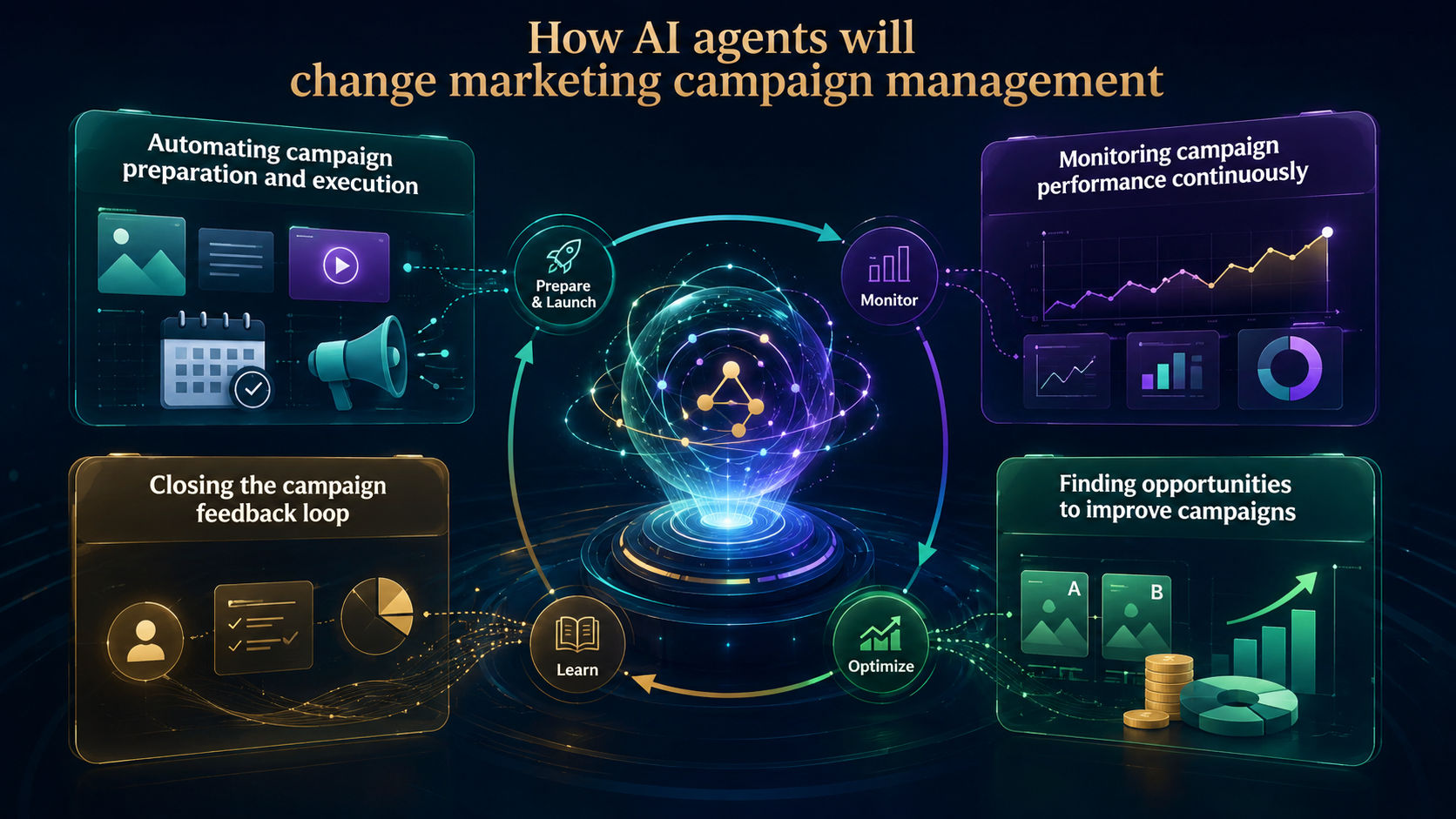
Campaign management is another area where AI agents can reduce repetitive work. Instead of handling campaign setup, monitoring, and reporting as separate tasks, AI agents can connect them into one simple workflow.
Automating campaign preparation and execution
Launching a campaign usually involves planning, approvals, setup, testing, and deployment. With AI agents, many of these tasks can be automated.
Agents can prepare workflows, manage launch schedules, and make sure campaign assets are shared correctly. This can reduce delays and help marketing teams work more efficiently.
Monitoring campaign performance continuously
Many marketers check campaign performance weekly or monthly. AI agents can monitor key metrics continuously and spot important changes as they happen.
This gives marketing teams a clearer view of how their campaigns are performing. It also helps them respond faster to new opportunities or problems.
Finding opportunities to improve campaigns
AI agents can do more than monitor campaigns. They can also suggest or make changes to improve results. For example, they can move more budget to a better-performing ad set, adjust bidding strategies, or pause ads that are not performing well.
Agents can also test small changes and identify which combinations deliver better results.
Closing the campaign feedback loop
When a campaign ends, its results should help shape future campaigns. AI agents can summarize what worked, what did not, and why. This turns campaign data into useful lessons for the next campaign.
This step is often missed because marketing teams are short on time. AI agents can make post-campaign analysis easier and more consistent.
Also Read: How Do Marketers Use AI Prompts to Create Campaigns Faster?
How AI agents will connect the marketing technology stack
Most marketing teams use a wide range of tools that were never designed to work together seamlessly. AI agents for marketing operations are increasingly being used as the connective layer that ties these systems together.
Connecting CRM and marketing automation data
CRM systems and marketing platforms often hold overlapping but slightly different data. Modern marketing automation tools can keep these systems in sync, making sure that lead status, contact details, and engagement history match across platforms.
This kind of agent-driven automation reduces the confusion that happens when sales and marketing teams are working from different versions of the same record.
Coordinating actions across marketing platforms
Instead of manually triggering an action in one tool after checking another, marketing operations focused agents can coordinate actions across platforms directly. For example, an agent might update a CRM field, then trigger an email sequence, then adjust an ad audience, all based on a single customer action.
This kind of coordination is difficult to manage manually at scale, which is why AI marketing automation is becoming a practical way to handle it.
Moving data between connected systems
Data often needs to move from one system to another, such as syncing form submissions into a CRM or pushing campaign results into a reporting tool. AI agents marketing operations automation can manage these transfers automatically, checking for errors and correcting formatting issues along the way.
This reduces the manual export and import work that used to eat up hours of a marketing operations person's week.
Orchestrating cross platform marketing workflows
Beyond individual data transfers, AI agents for marketing operations can manage entire workflows that span several platforms at once. This includes sequencing actions correctly, waiting for confirmation before moving to the next step, and handling exceptions when something does not go as planned.
This level of automation turns a collection of separate tools into something closer to one connected system.
Prepare for the future of AI-powered marketing. Explore upGrad KnowledgeHut Artificial Intelligence Courses to build practical, industry-relevant AI skills.
How AI agents will change the role of marketing operations teams
As agent led marketing operations automation takes over more repetitive work, the role of marketing operations professionals is shifting. The job is moving away from manual execution and toward oversight, strategy, and decision support.
Moving from workflow execution to agent supervision
Marketing operations teams will spend less time manually completing routine tasks. Instead, AI agents for marketing operations will handle approved workflows while people monitor performance and step in when an exception occurs.
This makes supervision an important part of AI marketing automation.
Shifting from manual reporting to decision support
Instead of spending hours collecting data, teams can use AI agents marketing operations automation to gather information and identify important changes.
Marketing professionals can then focus on understanding why performance changed and what the business should do next.
This is one of the more valuable shifts brought on by AI agents, since it allows skilled professionals to focus on judgment calls rather than spreadsheet work.
Managing agent workflows and integrations
As businesses adopt more AI agents for marketing operations, someone will need to manage their connections, permissions, instructions, and performance.
Marketing operations professionals can become responsible for designing reliable workflows and ensuring that AI marketing automation works correctly across the technology stack.
Focusing more on strategic marketing operations
As routine work is handled by agents, marketing operations professionals get more room to focus on strategic planning, process design, and long-term improvements.
Agent driven marketing automation does not remove the need for skilled marketing operations people entirely. It changes what they spend their time on.
Also Read: How AI is Changing Digital Marketing Careers in 2026
How businesses can prepare for agent driven marketing operations
Businesses do not need to automate every marketing process at once. A practical approach to AI agents marketing operations automation is to start with one workflow, measure the results, and expand gradually.
Auditing existing marketing automation workflows
Start by reviewing current workflows. Identify processes that involve repetitive tasks, frequent manual checks, clear rules, and measurable outcomes.
These workflows are often good starting points for AI agents for marketing operations because their performance can be compared before and after automation.
Prioritizing repetitive and measurable processes
Good starting points for AI marketing automation include lead enrichment, data cleanup, reporting, campaign QA, and lead routing.
Avoid starting with complex, high-risk decisions where an error could have a major business or customer impact.
Defining agent permissions and approval controls
Before deploying AI agents marketing operations automation, decide what each agent can read, change, and execute.
Low-risk actions may be automated, while high-impact actions can require human approval. Clear permissions help businesses use AI agents for marketing operations without giving agents unnecessary control.
Measuring automation performance and ROI
Once agents are in place, their performance should be tracked just like any other marketing initiative. This means measuring time saved, error rates, campaign performance, and cost compared to manual processes.
Tracking these numbers helps marketing operations teams understand the real value of AI marketing automation rather than assuming it is working based on impressions alone.
Scaling from individual agents to coordinated workflows
Many teams start with a single agent handling one task, such as lead scoring or reporting. Over time, this can expand into a network of AI agents for marketing operations working together across the entire campaign lifecycle.
Also Read: How AI Search Engines Are Changing Digital Marketing Strategies
Conclusion
AI agents are changing marketing operations by moving teams from manual, rule-based tasks to connected and automated workflows. They can handle repetitive processes, monitor campaigns, connect marketing systems, and support faster decisions.
AI agents marketing operations automation can improve efficiency while allowing teams to focus more on strategy and growth. The best approach is to start with measurable workflows, set clear controls, and scale gradually as results improve.
Have A Query? Get in Touch With Our Customer Support | upGrad KnowledgeHut
Frequently Asked Questions (FAQs)
What are AI agents in marketing?
AI agents in marketing are software systems that can understand goals, analyze data, make decisions, and complete marketing tasks with limited human input. They can work across connected tools to manage multi-step workflows. Unlike basic automation, they can respond to changing conditions and determine the next action.
How are AI agents different from marketing automation?
Traditional marketing automation follows predefined rules, triggers, and workflows set by marketers. AI agents can evaluate information, choose the next step, and coordinate multiple actions based on context. This makes them more flexible for complex and changing marketing processes.
How will AI agents change marketing operations?
AI agents will move marketing operations from manually managing individual tasks to supervising connected, automated workflows. They can monitor campaigns, manage data, coordinate platforms, and support faster decisions. Marketing teams can then spend more time on strategy, optimization, and process improvement.
What marketing tasks can AI agents automate?
AI agents can automate lead qualification, scoring, routing, campaign checks, data enrichment, reporting, audience segmentation, and performance monitoring. They can also coordinate actions across CRM, marketing automation, analytics, and advertising platforms. This reduces repetitive manual work and speeds up marketing processes.
Will AI agents replace marketing operations teams?
AI agents are more likely to change marketing operations roles than completely replace them. They can handle repetitive execution while professionals manage strategy, governance, approvals, and complex decisions. Marketing operations teams will increasingly focus on supervising agents and improving workflows.
What are the benefits of AI agents for marketers?
AI agents can help marketers save time, reduce manual errors, improve data quality, and respond faster to campaign changes. They can also connect different marketing systems and support more personalized customer experiences. These benefits allow teams to manage more workflows without increasing manual effort at the same rate.
What are real-world examples of AI agents in marketing?
Examples include agents that qualify and route leads, check campaign setups, monitor performance, enrich customer data, and generate marketing reports. An agent can also connect CRM activity with audience and campaign actions. These use cases show how AI can manage several related marketing tasks instead of just one.
What skills will marketers need in an agentic AI environment?
Marketers will need stronger skills in AI tools, workflow design, data analysis, automation, and prompt or instruction design. They will also need to understand how to monitor AI outputs and set appropriate controls. Strategic thinking, creativity, communication, and decision-making will remain equally important.
How should companies implement AI agents?
Companies should start with one repetitive, measurable, and relatively low-risk marketing workflow. They should define permissions, approval requirements, success metrics, and monitoring processes before expanding automation. Once the initial workflow performs reliably, businesses can connect additional agents and systems.
What KPIs improve when AI agents are deployed?
The impact can be measured through metrics such as workflow completion time, manual hours saved, error rates, lead routing accuracy, campaign launch time, and cost per process. Depending on the use case, teams can also track conversion rates, engagement, and campaign performance. The right KPIs should compare agent-driven workflows with the previous manual or automated process.
1639 articles published
KnowledgeHut is an outcome-focused global ed-tech company. We help organizations and professionals unlock excellence through skills development. We offer training solutions under the people and proces...
Get Free Consultation
By submitting, I accept the T&C and
Privacy Policy