
- Blog Categories
- Project Management
- Agile Management
- IT Service Management
- Cloud Computing
- Business Management
- BI And Visualisation
- Quality Management
- Cyber Security
- DevOps
- Most Popular Blogs
- PMP Exam Schedule for 2025: Check PMP Exam Date
- Top 60+ PMP Exam Questions and Answers for 2025
- PMP Cheat Sheet and PMP Formulas To Use in 2025
- What is PMP Process? A Complete List of 49 Processes of PMP
- Top 15+ Project Management Case Studies with Examples 2025
- Top Picks by Authors
- Top 170 Project Management Research Topics
- What is Effective Communication: Definition
- How to Create a Project Plan in Excel in 2025?
- PMP Certification Exam Eligibility in 2025 [A Complete Checklist]
- PMP Certification Fees - All Aspects of PMP Certification Fee
- Most Popular Blogs
- CSM vs PSM: Which Certification to Choose in 2025?
- How Much Does Scrum Master Certification Cost in 2025?
- CSPO vs PSPO Certification: What to Choose in 2025?
- 8 Best Scrum Master Certifications to Pursue in 2025
- Safe Agilist Exam: A Complete Study Guide 2025
- Top Picks by Authors
- SAFe vs Agile: Difference Between Scaled Agile and Agile
- Top 21 Scrum Best Practices for Efficient Agile Workflow
- 30 User Story Examples and Templates to Use in 2025
- State of Agile: Things You Need to Know
- Top 24 Career Benefits of a Certifed Scrum Master
- Most Popular Blogs
- ITIL Certification Cost in 2025 [Exam Fee & Other Expenses]
- Top 17 Required Skills for System Administrator in 2025
- How Effective Is Itil Certification for a Job Switch?
- IT Service Management (ITSM) Role and Responsibilities
- Top 25 Service Based Companies in India in 2025
- Top Picks by Authors
- What is Escalation Matrix & How Does It Work? [Types, Process]
- ITIL Service Operation: Phases, Functions, Best Practices
- 10 Best Facility Management Software in 2025
- What is Service Request Management in ITIL? Example, Steps, Tips
- An Introduction To ITIL® Exam
- Most Popular Blogs
- A Complete AWS Cheat Sheet: Important Topics Covered
- Top AWS Solution Architect Projects in 2025
- 15 Best Azure Certifications 2025: Which one to Choose?
- Top 22 Cloud Computing Project Ideas in 2025 [Source Code]
- How to Become an Azure Data Engineer? 2025 Roadmap
- Top Picks by Authors
- Top 40 IoT Project Ideas and Topics in 2025 [Source Code]
- The Future of AWS: Top Trends & Predictions in 2025
- AWS Solutions Architect vs AWS Developer [Key Differences]
- Top 20 Azure Data Engineering Projects in 2025 [Source Code]
- 25 Best Cloud Computing Tools in 2025
- Most Popular Blogs
- Company Analysis Report: Examples, Templates, Components
- 400 Trending Business Management Research Topics
- Business Analysis Body of Knowledge (BABOK): Guide
- ECBA Certification: Is it Worth it?
- Top Picks by Authors
- Top 20 Business Analytics Project in 2025 [With Source Code]
- ECBA Certification Cost Across Countries
- Top 9 Free Business Requirements Document (BRD) Templates
- Business Analyst Job Description in 2025 [Key Responsibility]
- Business Analysis Framework: Elements, Process, Techniques
- Most Popular Blogs
- Best Career options after BA [2025]
- Top Career Options after BCom to Know in 2025
- Top 10 Power Bi Books of 2025 [Beginners to Experienced]
- Power BI Skills in Demand: How to Stand Out in the Job Market
- Top 15 Power BI Project Ideas
- Top Picks by Authors
- 10 Limitations of Power BI: You Must Know in 2025
- Top 45 Career Options After BBA in 2025 [With Salary]
- Top Power BI Dashboard Templates of 2025
- What is Power BI Used For - Practical Applications Of Power BI
- SSRS Vs Power BI - What are the Key Differences?
- Most Popular Blogs
- Data Collection Plan For Six Sigma: How to Create One?
- Quality Engineer Resume for 2025 [Examples + Tips]
- 20 Best Quality Management Certifications That Pay Well in 2025
- Six Sigma in Operations Management [A Brief Introduction]
- Top Picks by Authors
- Six Sigma Green Belt vs PMP: What's the Difference
- Quality Management: Definition, Importance, Components
- Adding Green Belt Certifications to Your Resume
- Six Sigma Green Belt in Healthcare: Concepts, Benefits and Examples
- Most Popular Blogs
- Latest CISSP Exam Dumps of 2025 [Free CISSP Dumps]
- CISSP vs Security+ Certifications: Which is Best in 2025?
- Best CISSP Study Guides for 2025 + CISSP Study Plan
- How to Become an Ethical Hacker in 2025?
- Top Picks by Authors
- CISSP vs Master's Degree: Which One to Choose in 2025?
- CISSP Endorsement Process: Requirements & Example
- OSCP vs CISSP | Top Cybersecurity Certifications
- How to Pass the CISSP Exam on Your 1st Attempt in 2025?
- Most Popular Blogs
- Top 7 Kubernetes Certifications in 2025
- Kubernetes Pods: Types, Examples, Best Practices
- DevOps Methodologies: Practices & Principles
- Docker Image Commands
- Top Picks by Authors
- Best DevOps Certifications in 2025
- 20 Best Automation Tools for DevOps
- Top 20 DevOps Projects of 2025
- OS for Docker: Features, Factors and Tips
- More
- Agile & PMP Practice Tests
- Agile Testing
- Agile Scrum Practice Exam
- CAPM Practice Test
- PRINCE2 Foundation Exam
- PMP Practice Exam
- Cloud Related Practice Test
- Azure Infrastructure Solutions
- AWS Solutions Architect
- IT Related Pratice Test
- ITIL Practice Test
- Devops Practice Test
- TOGAF® Practice Test
- Other Practice Test
- Oracle Primavera P6 V8
- MS Project Practice Test
- Project Management & Agile
- Project Management Interview Questions
- Release Train Engineer Interview Questions
- Agile Coach Interview Questions
- Scrum Interview Questions
- IT Project Manager Interview Questions
- Cloud & Data
- Azure Databricks Interview Questions
- AWS architect Interview Questions
- Cloud Computing Interview Questions
- AWS Interview Questions
- Kubernetes Interview Questions
- Web Development
- CSS3 Free Course with Certificates
- Basics of Spring Core and MVC
- Javascript Free Course with Certificate
- React Free Course with Certificate
- Node JS Free Certification Course
- Data Science
- Python Machine Learning Course
- Python for Data Science Free Course
- NLP Free Course with Certificate
- Data Analysis Using SQL
- Home
- Blog
- Data Science
- Hybrid Search vs Vector Search: What Is the Difference
Hybrid Search vs Vector Search: What Is the Difference
Updated on Aug 31, 2026 | 429 views
Share:
Table of Contents
View all
Quick Overview
- Vector Search vs Hybrid Search: Vector search focuses on semantic similarity, while hybrid search combines semantic and keyword-based retrieval for broader and more precise results.
- Vector search works best for conceptual and natural language queries where understanding meaning is more important than exact terms.
- Hybrid search is useful when queries include exact keywords, SKUs, IDs, error codes, technical terms, or other specific information.
- This guide covers the key differences between vector and hybrid search, how each works, their accuracy, use cases, RAG impact, and how to choose the right approach.
Learn how vector search, hybrid search, and RAG work together in modern AI applications with upGrad KnowledgeHut Advanced AI Masters Program with Microsoft.
Hybrid search vs vector search: Key differences
The biggest difference between vector search and hybrid search lies in how they retrieve relevant content.
Below is a comparison of vector search and hybrid search in terms of their core approach, technology, search capabilities, implementation, latency, and suitability for different use cases.
Factor |
Vector Search |
Hybrid Search |
| Core approach | Searches by meaning | Searches by meaning + keywords |
| Main technology | Dense vectors / embeddings | Dense vectors + keyword search |
| Understands context | Strong | Strong |
| Exact keyword matching | Limited | Strong |
| Handles synonyms | Strong | Strong |
| Handles SKUs, IDs, and codes | Can be weaker | Strong |
| Technical terms | May miss exact terms | Better at exact terms |
| Query types | Mainly meaning-based | Meaning-based + keyword-based |
| Implementation | Simpler | More complex |
| Search signals | Single | Multiple |
| Latency | Usually lower | Can be higher |
| Best for | Finding content by meaning | Searches that need meaning and exact terms |
| RAG suitability | Good for semantic queries | Better for mixed enterprise queries |
Also Read: Vector Databases for Generative AI Applications
What is vector search and how does it work?
A vector search refers to a search technique that relies on finding information according to meaning rather than exact keywords. The process involves turning data into numerical formats referred to as vectors.
In hybrid search vs vector search, vector search stands out because of its capability to understand natural language and user intent through semantic search as opposed to keyword matching.
For instance, a search term such as "affordable smartphones" will bring results of content that uses "budget mobile phones."
How does vector search work?
The vector search algorithm operates as follows:
- Texts are encoded in vectors.
- Queries are encoded into vectors.
- Query vectors are matched to document vectors.
- The most semantically similar results are returned.
Where does vector search work best?
Vector search proves especially successful in cases when:
- Users pose questions using natural language.
- Documents use different words to describe similar concepts.
- Search requires more meaning than keywords.
- Related content discovery is essential.
- Conversational AI systems rely on semantic knowledge.
Also Read: Enterprise RAG Architecture
What is hybrid search and how does it work?
The process of hybrid search is a blend of two different search methodologies: semantic search with the help of vectors, and keyword-based search using sparse retrieval methodologies like BM25. It has been done to make sure that the strengths of both search mechanisms can be utilized.
It is because of this reason that many people prefer hybrid search where both accuracy in terms of concepts and keywords are essential.
How does hybrid search work?
The hybrid search workflow includes the following steps:
- vector search finds semantically similar content
- keyword search finds matches to the keywords
- both sets of results are merged together
- ranking determines the ordering of results
Why combine vector and keyword search?
By combining vector and keyword searches, one eliminates the shortcomings of conventional search engines.
Advantages include:
- Improved processing of product names
- Enhanced retrieval of technical terms
- Better identification of codes and other identifiers
- Relevance for enterprise applications
- Retrieval-Augmented Generation (RAG) support
Build the skills behind modern AI retrieval systems, from machine learning and NLP to vector-based applications. Explore upGrad KnowledgeHut Data Science Courses to strengthen your expertise.
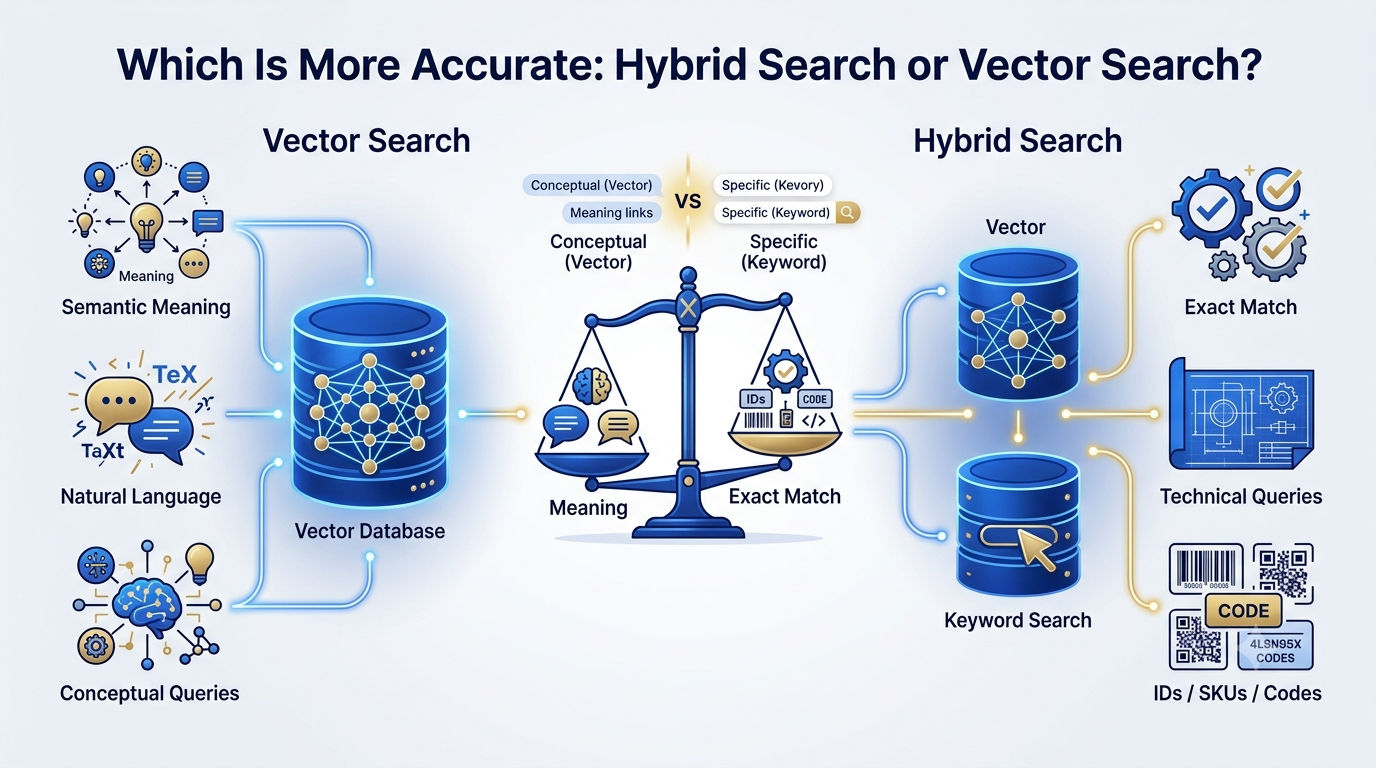
Which is more accurate: Hybrid search or vector search?
The answer depends on the content, query, and searching criteria. Vector search will yield outstanding results when it comes to semantic searches, whereas hybrid search works well when exact search terms are necessary.
When vector search can be more effective
In these instances, vector search alone ensures high accuracy without any additional effort.
- Queries are mostly conceptual.
- Natural language is used by users.
- Exact terms are not crucial.
- It is necessary to detect semantic relationships rather than match literally.
When hybrid search can be more effective
Under the below conditions, hybrid search performs better, as it is not limited only by semantic similarity.
- Queries involve exact IDs.
- Users are searching for technical documentation.
- Product names, SKU numbers, error codes, or models are relevant.
- The combination of semantic and term-based query makes sense.
When should you use hybrid search vs vector search?
The choice between hybrid search vs vector search depends on users’ search behaviour and the nature of data stored in the system.
Choose vector search when
Vector search is a good starting point when:
- The search process is semantic.
- Users make concept-based questions.
- Data is somewhat uniform in terminology.
- Accuracy of identifiers does not play a major role.
- Simplicity is valued.
- Vector search meets the relevance criteria during the evaluation process.
For the case of a small knowledge base and semantic discovery application, there will be no benefit from using several retrieval processes.
Choose hybrid search when
Hybrid search is preferable when:
- Users conduct searches both conceptually and by exact terms.
- Technical terminology matters.
- There are SKUs, product IDs, error codes, names or other references in the corpus.
- Quality of the search is valued more than minimal complexity of its implementation.
- Vector-only retrieval often misses relevant exact matches.
- Enterprise RAG requires both semantic understanding and technical terminology.
Conclusion
Vector search is ideal when understanding the meaning and context of a query is the main priority. Hybrid search combines semantic and keyword retrieval, making it useful for queries that need both context and exact matches.
For enterprise search and RAG, hybrid search can offer better coverage when technical terms, IDs, or codes matter. The right choice depends on your data, query patterns, relevance needs, and performance requirements.
Have A Query? Get in Touch With Our Customer Support | upGrad KnowledgeHut
Frequently Asked Questions (FAQs)
Is hybrid search better than vector search?
Hybrid search is not always better than vector search. It is more useful when queries need both semantic understanding and exact keyword matching. Vector search can be enough when users mainly make conceptual or natural language queries.
How does hybrid search affect RAG latency?
Hybrid search can increase RAG latency because it runs multiple retrieval methods and combines their results. The actual impact depends on the database, indexing setup, query complexity, and result fusion method. Parallel retrieval and efficient indexing can help reduce the added latency.
What is Reciprocal Rank Fusion?
Reciprocal Rank Fusion (RRF) is a method used to combine results from different search systems. It considers the ranking position of each result instead of directly comparing scores from different retrieval methods. In hybrid search, RRF commonly combines keyword and vector search results into one ranked list.
How do vector databases work?
Vector databases store numerical representations called embeddings that capture the meaning of data. When a query is converted into an embedding, the database finds stored vectors that are most similar to it. This allows applications to retrieve semantically relevant content even when the exact words do not match.
Is hybrid search slower than vector search?
Hybrid search can be slower because it may perform both vector and keyword retrieval before combining the results. However, the actual difference depends on the database, index configuration, hardware, and retrieval strategy. Parallel execution and efficient indexing can help keep the additional latency low.
What is the main advantage of hybrid search?
The main advantage of hybrid search is that it combines semantic understanding with exact keyword matching. Vector retrieval can understand context, while keyword retrieval can identify specific terms, codes, names, and IDs. This makes hybrid search useful for applications with mixed search requirements.
When should an enterprise move from vector only to hybrid search?
An enterprise should consider moving from vector only to hybrid search when vector retrieval regularly misses exact names, product IDs, SKUs, error codes, or technical terms. It can also help when users combine natural language questions with specific keywords. The decision should be based on real search performance and user queries rather than assumptions.
What is the difference between hybrid search and semantic search?
Semantic search focuses on the meaning and intent behind a query, commonly using vector embeddings. Hybrid search combines semantic retrieval with keyword or lexical retrieval to capture both meaning and exact terms. Therefore, semantic search is one retrieval approach, while hybrid search combines multiple retrieval signals.
How do I choose between vector and hybrid search?
Choose vector search when users mainly ask conceptual questions and semantic similarity is the primary requirement. Choose hybrid search when exact terms, identifiers, technical language, or product information are also important. Testing both approaches with real queries and comparing relevance, recall, latency, and cost can help you make the right choice.
Which search is best for enterprise applications?
Hybrid search is often a strong choice for enterprise applications because enterprise data usually contains both natural language and exact terminology. It can support technical documentation, internal knowledge bases, product search, and RAG applications effectively. However, vector search may be preferable when the main requirement is simple semantic discovery.
1639 articles published
KnowledgeHut is an outcome-focused global ed-tech company. We help organizations and professionals unlock excellence through skills development. We offer training solutions under the people and proces...
Get Free Consultation
By submitting, I accept the T&C and
Privacy Policy