
- Blog Categories
- Project Management
- Agile Management
- IT Service Management
- Cloud Computing
- Business Management
- BI And Visualisation
- Quality Management
- Cyber Security
- DevOps
- Most Popular Blogs
- PMP Exam Schedule for 2025: Check PMP Exam Date
- Top 60+ PMP Exam Questions and Answers for 2025
- PMP Cheat Sheet and PMP Formulas To Use in 2025
- What is PMP Process? A Complete List of 49 Processes of PMP
- Top 15+ Project Management Case Studies with Examples 2025
- Top Picks by Authors
- Top 170 Project Management Research Topics
- What is Effective Communication: Definition
- How to Create a Project Plan in Excel in 2025?
- PMP Certification Exam Eligibility in 2025 [A Complete Checklist]
- PMP Certification Fees - All Aspects of PMP Certification Fee
- Most Popular Blogs
- CSM vs PSM: Which Certification to Choose in 2025?
- How Much Does Scrum Master Certification Cost in 2025?
- CSPO vs PSPO Certification: What to Choose in 2025?
- 8 Best Scrum Master Certifications to Pursue in 2025
- Safe Agilist Exam: A Complete Study Guide 2025
- Top Picks by Authors
- SAFe vs Agile: Difference Between Scaled Agile and Agile
- Top 21 Scrum Best Practices for Efficient Agile Workflow
- 30 User Story Examples and Templates to Use in 2025
- State of Agile: Things You Need to Know
- Top 24 Career Benefits of a Certifed Scrum Master
- Most Popular Blogs
- ITIL Certification Cost in 2025 [Exam Fee & Other Expenses]
- Top 17 Required Skills for System Administrator in 2025
- How Effective Is Itil Certification for a Job Switch?
- IT Service Management (ITSM) Role and Responsibilities
- Top 25 Service Based Companies in India in 2025
- Top Picks by Authors
- What is Escalation Matrix & How Does It Work? [Types, Process]
- ITIL Service Operation: Phases, Functions, Best Practices
- 10 Best Facility Management Software in 2025
- What is Service Request Management in ITIL? Example, Steps, Tips
- An Introduction To ITIL® Exam
- Most Popular Blogs
- A Complete AWS Cheat Sheet: Important Topics Covered
- Top AWS Solution Architect Projects in 2025
- 15 Best Azure Certifications 2025: Which one to Choose?
- Top 22 Cloud Computing Project Ideas in 2025 [Source Code]
- How to Become an Azure Data Engineer? 2025 Roadmap
- Top Picks by Authors
- Top 40 IoT Project Ideas and Topics in 2025 [Source Code]
- The Future of AWS: Top Trends & Predictions in 2025
- AWS Solutions Architect vs AWS Developer [Key Differences]
- Top 20 Azure Data Engineering Projects in 2025 [Source Code]
- 25 Best Cloud Computing Tools in 2025
- Most Popular Blogs
- Company Analysis Report: Examples, Templates, Components
- 400 Trending Business Management Research Topics
- Business Analysis Body of Knowledge (BABOK): Guide
- ECBA Certification: Is it Worth it?
- Top Picks by Authors
- Top 20 Business Analytics Project in 2025 [With Source Code]
- ECBA Certification Cost Across Countries
- Top 9 Free Business Requirements Document (BRD) Templates
- Business Analyst Job Description in 2025 [Key Responsibility]
- Business Analysis Framework: Elements, Process, Techniques
- Most Popular Blogs
- Best Career options after BA [2025]
- Top Career Options after BCom to Know in 2025
- Top 10 Power Bi Books of 2025 [Beginners to Experienced]
- Power BI Skills in Demand: How to Stand Out in the Job Market
- Top 15 Power BI Project Ideas
- Top Picks by Authors
- 10 Limitations of Power BI: You Must Know in 2025
- Top 45 Career Options After BBA in 2025 [With Salary]
- Top Power BI Dashboard Templates of 2025
- What is Power BI Used For - Practical Applications Of Power BI
- SSRS Vs Power BI - What are the Key Differences?
- Most Popular Blogs
- Data Collection Plan For Six Sigma: How to Create One?
- Quality Engineer Resume for 2025 [Examples + Tips]
- 20 Best Quality Management Certifications That Pay Well in 2025
- Six Sigma in Operations Management [A Brief Introduction]
- Top Picks by Authors
- Six Sigma Green Belt vs PMP: What's the Difference
- Quality Management: Definition, Importance, Components
- Adding Green Belt Certifications to Your Resume
- Six Sigma Green Belt in Healthcare: Concepts, Benefits and Examples
- Most Popular Blogs
- Latest CISSP Exam Dumps of 2025 [Free CISSP Dumps]
- CISSP vs Security+ Certifications: Which is Best in 2025?
- Best CISSP Study Guides for 2025 + CISSP Study Plan
- How to Become an Ethical Hacker in 2025?
- Top Picks by Authors
- CISSP vs Master's Degree: Which One to Choose in 2025?
- CISSP Endorsement Process: Requirements & Example
- OSCP vs CISSP | Top Cybersecurity Certifications
- How to Pass the CISSP Exam on Your 1st Attempt in 2025?
- Most Popular Blogs
- Top 7 Kubernetes Certifications in 2025
- Kubernetes Pods: Types, Examples, Best Practices
- DevOps Methodologies: Practices & Principles
- Docker Image Commands
- Top Picks by Authors
- Best DevOps Certifications in 2025
- 20 Best Automation Tools for DevOps
- Top 20 DevOps Projects of 2025
- OS for Docker: Features, Factors and Tips
- More
- Agile & PMP Practice Tests
- Agile Testing
- Agile Scrum Practice Exam
- CAPM Practice Test
- PRINCE2 Foundation Exam
- PMP Practice Exam
- Cloud Related Practice Test
- Azure Infrastructure Solutions
- AWS Solutions Architect
- IT Related Pratice Test
- ITIL Practice Test
- Devops Practice Test
- TOGAF® Practice Test
- Other Practice Test
- Oracle Primavera P6 V8
- MS Project Practice Test
- Project Management & Agile
- Project Management Interview Questions
- Release Train Engineer Interview Questions
- Agile Coach Interview Questions
- Scrum Interview Questions
- IT Project Manager Interview Questions
- Cloud & Data
- Azure Databricks Interview Questions
- AWS architect Interview Questions
- Cloud Computing Interview Questions
- AWS Interview Questions
- Kubernetes Interview Questions
- Web Development
- CSS3 Free Course with Certificates
- Basics of Spring Core and MVC
- Javascript Free Course with Certificate
- React Free Course with Certificate
- Node JS Free Certification Course
- Data Science
- Python Machine Learning Course
- Python for Data Science Free Course
- NLP Free Course with Certificate
- Data Analysis Using SQL
- Home
- Blog
- Artificial Intelligence
- What Are the Best AI Prompts for Content Marketing?
What Are the Best AI Prompts for Content Marketing?
Updated on Aug 16, 2026 | 0.6k+ views
Share:
Table of Contents
View all
- What should a good AI prompt include?
- AI Prompts for content strategy and audience research
- AI prompts for blog ideas, outlines, and drafts
- AI prompts for SEO and search-intent optimization
- AI prompts for social media and email content
- AI prompts for content repurposing and distribution
- AI prompts for editing, fact-checking, and content quality
- AI Prompts for Content Performance Analysis
- How to get better results from AI content marketing prompts
- How to use AI prompts without losing content quality
- Common mistakes to avoid when using AI prompts for content marketing
- Conclusion
Quick Overview
- The best AI prompts for content marketing use clear roles, specific audience details, relevant context, and structured formats to produce useful, focused content.
- AI prompts can support content strategy, audience research, blog ideas, SEO optimization, social media, email content, and content repurposing.
- Specific instructions, reliable reference material, and smaller tasks can help improve AI output while reducing generic or repetitive content.
- Human review remains important for fact-checking, brand voice, originality, clarity, and content quality before publishing.
- This guide covers practical AI prompts for content planning, blog creation, SEO, social media, email marketing, content distribution, editing, and performance analysis.
Turn AI prompts into practical marketing strategies. Enroll in upGrad KnowledgeHut AI-Driven Digital Marketing Certification Course and learn how to apply AI across digital marketing tasks.
What should a good AI prompt include?
The best AI prompts include a goal, audience, context, and format. Good prompts clearly explain what you want the content to achieve, who it is for, what information to use, and how the final content should look.
A simple formula is Role + Goal + Audience + Context + Task + Format + Tone + Rules
- Role: Tell AI who it should act as, such as a content writer, SEO expert, or social media manager.
- Goal: Explain what you want to achieve.
- Audience: Tell AI who will read or use the content.
- Context: Give useful background information about the topic, brand, product, or situation.
- Task: Clearly explain what you want AI to do.
- Format: Tell AI how you want the response structured, such as a blog, list, email, or social media post.
- Tone: Describe how the content should sound, such as friendly, professional, simple, or conversational.
- Rules: Add any specific requirements, such as word count, keywords, writing style, or things to avoid.
The content marketing prompt formula
Here is a template you can use for most content tasks:
Act as a [role]. Create a [content type] for [target audience] about [topic]. The goal is to [business or content goal]. Use a [tone] tone and include [key points]. Format the response as [format]. Keep it to [length]. Avoid [restrictions].
This formula can also help when connecting prompts to AI agents for marketing tasks. When the instructions are clear, the same task can be repeated automatically each week.
Also Read: What is Prompt Engineering in Generative AI
Information to add before using a prompt
Before using a prompt, provide these details:
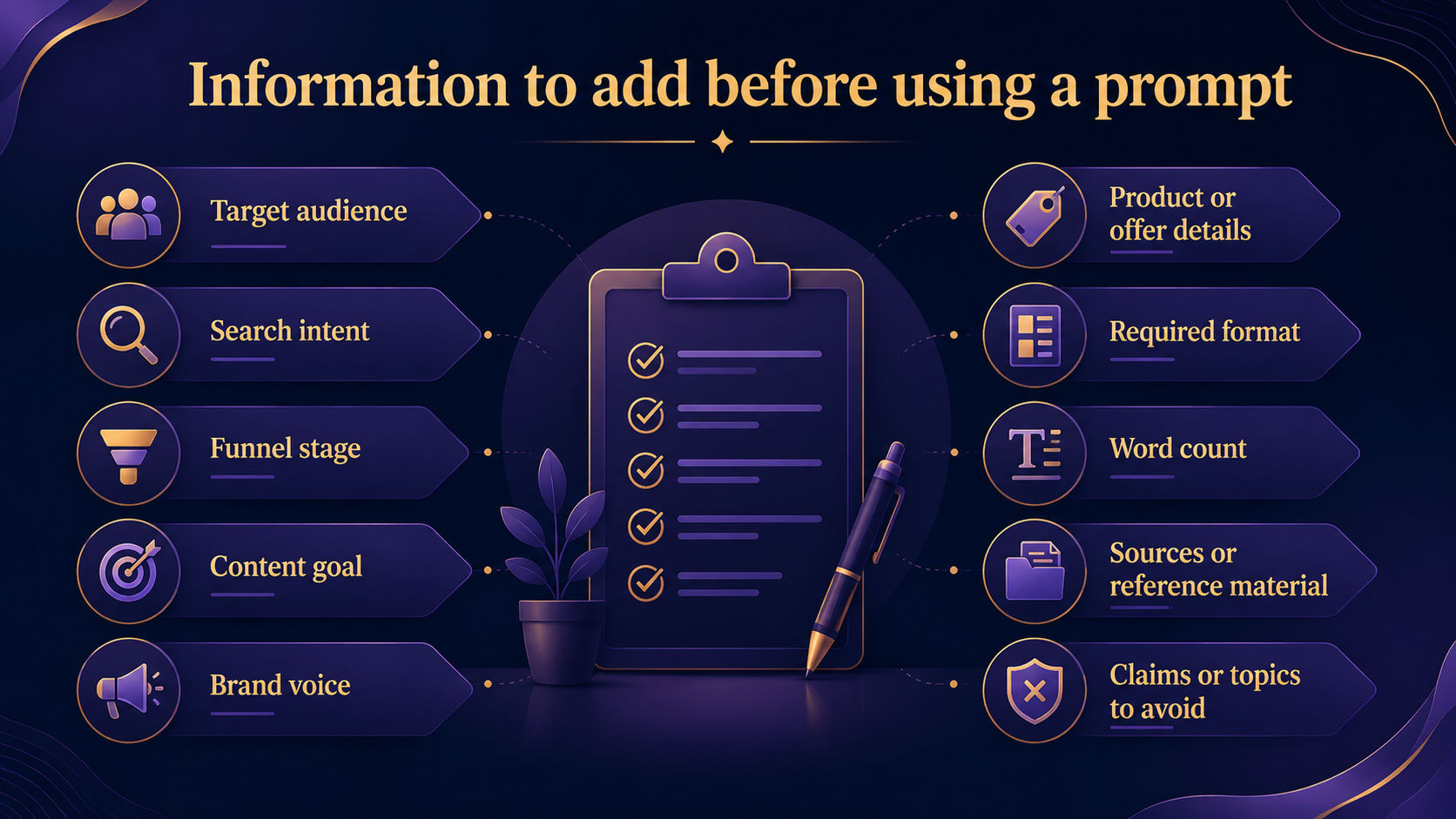
- Target audience
- Search intent
- Funnel stage
- Content goal
- Brand voice
- Product or offer details
- Required format
- Word count
- Sources or reference material
- Claims or topics to avoid
These details help create content that matches your business goals instead of producing generic content.
Also Read: How Does AI Help Marketers Understand Customer Intent?
AI Prompts for content strategy and audience research
Content strategy starts with knowing your audience. AI can help organize audience information, find common questions, and plan content for different stages of the buying journey.
Prompt for defining a target audience
Define the target audience for [product or service]. Include their goals, problems, concerns, preferred content types, reasons for buying, and common questions.
Prompt for creating buyer personas
Create three buyer personas for [business]. For each persona, include their job role, goals, challenges, concerns, search habits, preferred channels, and content needs. Clearly separate facts from assumptions.
Prompt for mapping content to the buyer journey
Create a content map for [audience] across the awareness, consideration, and decision stages. For each stage, suggest topics, content formats, user intent, and calls to action.
Prompt for building a content calendar
Create a 30-day content calendar for [business] targeting [audience]. Include the topic, format, platform, target keyword, funnel stage, content goal, and CTA.
Also Read: Best AI Tools for Content Creation
AI prompts for blog ideas, outlines, and drafts
Once the strategy is ready, AI can help move from planning to production. The key is to use AI for specific tasks instead of asking it to create everything at once.
Prompt for generating content ideas
Give me 20 content ideas about [topic] for [audience]. Focus on real problems, questions, and goals. Include the search intent, suggested format, and the main point each piece should cover. Avoid generic topics.
Prompt for creating an SEO-focused outline
Create an SEO-focused outline for a blog about [topic]. The target keyword is [keyword]. The audience is [audience]. Cover the main questions behind the search, related subtopics, important entities, examples, and practical advice. Use H2 and H3 headings. Do not force keywords into every heading.
For larger teams, this step can become part of AI agents marketing operations automation, where research and outline creation happen before writing begins.
Prompt for drafting a section
Write the section titled "[heading]" for an article about [topic]. The audience is [audience]. Use a simple and natural tone. Explain the idea clearly, include one useful example, avoid filler, and do not repeat points covered in other sections.
Prompt for improving an existing draft
Improve the following draft without changing its main meaning. Remove unnecessary words, improve flow, make sentences easier to understand, and fix grammar. Keep the original brand voice. Do not add unsupported facts. Here is the draft: [paste draft].
Also Read: How Generative AI is Changing Creative Industries in 2026
AI prompts for SEO and search-intent optimization
SEO content should answer the reason behind a search, not simply repeat a keyword. AI can help marketers examine search intent and identify missing information.
Prompt for identifying search intent
Analyze the keyword "[keyword]." Identify the likely search intent. Explain what the searcher wants, what questions they may have, what type of content they expect, and what would make a page more useful than competing results.
Prompt for finding content gaps
Review this topic and the following competitor or reference content: [paste content or summaries]. Identify important questions, subtopics, examples, or practical details that are missing. Separate essential gaps from optional additions.
Prompt for title and meta description ideas
Create 10 SEO title options and 10 meta description options for a page about [topic]. The primary keyword is [keyword]. Keep them clear, specific, and useful. Avoid clickbait and keyword stuffing.
Prompt for improving topical coverage
Review this article about [topic]. Identify important related concepts, questions, entities, and examples that should be covered. Explain where each item could fit naturally. Do not recommend information that is unrelated to the reader's main goal.
Also Read: Prompt Engineering for SEO and Digital Marketing Teams
AI prompts for social media and email content
One strong article can support several smaller content pieces. AI can help turn the main idea into social posts and emails without starting from zero.
Prompt for social media posts
Turn the following blog section into five social media posts for [audience]. Each post should have a different angle. Keep the language natural and useful. Avoid exaggerated claims and unnecessary hashtags. Here is the source content: [paste content].
Prompt for platform-specific variations
Create versions of this message for LinkedIn, Instagram, X, and Facebook. Adjust the length, tone, structure, and CTA for each platform. Keep the core message and facts consistent. Do not use the same wording for every platform.
Prompt for email newsletters
Write a short email newsletter based on this article: [paste article]. The audience is [audience]. Start with a useful idea, summarize the main takeaway, and encourage readers to visit the full article. Use a friendly and direct tone. Keep it under [word count] words.
Prompt for email subject-line testing
Create 12 email subject lines for this newsletter. Provide four clear options, four curiosity-based options, and four benefit-focused options. Avoid misleading claims, excessive punctuation, and spammy language.
Also Read: Gen AI for Marketers: How to Use Generative AI Tools in Your Daily Workflow
AI prompts for content repurposing and distribution
Content repurposing helps teams get more value from work they have already completed.
Prompt for repurposing a blog post
Repurpose this blog post into a LinkedIn post, five short social posts, a newsletter, three video ideas, and five FAQ questions. Keep all facts consistent with the original article. Identify which points are best suited to each format.
Prompt for creating a video script
Turn this article into a 60-second video script for [audience]. Start with a clear hook, explain the main idea, give two or three useful points, and finish with a simple CTA. Keep the language natural and conversational.
Prompt for creating a content distribution plan
Create a distribution plan for this article: [paste article]. Include the channels to use, audience for each channel, content format, publishing timing, CTA, and repurposing idea. Prioritize channels based on likely audience value rather than simply listing every platform.
AI prompts for editing, fact-checking, and content quality
AI-generated content still needs human review. Editing and fact-checking are important before anything is published.
Prompt for checking factual claims
Review the following content and identify every factual claim that should be verified. For each claim, explain what needs to be checked and why. Do not decide that a claim is true unless reliable source material has been provided.
Prompt for improving clarity and readability
Edit this content for clarity and readability. Use short sentences where possible, remove unnecessary jargon, improve transitions, and keep the meaning unchanged. Make the writing sound natural and useful for [audience].
Prompt for checking brand voice
Review this content against the following brand voice guidelines: [paste guidelines]. Identify sentences that do not match the voice and suggest improvements. Keep the tone consistent, clear, and natural.
Prompt for detecting repetition and unsupported claims
Review this article for repeated ideas, repeated phrases, unsupported claims, vague statements, and unnecessary sections. List each issue and suggest a specific improvement. Do not rewrite the entire article.
Ready to improve how AI supports your content workflow? Explore upGrad KnowledgeHut Artificial Intelligence Courses and build practical skills in generative AI and prompt engineering.
AI Prompts for Content Performance Analysis
AI is not only useful before publishing. It can also help marketers understand what happened after content went live.
Content performance analysis prompt
Analyze the performance data for these content pieces: [add data]. Compare traffic, impressions, clicks, rankings, engagement, conversions, and publishing dates. Identify the strongest and weakest performers and explain possible reasons for the differences.
Use real analytics data wherever possible. AI can help explain patterns, but it should not replace your analytics platform.
Engagement analysis prompt
Analyze these engagement metrics: [add metrics]. Identify which topics, formats, headlines, or channels appear to generate the strongest engagement. Separate clear patterns from assumptions that need more data.
Conversion-focused analysis prompt
Analyze the following content performance data with a focus on conversions. Identify which pages or topics generate leads, sign-ups, purchases, or other target actions. Suggest three tests that could improve conversion rates without making unsupported assumptions.
Content gap and underperforming content prompt
Review this content performance report. Identify pages that receive traffic but have low engagement or conversions, pages losing traffic, and important topics with little or no coverage. Recommend which pages should be updated, expanded, combined, or replaced.
Also Read: Prompt Engineering for Marketing
How to get better results from AI content marketing prompts
Better results do not always require longer prompts. They require relevant information and clear instructions.
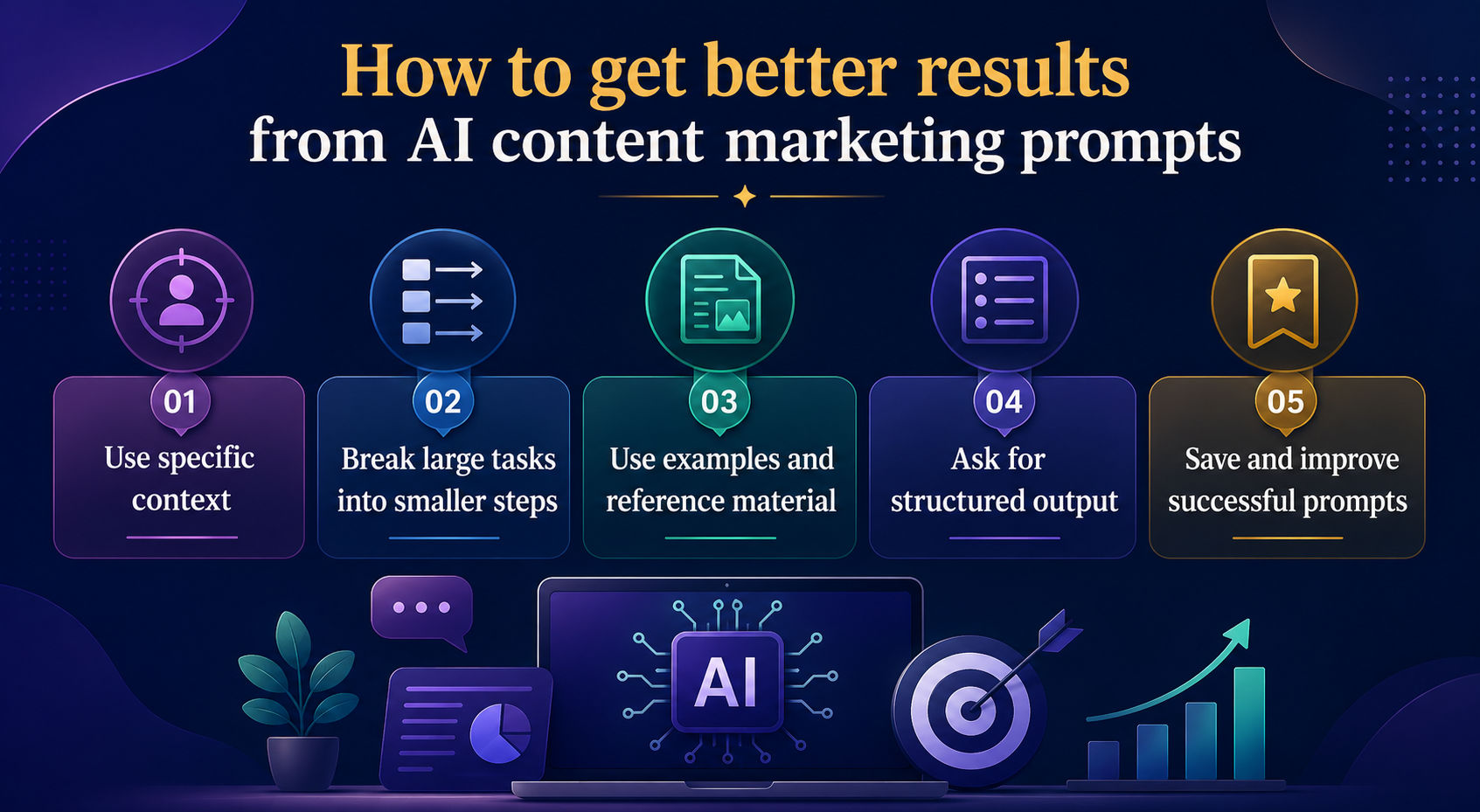
1. Use specific context
Tell AI who the audience is, what the content should achieve, what information is available, and what should be avoided.
Specific context also improves AI agents marketing operations automation because automated workflows need clear instructions at each stage.
2. Break large tasks into smaller steps
Do not ask AI to research a topic, create a strategy, write a complete article, optimize it, and fact-check everything in one request.
Break the work into research, planning, writing, editing, and review. This makes errors easier to identify and supports more reliable AI marketing automation workflows.
3. Use examples and reference material
Give AI examples of approved content, brand guidelines, research, customer information, or previous campaigns where appropriate.
Reference material reduces guesswork and helps the output match the required style and subject.
4. Ask for structured output
Specify whether the response should use headings, bullets, tables, columns, steps, or another format.
Structured output is especially useful for AI agents for marketing operations, because one workflow can pass a predictable output to the next step.
5. Save and improve successful prompts
Keep prompts that consistently produce useful results. Test small changes to context, tone, format, and constraints to improve them over time.
Also Read: How Do Marketers Use AI Prompts to Create Campaigns Faster?
How to use AI prompts without losing content quality
AI can make content work faster, but speed should not replace quality. Human judgment is still needed to decide whether content is accurate, useful, original, and appropriate for the audience.
1. Give AI enough context and reliable source material
Provide accurate information, relevant research, product details, audience insights, and other useful references. Do not expect AI to know business-specific information that has not been provided.
2. Keep brand voice and audience needs central
AI-generated content can sound generic when the prompt does not include a clear brand voice. Provide examples of approved writing and explain how the audience should be addressed.
3. Fact-check AI-generated claims
Check statistics, research, dates, names, product details, and other important claims before publishing. AI can produce confident statements that still need verification.
4. Add original insights and examples
Bring in expert opinions, customer experiences, original examples, internal data, and practical observations. These elements can make content more useful and distinctive.
5. Edit for accuracy, clarity, and originality
Read the final content from the audience's point of view. Remove repetition, simplify difficult explanations, strengthen weak sections, and make sure the content actually answers the search query.
6. Avoid publishing the first AI output
The first response should be treated as a draft. Review it, improve it, fact-check it, and add human expertise before publication.
This human review is important even when AI agents for marketing operations handle several content tasks automatically. AI marketing automation should reduce repetitive work, not remove editorial responsibility.
Also Read: Gen AI for Marketers
Common mistakes to avoid when using AI prompts for content marketing
Using vague instructions
A prompt such as “Write an article about content marketing” gives very little direction. Include the topic, audience, goal, format, tone, and important points.
Skipping audience information
Content written for a beginner will differ from content written for an experienced marketing professional. Always define the intended reader.
Ignoring search intent
Using the right keyword is not enough. Content should answer what the searcher actually wants to know and provide the level of detail expected.
Asking for everything in one prompt
Large requests can produce inconsistent results. Divide complex work into smaller steps and review each output before moving forward.
Publishing AI output without editing
AI can miss context, repeat ideas, use weak examples, or make unsupported claims. Human editing should remain part of every important content workflow.
For teams using AI agents marketing operations automation, this review step is even more important because automation can scale both good processes and poor ones.
Also Read: How AI is Changing Digital Marketing Careers in 2026
Conclusion
Effective AI prompts help marketers create more relevant, useful, and audience-focused content across the entire content workflow. Clear goals, context, search intent, and structured instructions can improve the quality of AI-generated output.
However, AI should support human expertise, not replace fact-checking, editing, and creative judgment. With the right approach, AI can make content planning, creation, optimization, and distribution faster and more consistent.
Have A Query? Get in Touch With Our Customer Support | upGrad KnowledgeHut
FAQs
What are AI prompts for content marketing?
AI prompts for content marketing are instructions that tell AI what type of content to create, improve, or analyze. They can include the target audience, content goal, topic, tone, format, and other requirements. Clear prompts help marketers get more relevant and useful results.
How do I write a good AI prompt for creation?
Start with a clear goal and define the target audience, topic, tone, context, and desired format. Add useful examples, reference material, word count, and specific limitations. Clear instructions reduce generic output and make the content easier to refine.
Can the same AI prompts work in ChatGPT, Gemini, and Perplexity?
Yes, most well-structured prompts can be used across ChatGPT, Gemini, and Perplexity. However, results can vary based on each platform's capabilities and how it processes the information. Prompts may need small adjustments depending on the task and tool.
How do I make AI-generated content sound less generic?
Provide specific information about the audience, brand voice, content goal, and subject instead of using broad instructions. Add real examples, original insights, and reliable reference material to guide the output. Always edit the final content to make it more natural and relevant.
How do marketers use AI prompts without losing brand voice?
Include clear brand voice guidelines, preferred terminology, tone, and examples of approved content in the prompt. Review the AI output carefully before publishing. Human editing ensures the final content remains consistent with the brand's identity and messaging.
How to structure a multi-step AI prompt?
Break a large content task into smaller steps such as research, planning, outlining, drafting, editing, and fact-checking. Give each step a specific objective and required output. This makes the process easier to manage and helps identify errors at each stage.
What is the difference between a generic prompt and a structured prompt?
A generic prompt gives broad instructions with little context, such as asking AI to write an article. A structured prompt defines the audience, goal, context, task, tone, format, and constraints. This gives AI clearer direction and usually produces more focused results.
How can AI prompts be incorporated into a content workflow?
AI prompts can support different stages, including audience research, content planning, writing, SEO, editing, repurposing, distribution, and performance analysis. Reusable prompts can make recurring tasks more consistent. Human review should remain part of the workflow.
How to use AI prompts for AEO and GEO?
Create prompts around direct user questions, clear answers, search intent, relevant entities, and factual information. Ask AI to identify important questions and structure concise, useful responses. Review the output to ensure the information is accurate and genuinely helpful.
How to create AI prompts based on buyer personas?
Start with details such as the persona's goals, challenges, objections, knowledge level, search behavior, and preferred content channels. Add these details to the prompt along with the content goal and format. This helps create content that is more relevant to a specific audience segment.
Is publishing AI-generated content without editing recommended?
No, AI-generated content should be reviewed and edited before publication. Check factual claims, brand voice, originality, relevance, clarity, and repetition during the review. Adding human insights and examples can also make the final content more useful and credible.
1639 articles published
KnowledgeHut is an outcome-focused global ed-tech company. We help organizations and professionals unlock excellence through skills development. We offer training solutions under the people and proces...
Get Free Consultation
By submitting, I accept the T&C and
Privacy Policy