
- Home
- Blog
- It Service Management
- ITIL vs COBIT: Comparing IT Governance Frameworks
ITIL vs COBIT: Comparing IT Governance Frameworks
Updated on Mar 30, 2022 | 7 min read | 11.14K+ views
Share:
Table of Contents
View all

Every organization deals with the struggle of competition and to stay on top, one needs to realize the importance of the internet and data. This is where information technology plays a crucial role. To achieve stability and success, the organizations must optimize their IT resources through ITSM (Information Technology Service Management). ITSM in an organization is implemented through a proper framework.
COBIT and ITIL are two globally accepted standard frameworks for ITSM. A COBIT vs ITIL comparison will help you learn the differences between the two frameworks and make the right choice for your needs.
Master the Right Skills & Boost Your Career
Avail your free 1:1 mentorship session
Basics of COBIT
COBIT (Control Objectives for Information and Related Technologies) was introduced in 1996 by ISACA and ties in with larger project management tools such as TOGAF, CMMI, and PMBOK . This framework combines a set of guidelines and practices that have to be carried out to reap the maximum benefits out of the company’s IT resources. It precisely bridges the gap between business and IT goals and is carried out through proper implementation without affecting the costs. This provides a proper oversight and structure to the IT functioning while adhering to the privacy standards.
COBIT’s Core Components Are:
- Frameworks
- Control Objectives
- Maturity Models
- Process Descriptions
- Management Guidelines
COBIT Framework Follows these Principles:
- Introduction of a holistic approach
- Creation of an integrated framework within the organization
- Separation of governance and management
- End-to-end enterprise coverage
- Compliance with the stakeholder demands
You can invest in upgrading your ITSM skills through the top-most service management certifications by KnowledgeHut to efficiently manage your company’s IT environment.
Basics of ITIL
ITIL (Information Technology Infrastructure Library) is a framework planned out to manage the IT services of an organization through a set of planning, practices, and selection. ITIL assists the organization’s IT department in everyday routines and processes along with handling their issues.
Five Components of ITIL
- Service Strategy
- Service Design
- Service Transition
- Service Operation
- Continuous Service Improvement
An ITIL foundation certification course is a great step towards ITSM improvement for every business. In a personal capacity as well, a professional certification improves your employability and validates your professional skills.
COBIT vs ITIL Comparison Table
| Comparison | COBIT | ITIL |
|---|---|---|
| Definition |
COBIT is a framework that is used for the development, monitoring, improving, and implementing the IT governance and management published by ISACA. It is a set of guidelines that are essential for every organization. | ITIL is a framework that lays out the best practices, plans, and implementations that work to improve the IT services in accordance with the business requirements. It also defines the entire process to improve the IT service lifecycle. |
| Scope | It focuses on the ITSM but has a broader scope than ITIL. COBIT focuses on the entire organization. | ITIL focuses on the ITSM but its framework is restricted to the IT domain. |
| Approach | It has a top-down approach to provide a precise difference between governance and management of the IT sector. | It has a bottom-up approach that focuses on the tactics and controls the management of ITSM IT services. |
| Objective | The main objective is to hand over the control of IT services to the organization through a set of rules. It also aligns the IT goals with the business goals and manages the risks, IT efficiency, and resources. | The main objective is to control the ITSM IT departments and services. It provides support for operational perfection. |
| General Problems |
The general problems are handled in an effective way. COBIT lays down the benchmarks for the IT department and evaluates them frequently to reach the goals. | The general problems are handled effectively by the IT department. It assists the department in reducing the downtime and consistent overloading problem. |
COBIT 5 vs ITIL 4
COBIT is a framework, a set of practices for the organization’s top management to understand the method through which the IT enterprise should be approached. It supports the organization in meeting everyday business challenges in risk management and regulatory compliance and aligning the organizational goals with the IT strategy. COBIT 5, released in 2012 is the latest version of the framework.
ITIL
ITIL is a roadmap laid down for the organization and helps in the understanding of how to deal with the IT department’s regular processes. It is a library of volumes that helps an organization in managing its risks, establishing cost-effective practices, and strengthening customer relations. ITIL 4 is the latest version where a digital operating model is provided to the organization to induce effective value from the IT products and services.
How Do You Implement ITIL and COBIT?
After learning the difference between COBIT and ITIL, let us try to understand the methods of implementation for each of them. Every framework operates distinctively and benefits the enterprise in its own way. While COBIT pays attention to improving the IT structure for the company’s benefit, ITIL searches for the practices through which the IT department can function better.
COBIT Implementation
For a better understanding of COBIT implementation, let’s take an example –
Suppose an organization is unable to leverage the IT department effectively and this leads to several miscommunications, delays, and unavoidable downtime. Here’s how such an organization would implement COBIT –
Stage 1:
A stakeholders’ meeting is scheduled to define and understand the goals. These goals address the current problem and identify which IT processes have to be adopted.
Stage 2:
Benchmarks are created for the IT department to achieve the goals. Every benchmark that is achieved helps the organization in achieving its goals. If there is a stipulated time frame, then the progress can be tracked and controlled accordingly.
Stage 3:
Lastly, if the goals are not met through the current IT structure, new resources, including infrastructure and software are added.
ITIL Implementation
ITIL framework is carried out within the IT department itself. The stakeholders, managers, or C-level executives aren’t involved or in control.
For example:
- If there are frequent network issues due to heavy traffic or glitch in the system, the IT department’s service transition and service operation managers join hands to restructure and delay the network usage to prevent overloading issues. If the problem isn’t targeted within a particular timeframe, it can lead to the company’s loss.
- The IT staff’s performance cannot be monitored and the company needs to target the redundant and inefficient personnel. In this scenario, the service improvement’s KPIs are taken into account to measure and improve the performance.
Learn meticulously about the ITIL implementation through knowledgehut ITIL foundation certification for better understanding and functioning.
Top Cities where KnowledgeHut Conduct ITIL Certification Training Course Online
Can COBIT & ITIL Work Together?
The relationship between COBIT and ITIL corresponds to the relationship between the “what and how”. In numerous ways, they are not opponents but rather complementary to each other in the business.
Both COBIT and ITIL focus on the transformation of the stakeholders’ requirements into value. Tailored to match an organization’s requirements, both frameworks enable the business to use the IT structure in the most efficient manner.
For better clarity, here is an example –
ITIL 4 (the latest version) focuses rigidly on the ITSM governance and includes the Service Value System. This helps the organizations understand where and how COBIT can become a part of the strategy. ITIL 4 provides well-structured advice on how the organization can carry out several COBIT processes.
COBIT uses goal cascading that helps the organization in bridging the gap between stakeholders’ requirements and company goals. This structure improves the ITIL’s effectiveness and identifies the key ITSM activities.
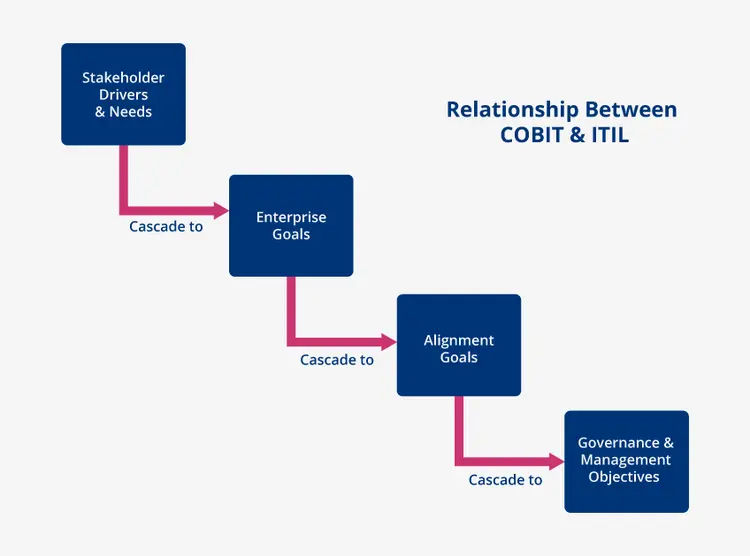
COBIT and ITIL, when utilized together, provide guidance for effective IT service management.
Enhance your project management expertise with our best project management training course. Elevate your abilities and guide your team towards triumph!
ITIL vs COBIT or ITIL & COBIT?
The goal of ITIL and COBIT is identical – to improve the efficiency and stability of the IT structure. Although ITIL and COBIT work efficiently together, they can also be separately adopted. ITIL provides a strategic base for the IT services which is sufficient for small enterprises while COBIT is a framework well-suited for large-scale enterprises.
ITIL tactics can be used without the COBIT strategy as to include COBIT into the plan of action, an organization requires several IT processes and a considerable IT governance enterprise. To achieve that scope of IT maturity on a higher level, ITIL is a preferable first step.
So, the first step of ITSM implementation should be ITIL and once there is a clear understanding of the framework, an organization can start thinking on a global level.
Frequently Asked Questions (FAQs)
1. Is ITIL part of COBIT?
Although the end goal of ITIL and COBIT is identical and are interlinked to each other, both are separate frameworks adopted for the governance of IT service. ITIL is a roadmap to identify how the IT employees’ everyday processes should be managed. COBIT is a set of practices followed by the top management to understand the manner in which the IT enterprise should be approached.
2. What differences do the check sheets show between ITIL and COBIT?
The check sheets of ITIL and COBIT show that both the frameworks are designed to manage the resources, risks, and IT systems but the scope of COBIT is larger than the ITIL. While COBIT handles the organization’s problems to bridge the gap between stakeholders’ interests and the company’s goals, ITIL is more focused towards the management of IT departments and IT services in ITSM.
98 articles published
Manikandan Mohanakrishnan is a highly skilled corporate trainer, consultant, and content developer with expertise in a wide range of areas including ITIL 4, PRINCE2, Agile/Scrum, PMP, DevOps, and soft...
Get Free Consultation
By submitting, I accept the T&C and
Privacy Policy
Ready to fast-track your ITSM career?