
- Home
- Blog
- It Service Management
- ITIL V3 vs ITIL V4: What's The Difference
ITIL V3 vs ITIL V4: What's The Difference
Updated on Jul 09, 2025 | 8 min read | 13.57K+ views
Share:
Table of Contents
View all
- An overview of ITILV3
- An overview of ITILV4
- ITIL® V3 Framework
- ITIL® V4 Framework
- ITIL V3 Process vs ITIL V4 Practices
- ITIL V3 Service Lifecycle vs ITIL V4 Service Value System
- ITIL V3 Continual Service Improvement vs ITIL V4 Continual Improvement
- ITIL V3 Guiding Principles vs ITIL V4 Guiding Principles
- ITIL V4 Four Dimensions vs. ITIL V3 Four P's
- ITIL V3 /ITIL V4 Qualification Roadmap
- Governance is Emphasized in ITIL V4
- ITIL V3 Value vs ITIL V4 Value Co-Creation
- Final Thoughts about ITIL V3 vs ITIL V4
The ITIL® framework, or Information Technology Infrastructure Library, is one of the most popular frameworks in IT service management. ITIL® creators must keep ITIL® current with modern technologies since IT is a domain that remains in constant flux. In response to this, Axelos Ltd recently released the new version of ITIL called ITIL V4. The article on ITIL V3 vs ITIL V4 discusses the major changes to ITIL® V4, highlighting the key difference between ITIL V3 and ITIL V4, the latest versions of the ITIL methodology.
Master the Right Skills & Boost Your Career
Avail your free 1:1 mentorship session
An overview of ITILV3
In order to provide ITSM (IT service management), ITIL provides a framework of best practices and processes. As a framework for ITSM, ITIL was first published in the 1980s and has since become one of the most widely adopted frameworks. By providing effective service delivery and cost-effectiveness, the framework strives to improve customer satisfaction.
As business requirements have changed over the years, several versions of ITIL have been released to meet these new requirements. It was released in 2007 and referred to as ITIL V3. A new version of ITIL V3 became available in 2011 due to this update, which is why ITIL V3 is also known as ITIL 2011 V3. Modern business environment requires a more strategic approach to IT service management, and this ITIL V3 covers that to ensure IT service management aligns with business requirements. No wonder, enterprises want their IT workforce to take ITIL foundation training online and upskill while being productive.
An overview of ITILV4
Information Technology Infrastructure Library 4 is the latest evolution of ITIL. With its launch in 2019, it reshapes established ITIL practices through an integrated view across customer experience, value streams, and digital transformation. It also embraces Lean, Agile, and DevOps approaches. Modern and emerging practices are integrated with established and proven know-how, ensuring continuity with existing working methods (where appropriate) and providing guidance about the benefits of adopting these new approaches with less disruption.
By elevating the profile of service management in an organization, ITIL 4 provides a holistic approach that emphasizes value delivery, while providing an integrated, flexible, and coordinated framework for effective governance and management of IT-enabled services. There is no question that ITIL 4 is one of the industry-recognized IT service management certification courses that provides a structured approach to developing IT service management skills.
ITIL® V3 Framework
The Information Technology Infrastructure Library, or ITIL V3, is the third version of this management framework, which represents best practices for managing information technology. In this framework, IT plays a leading role in helping businesses achieve their goals. In 2007, ITIL V3 was released as an IT service management framework considered to be among the best. An outstanding aspect of ITIL is that it is constantly evolving to accommodate the demands of today's business environment. As ITIL evolves to adapt to the latest trends and practices like DevOps and Lean, a new framework has been developed called ITIL 4, which brings the ITIL process in line with customer or organization requirements.
ITIL® V4 Framework
In addition to improving strategic elements that provide better alignment of IT service management with business requirements, ITIL v4 is an upgraded version of the ITIL V3 framework. With the release of ITIL v4, an end-to-end operating model for creating, delivering, and continuously improving technology-enabled products and services was created that helps build an effective ITSM process.
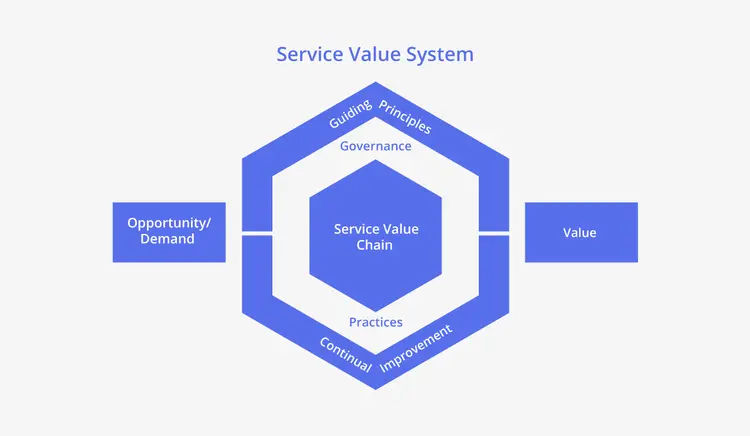
The new service management challenges are also addressed through guidance provided by ITIL V4. In an era of Cloud, Agile, DevOps, and transformation, it is of great help to utilize modern technology to its full potential. ITIL Service Value System (SVS) and the four-dimension model are the foundation of this framework. ITIL SVS comprises the following components:
- Service Value Chain (SVC)
- ITIL Practices
- ITIL Guiding Principles
- Governance
- Continual Improvement
ITIL V3 Process vs ITIL V4 Practices
Let us get started with ITIL V3 vs V4 differences in their practices. It is important to understand that processes in ITIL V3 are sequences of activities that have been converted into practices. Practices link to something that can be accomplished using the right resources. In ITIL V3 processes, you will find a description of the flow of activities, along with metrics and suggestions for roles. An organization is able to perform its ITIL V4 practices through its capabilities, on the other hand.
ITIL V3 Process vs ITIL V4 Practices
In ITIL V4, there are 34 practices, replacing 26 of those in ITIL V3. Check out this ITIL V4 vs V3 comparison table.
| ITIL V3 Processes |
ITIL V4 Practices |
| Service Strategy Strategy Management Demand Management Service Portfolio Management Financial Management Business Relationship Management Service Design Service Catalog Management Availability Management Information Security Management Service Level Management Capacity Management Design Coordination Supplier Management IT Service Continuity Management Service Transition Transition Planning and Support Change Management Change Evaluation Release and Deployment Management Service Assets & Configuration Management Service Validation and Testing Knowledge Management Service Operation Access Management Event Management Service Request Fulfilment Incident Management Problem Management Continual Service Improvement The Seven-Step Improvement |
General Management Practices Architecture Management Continual Improvement Information Security Management Knowledge Management Measurement and Reporting Organizational Change Management Portfolio Management Project Management Relationship Management Risk Management Service Financial Management Strategy Management Supplier Management Workforce and Talent Management Service Management Practices Availability Management Business Analysis Capacity and Performance Management Change Control Incident Management IT Asset Management Monitoring and Event Management Problem Management Release Management Service Catalog Management Service Configuration Management Service Continuity Management Service Design Service Desk Service Level Management Service Request Management Service Validation and Testing Technical Management Practices Deployment Management Infrastructure and Platform Management Software Development and Management |
ITIL V3 Service Lifecycle vs ITIL V4 Service Value System
Service lifecycles in ITIL V3 consist of five phases based on waterfall models. There are five stages in the service design process:
- Service Strategy
- Service Design
- Service Transition
- Service Operations
- Continual Service Improvement
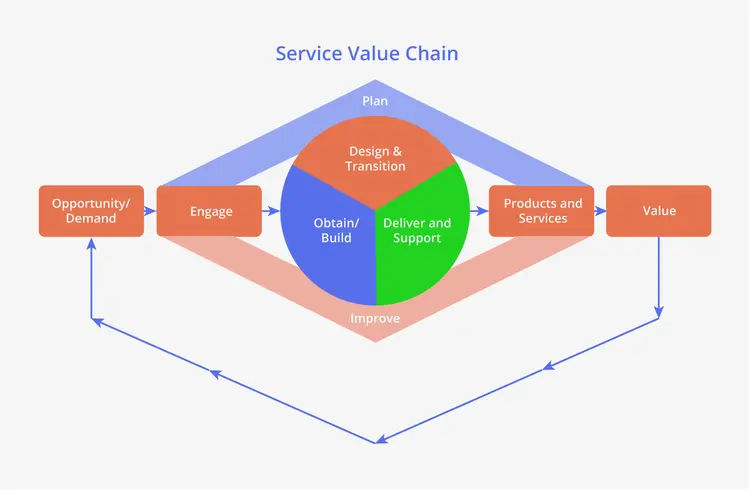
Based on a Service Value System (SVS), ITIL V4 describes how all aspects of the framework should work together in order to deliver value to an organization.
This is where the Service Value Chain is:
ITIL V3 Continual Service Improvement vs ITIL V4 Continual Improvement
ITIL V4's CSI model is now referred to as CI model in place of V3's. Using the ITIL V4 model for continuous improvement, a structured approach can be utilized to identify and implement various improvements that can be applied to all levels of the organization. This seven-step process is essentially the same as the ITIL V3 framework's seven-step improvement process.
ITIL V3 Guiding Principles vs ITIL V4 Guiding Principles
With ITIL V4, you are now limited to only 7 guiding principles that were part of ITIL V3. Check out the ITIL V3 vs V4 differences in their guiding principles.
| ITIL V3 Guiding Principles | ITIL V4 Guiding Principles |
|
|
ITIL V4 Four Dimensions vs. ITIL V3 Four P's
In the ITIL V4 framework, the four P's have been replaced with four dimensions.
| ITIL V3 Four P’s | ITIL V4 Four Dimensions |
|
|
ITIL V3 /ITIL V4 Qualification Roadmap
| ITIL V3 Four P’s | ITIL V4 Four Dimensions |
|
|
The ITIL V3 certification path starts with the foundation course and depending on the specialisation you choose between service capability and service lifecycle modules, you reach the intermediate certification of MALC, and then with further training, become an ITIL Expert and ultimately an ITIL Master. These modules were discontinued at the end of 2021. The ITIL V4 certification follows a modular and tiered approach, the journey starts with the foundation program, go on to the ITIL Managing Professional and ITIL Strategic Leader levels before becoming an ITIL Master.
Enroll in our project management course to achieve your career goals. Discover project management course objectives, acquire the expertise to steer triumphant projects, and elevate your professional growth.
Governance is Emphasized in ITIL V4
In the service value system, the governance component of ITIL V4 discusses how to direct and control any organization. This topic was covered as a subtopic within the earlier framework and was of little importance, but in the ITIL V4 framework, it occupies a prominent position within the SVS and is given a separate chapter.
ITIL V3 Value vs ITIL V4 Value Co-Creation
'Services' are defined in ITIL V3 as ways to deliver value to the customer by facilitating outcomes he wants to achieve without incurring specific costs or risks. ITIL V4 provides an updated definition of service as a cooperative effort to co-create value by facilitating the outcomes a customer desires without putting anything at risk or cost. In addition to Service Provider and Regulator participation and contribution, Consumers, Suppliers, and Regulators are also required to be involved in Value Co-Creation in the ITIL V4 framework.
Top Cities where KnowledgeHut Conduct ITIL Certification Training Course Online
Final Thoughts about ITIL V3 vs ITIL V4
Keeping this in mind when examining the leap from ITIL V3 to ITIL 4, remember that the latter isn't about changing the content of the library, but rather about changing the approach and philosophy of ITIL. Particularly in fields under IT's purview, technology is advancing at an exponential rate. Therefore, it is an absolute necessity for today's IT departments to be fully equipped and informed in order to function in this dynamic new environment, ready to deal with any changes introduced by new innovation.
As a result, an increasing number of companies and organizations are starting to accept the idea that their IT department is vital to their success. Because of this, the IT department is fully integrated into the company structure. To succeed in the 21st century, effective communication and collaboration are more essential than ever before.
Despite minor changes to ITIL 4's core concepts, the new edition sounds like a call to action that encourages employees and employers to change how they approach IT, as well as pointing them in the right direction for a more frictionless implementation. Hope this article helps you distinguish between these versions and address your ITIL V4 vs ITIL V3 queries. Learn more about KnowledgeHut ITIL foundation training online and upskill at you own schedule.
Frequently Asked Questions (FAQs)
1. What is the main difference between ITIL v3 and V4?
In ITIL 4, 34 practices describe what you'll need in order to create value with clients and stakeholders. From the perspective of ITIL V3, these practices are greatly expanded from what the 29 processes of ITIL V3 were-a a reflection of significant changes affecting the industry in recent years. Each organization will have its own needs and requirements related to these practices, so guidance is tailored to meet those needs.
2. How is ITIL V4 different from the previous version?
ITIL 4 differs from the older versions by expanding on best practices and adding new information on integration. ITIL 4 emphasizes the concepts of costs, outcomes, risks, and value.
98 articles published
Manikandan Mohanakrishnan is a highly skilled corporate trainer, consultant, and content developer with expertise in a wide range of areas including ITIL 4, PRINCE2, Agile/Scrum, PMP, DevOps, and soft...
Get Free Consultation
By submitting, I accept the T&C and
Privacy Policy
Ready to fast-track your ITSM career?