
- Home
- Blog
- It Service Management
- ITIL Certification vs Scrum Master – Key Differences
ITIL Certification vs Scrum Master – Key Differences
Updated on Jul 10, 2025 | 10 min read | 11.93K+ views
Share:
Table of Contents
View all
Master the Right Skills & Boost Your Career
Avail your free 1:1 mentorship session
Introduction
ITIL focuses on the Operations and Service part of an IT whereas Scrum is a framework for software development. Together, they are central to Agile software development, and IT operations. This often leads to comparison between ITIL vs Scrum. An ITIL certification demonstrates that an individual is skilled in IT service management best practices. It aligns IT with business and ensures better utilization of resources. Reducing cost and enhancing IT service are factors behind its popularity and why IT service management training courses online are in demand. The ITIL framework is owned by Axelos, which manages the training and examination institutes.
A Scrum Master is a team member who coordinates the team and heads the implementation of the Scrum framework to ensure successful project delivery. They ensure an effective and productive work environment to conduct the project successfully. They are supposed to be people-oriented and understand the team members to ensure maximum productivity.
An Overview About ITIL
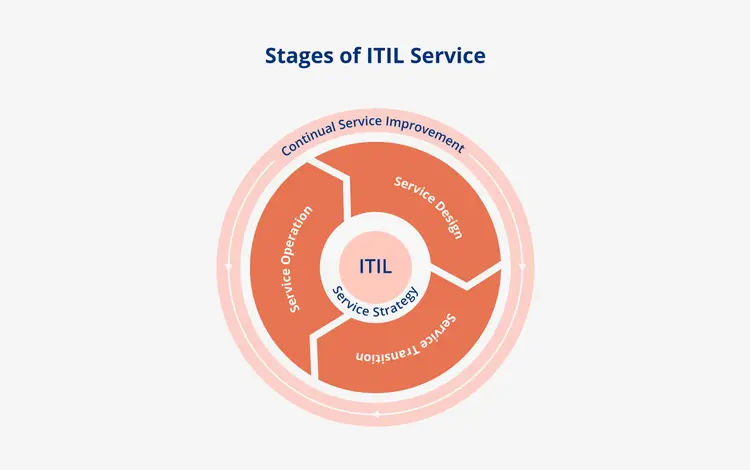
ITIL stands for Information Technology Infrastructure Library and is a set of practices based on ITSM (Information Technology Service Management). It was created in the UK during the 1980s. It is popular in IT organizations and helps them to align IT with businesses while improving IT service. It has become a standard for IT service and operations management. You can opt for an ITIL Foundation Training program to kickstart your career in this field.
ITIL uses a systematic approach and helps businesses increase efficiency, improve customer relations, manage risks, and build a scalable and stable environment for successful IT operations. It also includes Asset management and focuses on cost management. The five stages of the ITIL service lifecycle are as follows:
- Service strategy: Service strategy is the first and fundamental stage of the ITIL service lifecycle. A service strategy that is aligned with the business objectives paves the way for better service management.
- Service design: The service design stage is where the services are designed as per the strategies in the previous stage. This stage helps prepare for implementation of services efficiently.
- Service transition: This stage deals with the actual implementation of services where services are transitioned to a live stage.
- Service operation: In this stage, the services become operational and the service owners become accountable for the delivery of the services. The SLAs kick in and ensure this accountability.
- Continual service improvement: Optimal performance of services is the objective of this stage of the service lifecycle. KPIs and other parameters can help ensure that the services are meeting the business strategy.
The ITIL framework enables IT administrators to be a significant part of the business and not be limited to back-end support. ITIL was introduced in the 1980s, and over the years it has gone through many iterations. Axelos company oversees ITIL development. It announced the latest guidelines in 2017 and released related modules throughout 2019 and 2020. Each iteration of the ITIL provides updated documentation and certifications to enable admins for the current infrastructure.
An Overview of Scrum
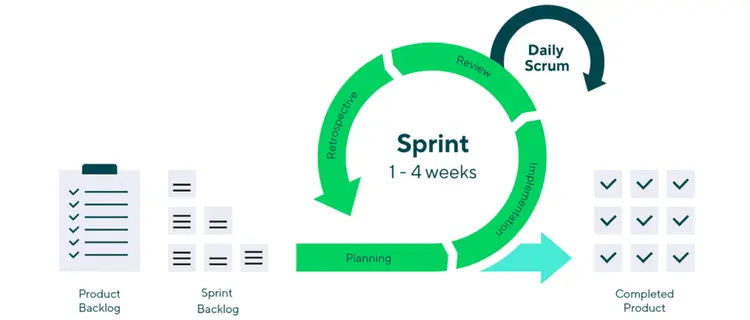
The term Scrum comes from the sport of rugby. It is a lightweight framework with which people can address complex adaptive problems while ensuring high productivity and creativity, by breaking down large and complex projects into short sprints. It helps people, teams, and organizations generate values through adaptive solutions. A Scrum Master should foster an environment where:
- The Scrum team allots tasks as an increment of value during a Sprint.
- A product owner identifies and shifts the work for complex problems into the Product Backlog.
- The Scrum team and stakeholders inspect the results and plan the upcoming Sprint.
The fundamental unit of Scrum is a Scrum team, which is a small team of people. The team has a Scrum Master, a product owner, and developers and there are no sub teams or hierarchies within the Scrum team. The Scrum events aim to maintain regularity and eliminate the need of holding unnecessary and frequent meetings. The Scrum events are as follows:
- Sprint: A short, defined space of time, usually a couple of weeks during which the Scrum team plans what they’ll do, and keep up daily communication about how they’re doing it.
- Sprint planning: Sprint planning is essentially a workshop for the entire team, led by the product owner. The team collectively decides on the sprint goal and the satisfaction criteria.
- Daily Scrum: The development team’s daily meeting of under 15 minutes is called the daily scrum. This is where the team shares the progress they’ve made on their tasks, and it gives the development team to modify their approach to the project if needed.
- Sprint Review: The development team gets to demonstrate the product they’ve built during the sprint and get feedback on it. The development team also gets to know the next batch of actions for them to focus on.
- Sprint Retrospective: A sprint retrospective is another short meeting for the development team to consider the processes they’ve implemented and how they can improve upon them before the next sprint planning session.
Unlock your potential as a Scrum Master with our scrum master certification training online. Acquire the skills to lead teams, foster innovation, and achieve outstanding outcomes. Enroll now!
ITIL vs Scrum
| ITIL Certification |
Scrum Master Certification |
| It demonstrates skills in the IT service management best practices. | It ensures an effective work environment to conduct and complete projects successfully. |
| ITIL is about operations and service management. | Scrum is more focused on software development that is in accordance with Agile principles and values. |
| ITIL involves skills and knowledge related to new software releases. | Scrum does not involve much information on new software releases. |
| ITIL-certified professionals are not involved in project management as it does not cover the aspects of project management completely. | Though Scrum master is not project manager, they are involved in project management because they help organizations to eliminate obstacles that may hinder the project. |
| ITIL is an IT framework that focuses on the process and not the practice. | A Scrum master manages practices to align their team with Agile practices. |
| They are more focused on IT operations and do not involve people-oriented tasks. | They are people-oriented and interact with teams and stakeholders to understand the strengths and weaknesses and take decisions accordingly. They ensure team values, morals and make software development possible. |
Certification
The ITIL Foundation to ITIL Master certifications is for people who want to learn and enhance their skills in IT Service Management and understand the ITSM governance framework. A Scrum Master certification, on the other hand, is people and process-oriented and validates your knowledge about software development techniques, methodologies, and values. It deals with organizing the team and tasks in the best way to gain maximum output and timely delivery of projects.
Goals
The ITIL is a framework to improve the overall lifecycle of IT within an enterprise or business. It is designed to standardize the planning, delivery, selection, and improvement of IT service management. It optimizes customer and organization value and improves the efficiency of the organization and achieves predictable service delivery. On the other hand, a Scrum Master is responsible for ensuring team values and making software development possible. They establish a suitable and safe work environment by eliminating obstacles and ensuring the smooth functioning of the project.
Salary
Both these certifications are reputed among organizations all over the world and are pretty in demand. They guarantee higher pay and a boost in career. Depending on the level of certifications, skills, and experience, the ITIL and Scrum certified professionals are paid. The salary of ITIL professionals in the US ranges between $80,000 and $130,000, depending on the level of certification. The average annual salary of a Scrum Master in the US is $97,776.
Project Management
The ITIL certification does not involve a full-fledged explanation of all aspects of project management. Therefore, an ITIL-certified professional is not involved in project management. A Scrum Master is not a project manager but an active participant in project management. They ensure better communication with the stakeholders and understand the demands and expectations of the project. They ensure that the principles of Scrum are upheld. They teach the principles of Scrum to the Scrum team. They work with the project managers to remove obstacles that may obstruct the project.
Achieve project management mastery with our PMP coaching online. Start your journey to success now!
Agile Development
Agile is a set of practices that aims to provide speedy software delivery. ITIL focuses more on process rather than on practice. A Scrum Masterworks as a facilitator for the Agile framework. They align their Scrum team with Agile principles and oversee how information is exchanged. They facilitate the strategies, practices and values of a larger team by following and applying software product development framework. They understand the strengths and weaknesses of the team and assist in the workflow.
Benefits
Both ITIL Certification and Scrum Master certification come with their own set of advantages, and work wonders in tandem, but work fairly well independent of each other also. The benefits of an ITIL certification are focused towards the management of the IT infrastructure of your business, while the Scrum Master certification is focused on solution development and delivery and fostering a strong culture of communication and collaboration in an organization.
On a personal level, both certifications bring monetary benefits, in terms of better salaries, and others such as roles with greater responsibility, and availability of better job options across the world. If you’re keen on cementing your career in IT services, you could opt for the KnowledgeHut ITIL foundation training right away!
Top Cities where KnowledgeHut Conduct ITIL Certification Training Course Online
What to Choose, When
It can seem strange that IT infrastructure, and Software development are so closely related and yet have such distinct processes and frameworks. The reason for this is the speed and scale at which they’ve grown, becoming independent fields. An ITIL certification puts you on the path to ensure that the IT infrastructure of your enterprise is robust, secure, and fast. A Scrum Master certification will put you in charge of teams delivering complex products in the software domain in short sprints. Your own skills and career aspirations, or business goals are the factors to keep in mind when deciding on a professional certification, and we hope that this little article helped you get some clarity.
Frequently Asked Questions (FAQs)
1. What is the difference between ITIL and Scrum?
ITIL is a framework of best practices related to Information Technology Service Management, and it is used to set-up and manage the IT infrastructure of an organization. Scrum is a project management methodology used extensively by software development teams to deliver products in iterative development.
2. Which is better Scrum or ITIL?
There is no straight answer to this question because ITIL and Scrum both are targeted at different functions. Scrum helps with software development and follows Agile principles while ITIL is a set of best practices for the enterprise’s IT policy to be beneficial for the business objectives. Choosing one or the other should depend on your organization’s business goals, or your personal career objectives and skill set.
98 articles published
Manikandan Mohanakrishnan is a highly skilled corporate trainer, consultant, and content developer with expertise in a wide range of areas including ITIL 4, PRINCE2, Agile/Scrum, PMP, DevOps, and soft...
Get Free Consultation
By submitting, I accept the T&C and
Privacy Policy
Ready to fast-track your ITSM career?